

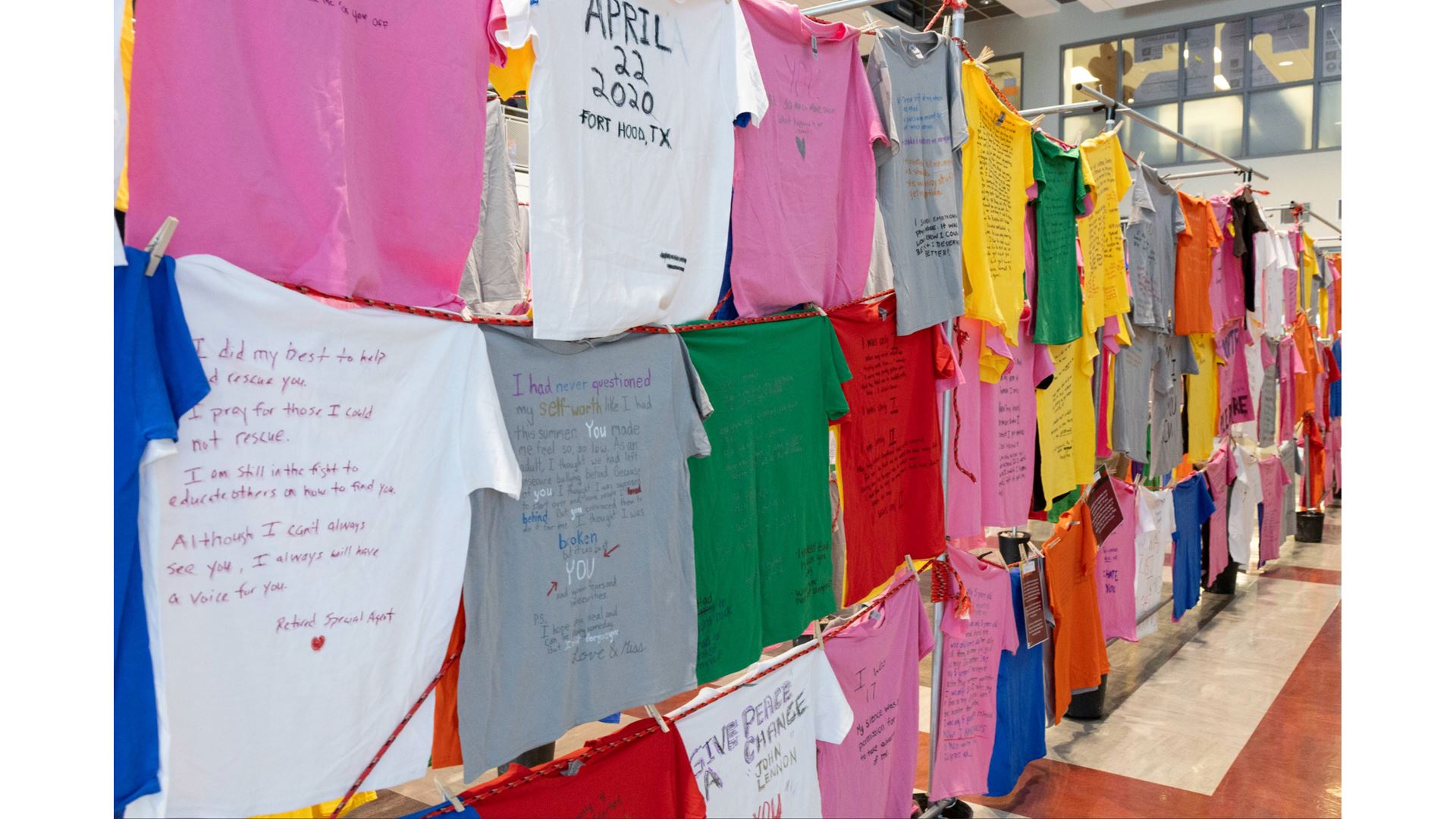
For the first time in its five-year history at New Mexico State University, the Clothesline Project will move beyond a single-day event and remain on display throughout October during Domestic Violence Awareness Month.
“When the display was available for only one day, a lot of students, faculty and staff simply didn't have an opportunity to see it because of their schedules," Ahram Cho, a criminal justice professor who spearheaded bringing the national project to NMSU, said. " Expanding the exhibit to an entire month allows more members of our campus community the opportunity to engage with survivors' experiences, reflect on the impact of interpersonal violence and participate in conversations that might otherwise never take place.”
The interactive exhibit will be on display at Branson Hall Library Atrium beginning Oct. 1, with an opening reception scheduled from 3:30 to 5:30 p.m. Tuesday, Oct. 6. Angie Rodriguez-Navarrette, coordinator for the Victim Assistance Unit at the Doña Ana County Sheriff's Office, will speak at the opening reception.
Visitors may create their own T-shirts throughout the month to add new voices to the ongoing exhibit.
For Cho, the month-long format represents another step toward the exhibit's growth.
“What began as a small departmental initiative has grown into a collaborative effort involving campus offices and numerous community partners, extending our reach beyond NMSU into the broader Las Cruces community,” she said.
With more time to visit, attendees will encounter a display designed to put the experiences of victims and survivors at the center of conversations. The Clothesline Project is an interactive exhibit featuring anonymous stories about interpersonal violence.
Walking into the exhibit, attendees witness hundreds of T-shirts hanging from a clothesline, each one color-coded to further represent the story written on it. Yellow represents domestic violence and physical assault; red, pink, and orange represent survivors of rape and sexual assault; blue and green represent survivors of incest and child sexual abuse; purple or lavender represents those attacked because of their sexual orientation or gender identity, black designates people attacked for political reasons, brown or gray t-shirts are for survivors of emotional, verbal, or spiritual abuse or stalking and white represents those who died as a result of violence.
The Clothesline Project began in 1990 with 31 shirts displayed on a village green in Hyannis, Massachusetts. Today, it is a worldwide campaign spanning multiple countries, dozens of U.S. states, and tens of thousands of handmade survivor shirts with an estimated collection of 50,000 to 60,000-plus shirts globally, created by survivors and loved ones to bear witness to interpersonal violence.
Cho worked hard to bring the national exhibit to NMSU to hold space and respect for victims and survivors who are often overlooked in the criminal justice system, which focuses mostly on perpetrators and their crimes. The shirts provide a way for people to anonymously share their personal experiences through a process that avoids stereotypes and victim-blaming that often makes it difficult for survivors to come forward.
“Interpersonal violence, particularly sexual assault, remains significantly underreported partly because of the culture of silence surrounding these experiences,” Cho said. “Victim-blaming attitudes, often rooted in the belief that people somehow deserve what happens to them, can reinforce this silence and discourage survivors from seeking help.”
The exhibit will include a designated resource table for visitors seeking support or information. While organizations will not staff booths throughout the month, the Doña Ana County Sheriff's Office, La Casa Inc. and NMSU Police Department will provide resources.
“As a community, we need to move away from questioning survivors’ credibility and instead focus on listening without judgment, believing their experiences, and respecting their choices,” Cho added. “Through the Clothesline Project, I hope to inspire our NMSU community to reflect on how our everyday words and actions can challenge harmful attitudes, break the cycle of silence, and create an environment where our students feel safe seeking support.”
The impact begins not with the shirt itself, but with what people choose to do once they walk away from the exhibit.
“We want these stories to inspire reflection and meaningful conversations within the NMSU community and beyond about how we respond to victimization and how we can create healthier systems and a more supportive community,” Cho said. “Ultimately, I hope the project empowers our students to turn awareness into action and become advocates for a healthier campus culture where violence is challenged, survivors are heard and supported, and every individual recognizes their role in shaping lasting culture.”
Resources for survivors are available at https://ohp.nmsu.edu/ or call 575-646-2813. Learn more about the Clothesline Project at https://www.theclotheslineproject.org/.
-30-
CUTLINE: T-shirts written with stories from survivors of interpersonal violence hang from a clothesline for the “Clothesline Project” on Oct. 21, 2025, in the Corbett Center Student Union’s first-floor Aggie Lounge. (Photo by Sarah Kimmerly)
CUTLINE: Two men view T-shirts with stories of interpersonal violence written on them for the “Clothesline Project” on Oct. 21, 2025, in the Corbett Center Student Union’s first-floor Aggie Lounge. (Photo by Sarah Kimmerly)
CUTLINE: A brown T-shirt reading “What happened to me was not the end of my story,” hanging in the Corbett Center Student Union’s first-floor Aggie Lounge for the “Clothesline Project” to represent survivors of interpersonal violence on Oct. 21, 2025. (Photo by Sarah Kimmerly)