

Over the summer, a New Mexico State University art professor and student embarked on an insightful, artistic residency in Europe to work with a robot and carve ancient marble in the Apuan Alps.
Carissa Samaniego, assistant professor in the Department of Art and her student mentee Lei Maslian, a recent NMSU Bachelor of Fine Arts graduate, returned from a month-long residency with the Digital Stone Project (DSP) at Garfagnana Innovazione in Gramolazzo, Italy. Supported by the university’s Discovery Scholars Program and the College of Arts & Sciences, the duo witnessed walls of Tuscan stone and experienced the remarkable reality of carving the same materials that artistic masters shaped five centuries ago.
“There's a pretty amazing lineage that we tapped into. One of the most famous sculptures, I think in the world, is Michelangelo's ‘David,’ Samaniego said. “The marble that he used for that sculpture, for ‘David’ and for other really important, significant cultural objects from the Renaissance, came from the same mountain that we got our marble from.”
Combining the past with the present, artists worked alongside five robots to begin their projects. Before arriving to Italy, artists sent their digital 3D model sculptures to the program directors who then had milling robots rough-carve their design, leaving the intricacies to the artist.
“It's the way that the technology operated in the artistic process, which I think was really important,” Samaniego said. “It wasn't that the robots were replacing the artist, but instead it opens up new ways of thinking about this material. It opens up new ways of asking questions as an artist today.”
While both artists were working with marble for the first time, the physical carving was an entirely different journey for Maslian, who had never worked with subtractive processes before.
“I usually work with sculpture, and I do additive processes. So, welding is like you add it together, and with marble, it's the complete opposite, you subtract it. And then once you remove that part, you can't put it back on,” Maslian said. “So that was definitely a stressful thing for me to think about having worked with marble for the first time.”
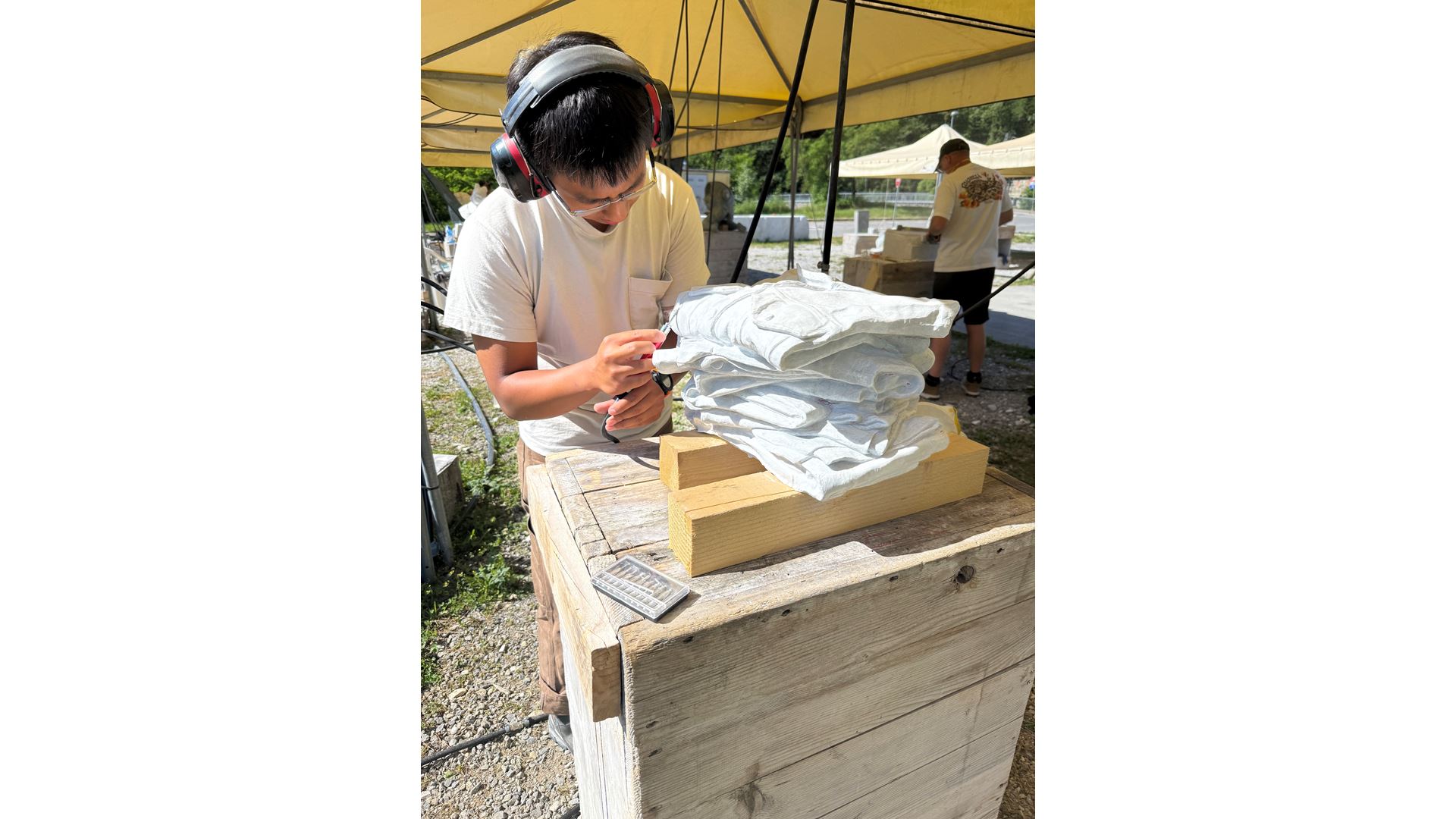
Adding to that pressure was Maslian’s unique standing in the program as the youngest resident in attendance. Maslian persevered through art. His piece, “Stack of Levi’s,” a sculpture of stacked denim fabric, was inspired by his heritage.
“I grew up in a very small town in the Philippines ... and there was an American base there. So, in our community, we had gotten very close to the American military, and they introduced us to the American culture, the Western wear, cowboys, country music, and I grew up with that,” he said. “I've had uncles who worked in the fields, wearing Levi jeans with a Levi jacket and flip-flops.”
While Maslian used heritage to inspire his art, Samaniego looked to technological history. While contemplating the “perfect” sculpture for months, she was inspired by her daughter singing the 1800’s song “Daisy Bell” by Harry Dacre. She learned the song was later used in 1961 as the first song ever “sung” by a computer. She carved a wilting daisy to represent this digital phenomenon.
“This is really interesting because it's this song that has become this signifier of the relationship between humans and robots,” Samaniego said. “It’s a reference to the legacy of this song throughout technological history. But also, it's meant to be a beautiful object. I mean, you can just appreciate it for that too, even if you don't know what it's spawned from.”
As their journey sculpting in the Apuan Alps came to an end, Samaniego and Maslian were joined by the rest of the participants from around the world to see their sculptures on display in the culminating exhibition, “Per Forza di Levare,” in Castelnuovo di Garfagnana, Italy. From June 26–Aug. 30 residents, collectors, and travelers will have the opportunity to view and admire work from across the globe.
Their residency in Italy created new perspectives and ideas for Samaniego and Maslian. As Maslian enters life after graduation, he takes with him connections and stories from experienced artists who’ve inspired him to explore further into his art career. As for Samaniego, she is excited to announce an upgraded Digital Craft Research Lab, equipped with 3D printers, laser cutters, and a CNC router, which will be open to the public in the fall.
“I hope for an opportunity to bring a student again to DSP because I think it's not only the art-making experience, but it's that professional network building opportunity where you can learn a lot about other programs,” Samaniego said.
-30-
CUTLINE: Recent New Mexico State University Bachelor of Fine Arts graduate Lei Maslian carves his sculpture “Stack of Levi’s” from marble during his artist residency for the Digital Stone Project in Gramolazzo, Italy. (Photo by Carissa Samaniego)
CUTLINE: New Mexico State University Assistant Professor, Carissa Samaniego, carves her sculpture “Daisy Bell” from marble during his artist residency for the Digital Stone Project in Gramolazzo, Italy. (Photo by Lei Maslian)
CUTLINE: Quarry in the Apuan Alps in Tuscany where the famous white and blue-grey Carrara marble has been extracted since the ancient Roman era. Traditionally, workers cut the stone directly from the exposed mountain faces, creating dramatic, white-stepped canyons. (Photo by Carissa Samaniego)
CUTLINE: Seven axis milling robot carving marble sculpture “Daisy Bell.” (Photo by the artist Carissa Samaniego)
CUTLINE: New Mexico State University Department of Art Assistant Professor, Carissa Samaniego’s marble sculpture, “Daisy Bell,” in the process of being sculpted at the Digital Stone Project in Gramolazzo, Italy. (Photo by Carissa Samaniego)
CUTLINE: “Daisy Bell” sculpture in its final stages at the Digital Stone Project in Gramolazzo, Italy. (Photo by the artist Carissa Samaniego)
CUTLINE: “Stack of Levi’s” in it’s final stages at the Digital Stone Project in Gramolazzo, Italy. (Photo by the artist Lei Maslian)
CUTLINE: “Stack of Levi’s” on display at the Per Forza di Levare exhibition in Italy. (Photo by the artist Lei Maslian)