

Writer: Allison Brady, engr_media@nmsu.edu
Technology is evolving at a rapid pace; 3D printing is already shaping the world, whether that be in engineering, construction, or biomedicine. Preparing students for the future of the workforce means tailoring their education to reflect the world they will be walking into.
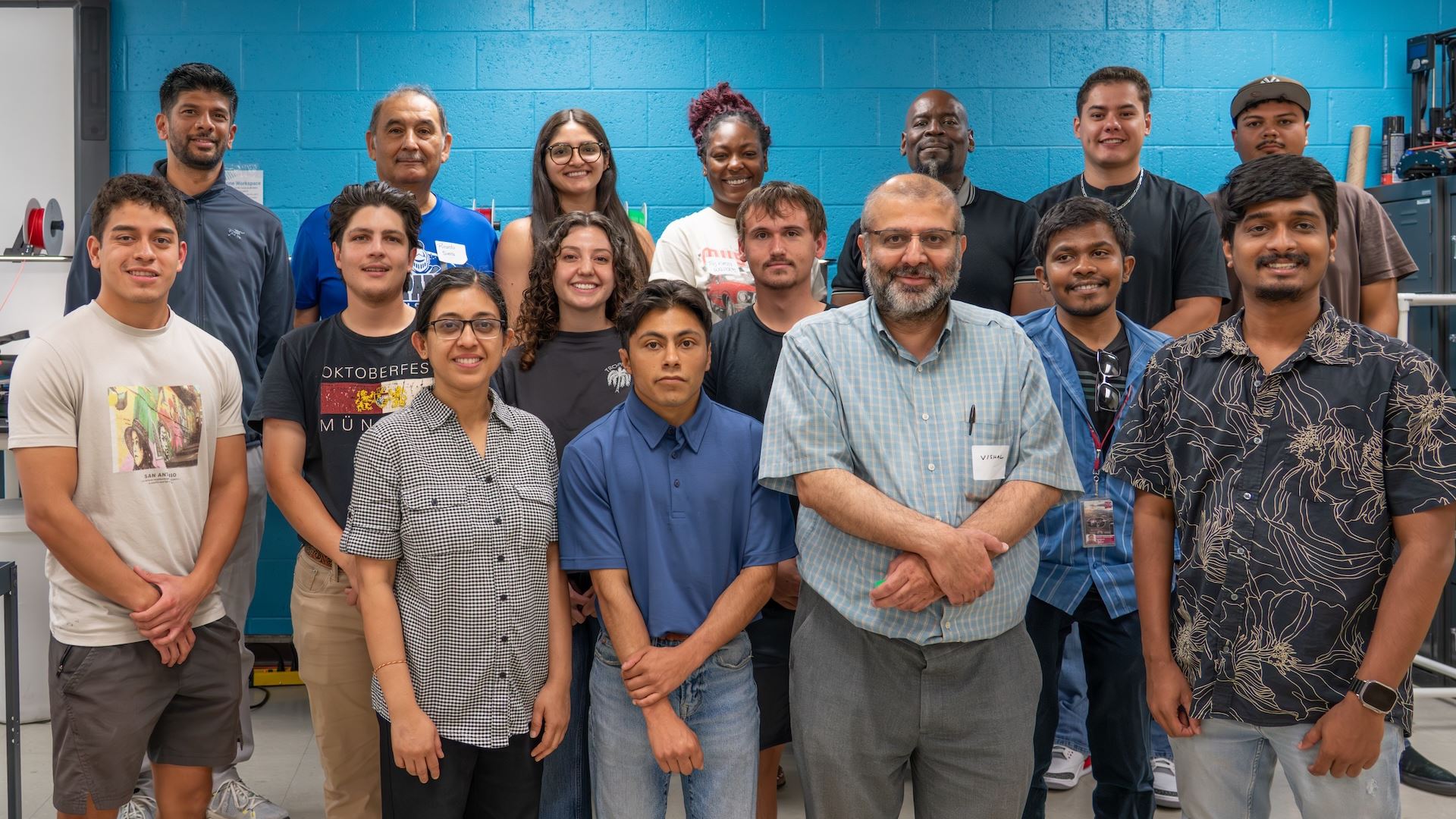
New Mexico State University, in collaboration with other New Mexico universities, is helping prepare for that future through the Center for Distributed Resilient and Emergent intelligence-based Additive Manufacturing Research Center. For three summers, they have invited educators from across New Mexico to attend their Additive Manufacturing Personal Development workshop.
Faculty from the DREAM Research Center worked with K-12 educators during the summer to bring a more expansive understanding of 3D printing and manufacturing to the younger generation in southern New Mexico.
Established in 2024 with funding from the National Science Foundation, the DREAM Research Center’s mission has been to build solutions that foster growth of small and medium enterprises within the advanced manufacturing industry. As a part of that mission, the DREAM Research Center invited K-12 educators from New Mexico to learn about the process of 3D printing.
Mat Martins, the program manager of the DREAM Research Center, said the initiative is meant to help develop the workforce’s next generation. By giving teachers the tools to effectively use 3D printing and educating them on its potential in professional fields, they would be able to take what they have learned into their classrooms.
“The program demystifies manufacturing through empowering students and educators to interact with advanced instruments,” Martins said. “This leads to learning more about STEM, finding creative ways of interacting with 3D objects and designs, and reimagining what it takes to make the world of material products around them.”
While at the program, teachers learned to work with the variety of 3D printers NMSU’s Aggie Innovation Space has to offer. During the multi-day hybrid training workshop, teachers navigated through the process of designing 3D objects, “slicing” their models to be printed, and operating 3D printers to fabricate their products correctly.
The workshop emphasized the principles of 3D printing, one of which is computer programming. Tajkirah Wallace, a special education high school teacher at Chaparral High School, said that was one of the most helpful aspects of the workshop.
“We’ve learned how to set things up within the programs and get them ready to print,” Wallace said. “Which, to me, that’s probably the most important part. Because you can work a printer, but I feel like working the printers is the easier part. But getting what you’re trying to do and programing all that, the software, that’s the harder part.
Martins said there was a focus on adapting the K-12 learning curriculum to keep up with modern technology. Not only is additive manufacturing something educators feel is important to prepare students for the future, but students are looking for classes which offer learning in that area.
Vishal Kapoor, a high school math teacher at Desert Pride Academy, said there’s a demand from students for classes that incorporate new technologies. Currently, he teaches a class on drones and now sees an increase in the number of students interested in STEM.
“The news spreads fast in this area by word of mouth, and when students know it’s going to be fun and it can be applicable to help them find a good high-paying job, they get into it,” Kapoor said. “They request my classes. My colleagues tell me all the time, ‘Why are you doing all this crazy extra stuff? They are going and changing my roster. It’s down to 10 students, and you're at 45.’ They like my classes with the inclusion of new technologies.”
With programs like the AMPD workshop and by providing educators with knowledge about up-and-coming careers in advanced manufacturing, Martin said he hopes to see educators find utility with 3D printing as a new way to reach students.
“That interacting with technology like 3D printing can be rewarding and worthwhile, that they have the power to bring designed 3D models to life,” Martins said. “That interacting with instruments can be easy when you understand the underlying principles, and that looking at the world from a STEM perspective opens opportunities for building unique objects and addressing unique problems.”
-30-
CUTLINE: New Mexico State University’s Center for Distributed Resilient and Emergent intelligence-based Additive Manufacturing hosted its third Additive Manufacturing Personal Development workshop for educators in the Las Cruces area. The purpose of the workshop was to teach K-12 teachers 3D printing skills and how they can be applied in their classrooms and in the professional world. (NMSU photo by Hannah Muñoz Villalobos)
Description: The teachers attending the DREAM Research Center’s AMPD workshop pose for a group photo with the heads of the program.