

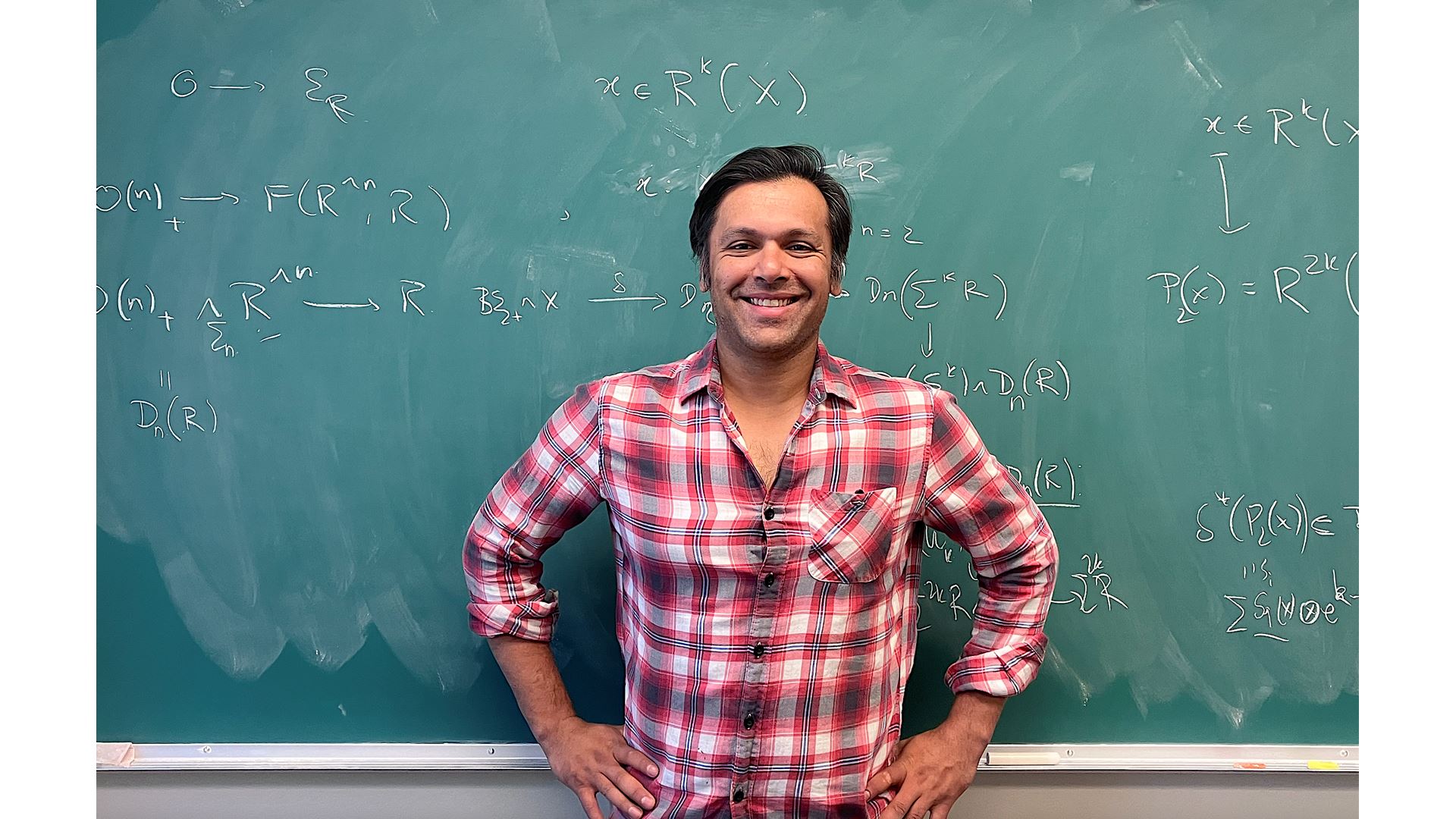
Prasit Bhattacharya joined the Department of Mathematics in the College of Arts and Sciences in August 2022 as an assistant professor, after serving as a post-doctoral fellow at Notre Dame. Originally from India, Bhattacharya was drawn to New Mexico State University due to its high-intensity research environment which supports his work in theoretical mathematics.
“Mondays and Wednesdays are devoted to the advancement of mathematical research. This involves, among other things, collaborating with researchers worldwide, typing manuscripts, refereeing papers for academic journals and thinking about the research problems,” said Bhattachayra. “Tuesdays and Thursdays are primarily dedicated to my students. I spend those days in the classroom, holding office hours and meeting with my graduate students to guide their doctoral research. This is also when I focus on departmental committee duties.”
As a researcher, Bhattacharya is particularly proud of his research on “Equivariant Steenrod Operations,” a project that led to a National Science Foundation (NSF) grant and a paper published in November 2025. His focus is homotopy theory: Simply put, a branch of mathematics that treats shapes as being the same if you can continuously deform one into the other without any tearing or gluing. Homotopy provides practical tools for analyzing qualitative system features, deformation and stability in fields like data analysis, robotics and physics. He has another paper coming out that was recently accepted by a prestigious journal.
“In our field, finding a new element in the stable homotopy groups of spheres is akin to discovering a new planet,” Bhattacharya said. “With this paper, we didn't just find a single 'planet'—we discovered an entire 'galaxy' of elements that had never been seen before.”
In addition to his research, he is proud of his community outreach. The “Math Problem of the Week” program he has run since joining NMSU has expanded to local high schools in the Las Cruces area, introducing a new incentive structure for younger students to foster a deeper engagement with complex mathematical thinking.
“Whether I am lecturing in a graduate course or diving into a research problem with my PhD students, I derive a lot of joying seeing students experience the 'aha' moments of advanced mathematics,” Bhattacharya said. “For me, the job is about more than just sharing information; it’s about inviting students into the frontier of discovery and research. What I enjoy most is the creativity inherent in the research, the thrill of navigating the unknown and discovering structures that no one has seen before.”