

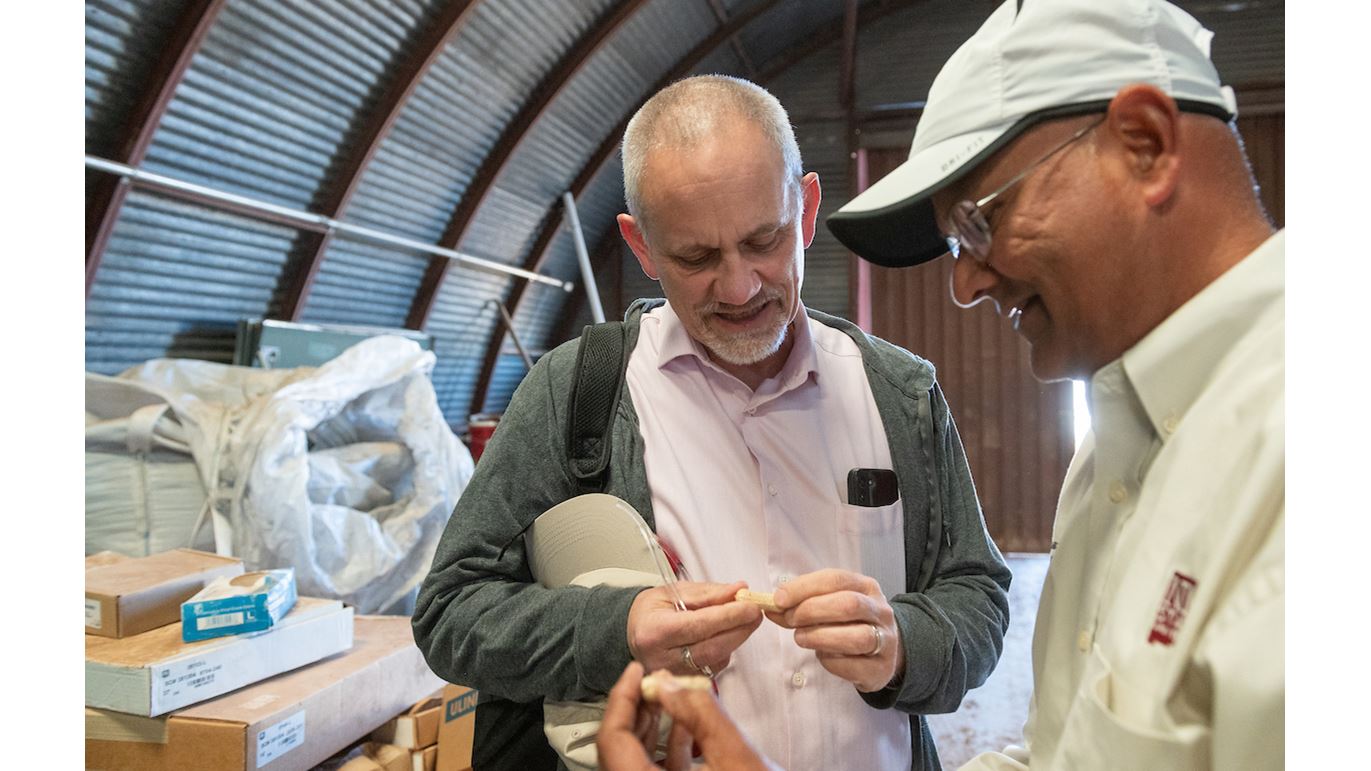
PHOTO CAPTION: New Mexico State University President Valerio Ferme speaks with NMSU peanut breeder Naveen Puppala during a visit to the NMSU Agricultural Science Center in Clovis last year. Community members are invited to learn more about research involving conservation and regenerative farming practices at the center’s field day, which will take place from 8 a.m. to noon Aug. 6 at 2346 State Road 288 in Clovis, New Mexico. (NMSU photo by Josh Bachman) IMAGE DESCRIPTION: A man examining a peanut while speaking to another man.
Community members are invited to learn more about research involving conservation and regenerative farming practices at this year’s field day, hosted by New Mexico State University’s Agricultural Science Center in Clovis.
The field day will take place from 8 a.m. to noon Aug. 6 at the center, located at 2346 State Road 288 in Clovis, New Mexico. The event is free and open to the public. Lunch will be provided.
The field day will focus on several research projects, including artificial intelligence for soil and nutrient cycling in semi-arid agriculture; a peanut variety update for eastern New Mexico and west Texas; yield response of biochar and compost application in sorghum; economic and environmental benefits of biochar in sustainable agriculture; water management practices in agriculture; circular buffer strips effect on cotton production; and microalgae-based remediation and nutrient management of dairy tail end water.
Attendees will also learn more about the New World Screwworm and receive updates on peanut and cotton varieties.
Rajan Ghimire, NMSU cropping systems agronomist, said his research group has been studying soil health, water conservation and other agro-environmental benefits of conservation and regenerative farming practices such as cover cropping, crop rotation, reduced tillage, and compost and biochar applications in dryland and irrigated cropping systems.
“This year's field day will feature the agronomic and economic benefits of a biochar and compost study and soil health management during the transition from irrigated to dryland production,” Ghimire said. “We will have project collaborators from NMSU’s main campus and Auburn University as guest speakers to discuss collaboration projects. “
Ghimire said the collaboration with Auburn University helped his group expand further to University College Dublin, Ireland, and the Agri-Food and Biosciences Institute in Northern Ireland, UK.
“This project trained two postdocs and four graduate students at NMSU,” Ghimire said. “Last year, professors and students from Ireland, the UK, the University of Delaware and Auburn University visited Clovis and replicated our work at their locations.”
The biochar and cover crop research done at ASC Clovis has been referenced in the New Mexico Healthy Soils Program, and the group’s cover crop data was used in preparing the Cover Crop Selection Tool for the Western Region, which was launched last year. The database helps farmers in New Mexico and other western states determine which cover crops to plant, seeding rates, timing and other management practices.
Wind and water stress are most significant factors affecting the productivity of irrigated agriculture in the region. Sangu Angadi, NMSU crop stress physiologist, is working on a long-term research project that focuses on reintroducing native perennial grass mixtures into center pivot-irrigated annual cropping as circular buffer strips to improve multiple ecosystem services. In the initial years of the project, the focus was on the corn production system. Since last year, the focus has shifted to the sustainability of cotton production, in collaboration with researchers from Texas A&M.
During the field day, researcher Prakriti Bista will speak about uses of smart soil sensors and advanced modeling, including machine learning, deep learning and process-based models to monitor soil water and nutrient dynamics in water-limited agroecosystems. These approaches provide data-driven insights to help growers conserve vital resources while growing food more efficiently and sustainably.
Field day attendees will learn how these AI tools turn real-time field data into actionable recommendations for cover crop selection and soil amendment application to optimize water-use efficiency.
Naveen Puppala, Valencia peanut breeder at NMSU, recently released three new Valencia peanut varieties for growers in eastern New Mexico and west Texas. The new varieties mature earlier, have an upright growth habit and produce higher yields than existing Valencia cultivars, providing growers with improved productivity and greater management flexibility. Puppala is also developing drought-tolerant peanut varieties and collaborating with researchers in the United States, Malawi and Uganda to study root traits that enhance drought resilience, supporting the development of climate-ready peanut cultivars.
Located in the heart of dairy country on the eastern part of the state, the center houses the NMSU Dairy Extension Program, which continues to inform producers about the latest in dairy production and management. Ongoing research on dairy sustainability and water management by Joyce Marumo looks at natural cleanup tools such as algae and worms to recover valuable nutrients from dairy tail-end water to be able to recycle them again as organic fertilizers, besides recovering the clean water, also referred to as “worm tea” for dairy cleaning and irrigation purposes.
Anyone who requires accommodations to participate may contact Maria Nuñez at 575-985-2292 or mtnunez@nmsu.edu.