

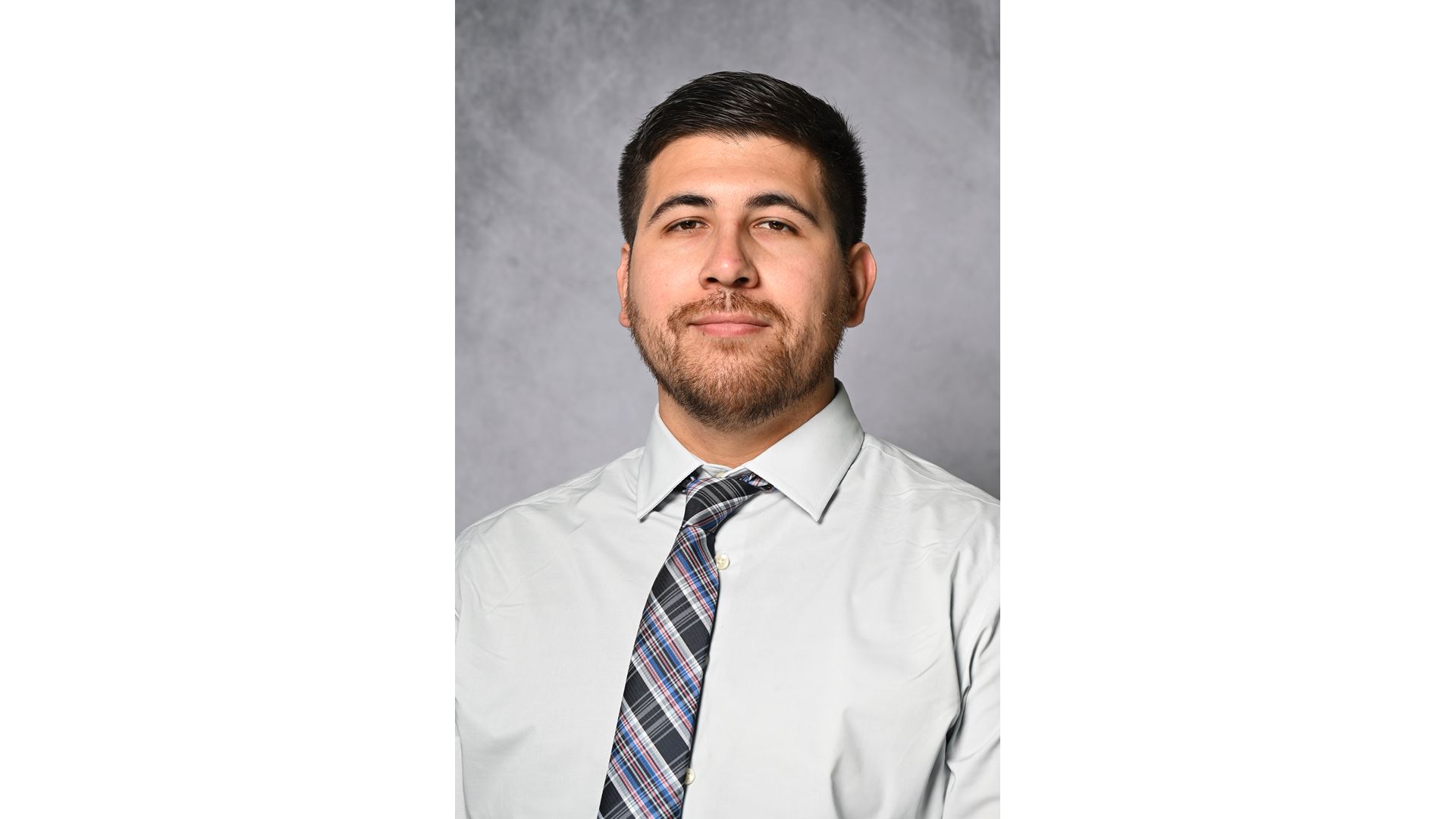
CUTLINE: The National Science Foundation has awarded New Mexico State University professor Alejandro Gallegos nearly half a million dollars for his program SoftDFT, which uses Classical Density Functional Theory to provide detailed molecular-scale predictions at a much lower cost than other methods. Fields of study like cancer research, water treatment processes, drug delivery technologies and more will be able to use cDFT to study molecular-scale behavior more efficiently. (Courtesy photo) Description: Head and shoulders of a man.
WRITER: Allison Brady, engr_media@nmsu.edu
The National Science Foundation awarded nearly half a million dollars to New Mexico State University assistant professor Alejandro Gallegos to build cost-effective molecular modeling tools that are more accessible to researchers.
Fields of study like cancer research, water treatment processes and drug delivery technologies, among others, will be able to use Classical Density Functional Theory to study molecular-scale behavior more efficiently.
Classical DFT is a statistical-mechanical theory researchers can use to predict the equilibrium structure and thermodynamic behavior of fluids and soft materials at the molecular scale.
Digital simulation is often the first step researchers take in experiments that involve soft matter systems. These soft matter systems are materials that hold shape like a solid but easily change shape with weak force, like plastics and gels. These simulations save researchers both time and money by allowing them to predict what will produce an ideal result before moving on to physical testing.
For years, researchers have used a variety of molecular simulation methods, but cDFT can provide detailed molecular-scale predictions at a much lower cost than other methods. Despite its advantages, cDFT has been underutilized due to its capacity for code errors and the programming skills traditionally required to operate it.
“One of the limitations in terms of why other people haven't done it is really just that classical DFT has a very small community relative to some of the other methods,” Gallegos said. “Classical DFT is a very general framework for approaching these problems, but it requires you to know some more details. The equations are not too complicated, but it's easy to make little mistakes and then you're not going to be able to use it. There’s a big barrier to entry.”
In the almost 50 years cDFT has existed, there have been attempts to bring it to the wider engineering and science communities. However, none were pursued long enough to see results. It is primarily being used by a small community of people dedicated to learning its code.
Gallegos’ program, SoftDFT, is meant to streamline the process, making it more accessible.
“SoftDFT is essentially supposed to make it so that you, as the user, don't have to worry about any of the underlying details,” Gallegos explained. “You push a button and you get the result, and so there are some details in terms of how we set up this pushing of the button, but those are very easy descriptors. We are setting up something that you can easily describe, and then it does all of the underlying details under the hood, and as a result, you get an answer to some problem.”
By making cDFT more user friendly, Gallegos said SoftDFT will allow the community around cDFT to grow.
Gallegos plans to expand user’s ability to share their work through SoftDFT. Meaning people can build off each other and further advance cDFT.
Users can upload their coding to GitHub, a social network where developers can manage and share their code. This allows other people to replicate the same experiments and get the same results as the original.
“Because replication is currently an issue, if you try to repeat things that happened five to 10 years ago, you might get a completely different result because there’s some details that are now lost to time, which can be as simple as they put the wrong value of something,” Gallegos said. “Basically, the hope of this all is that people will always be able to download whatever version at that time that was used. Then, by creating a database of everybody’s input files and the papers they’re linked to, people can also share results and so forth. We can get to a point where everybody can easily do what everyone else is doing to some extent, but everybody gets to be creative within their own space.”
What started as a pet project for Gallegos has gotten a $403,734 grant from the NSF, allowing him to expand the team behind SoftDFT.
Joseph Holles, department head of chemical and materials engineering at NMSU, said the importance of funding research can positively affect the growth of a wide variety of fields.
“This award shows that we are meeting the demands and expectations of an R1 research university,” Holles said. “Since this award will enable other researchers around the world to use DFT for simulations on weak polyelectrolytes, this demonstrates that Professor Gallegos and our department are leaders in this area. The award also demonstrates Professor Gallegos’ growth as an independent researcher, and it allows him to mentor graduate students and postdocs as they develop their research skills.”