
New Mexico State University anthropology students teamed up with groups from Brigham Young University and Weber State University for six weeks over the summer, not only to discover the ancient history of two regions in Utah, but also to gain important training that will allow them to fill a critical need for their skills in various government and corporate settings.
“To be hired, you have to have supervised experience,” said Katie Richards, NMSU anthropology assistant professor. “Employers aren't just expecting you to have field school, you're required legally oftentimes to have had some sort of field school or field training. This is what makes our students hirable, especially in our master's program, graduates from our program who want a job in archaeology get one.”
Richards explained the students were trained in skills they will be using when they get jobs in archaeology after graduation – completing surveys, using a compass and a GPS unit, drawing maps and properly documenting what they find so it complies with the state’s record system.
Jonathan Barnhart, junior at NMSU majoring in film, said the experience was transformative.
“Going out to wander around and survey the desert until you find something interesting is very fun. We did some surveying near Blanding on Alkali Ridge, updating and remapping sites as well as discovering some previously unknown sites, most notably a cliff dwelling of some kind, Barnhart said. “We then moved up north to Ogden where we were excavating a site called Prickly Pear Knoll. We excavated for four weeks and found plenty of artifacts. Although most of them were small – lithic debitage (by-products generated during the process of making stone tools and weapons) a few sherds (broken fragments of pottery) or adobe chunks – we also found a few projectile points.”
Students traveled to two locations in Utah to provide a diverse experience.
“In southeastern Utah, there is a lot more substantial architecture,” Richards said. “We did some work on the earliest known village in the northern Southwest. It's called Site 13, a very famous archaeological village. Ancestral Puebloans living in the Four Corners area started building villages about AD 750. On the last day, I got a call on the radio saying that one of our crews had found a multi-room structure with an associated kiva that we had to then record in the last two hours of our project.”
Numerous jobs are available for anthropology graduates with hands-on field experience. Richards named jobs in agency archaeology, the National Forest Service and the Bureau of Land Management as well as the National Parks – all of which need to manage the archeological resources on their lands.
“Eventually I want to work on short films, hopefully updating videos for our poorly funded state parks,” said Barnhart, who plans to take a year off after graduation to learn to sail in Croatia.
“There are also many contract companies doing what’s called cultural resource management (CRM) archaeology,” Richards said. “Anytime somebody needs to build something on federal or state land using federal or state funds, they will get environmental appraisals and archeological assessments to ensure they’re not about to destroy an important site. “
While other universities are eliminating their field programs due to expense and insurance costs, NMSU’s accessibility and affordability is attracting students outside the state.
“We ended up having a total of 10 students, seven of them were NMSU students, and three of them were NMSU students for the summer from other institutions,” Richards said. “The biggest thing for me is making sure people know about this opportunity and understand how important it is for our students to have this experience for their future employment.”
-30-
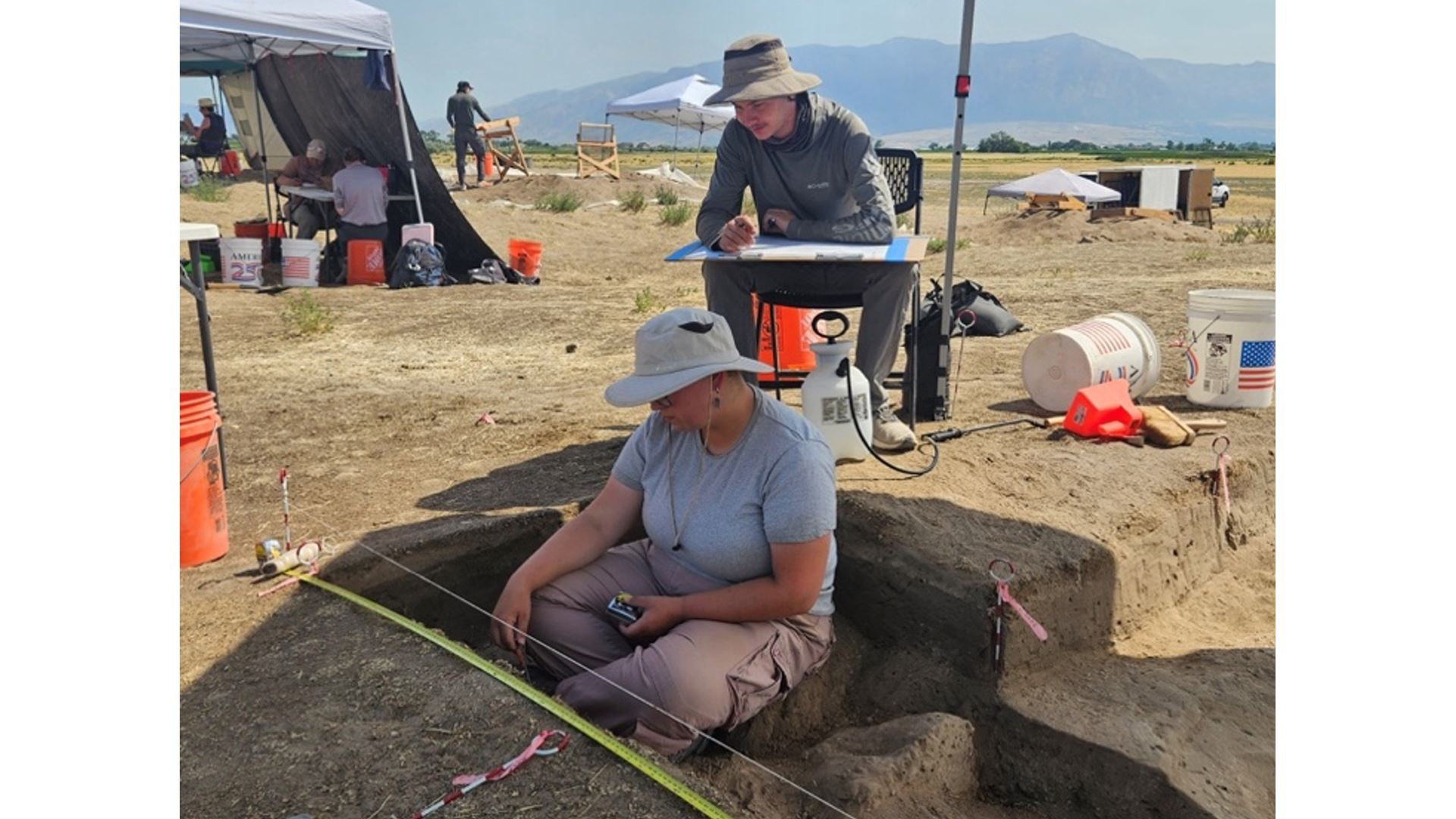
CUTLINE: Parker Jones-Wirth (NMSU) works with a WSU student to draw a stratigraphic profile of their excavation unit (NMSU photo by Jordan Franklin-Garza. (Courtesy photo)
CUTLINE: Members of the NMSU field school visiting Balcony House at Mesa Verde National Park. Names starting with the front and moving clockwise: Jordan Franklin-Garza, Johnny Chavez, Adam Rhoer, Jonathan Barnhart, Jesse Cavanaugh, and Parker Jones-Wirth (Photo by Jordan Franklin-Garza)
CUTLINE: Students learning from local archaeologists inside a replica kiva at Edge of the Cedars State Park. From left to right: Jesse Cavanaugh, Jonathan Barnhart, and Madeline Wright (Photo by Katie Richards)
CUTLINE: Students visiting Coal Bed Village, a Pueblo III great house near the survey area. From left right: Jordan Franklin-Garza, Madeline Wright, Mariah Valdez, Jacob Dyment, Parker Jones-Wirth, Jonathan Barnhart, Adam Rhoer, Kayla Abeyta-Lopez, Johnny Chavez, and Katie Richards (Photo by Kelly Jenks)