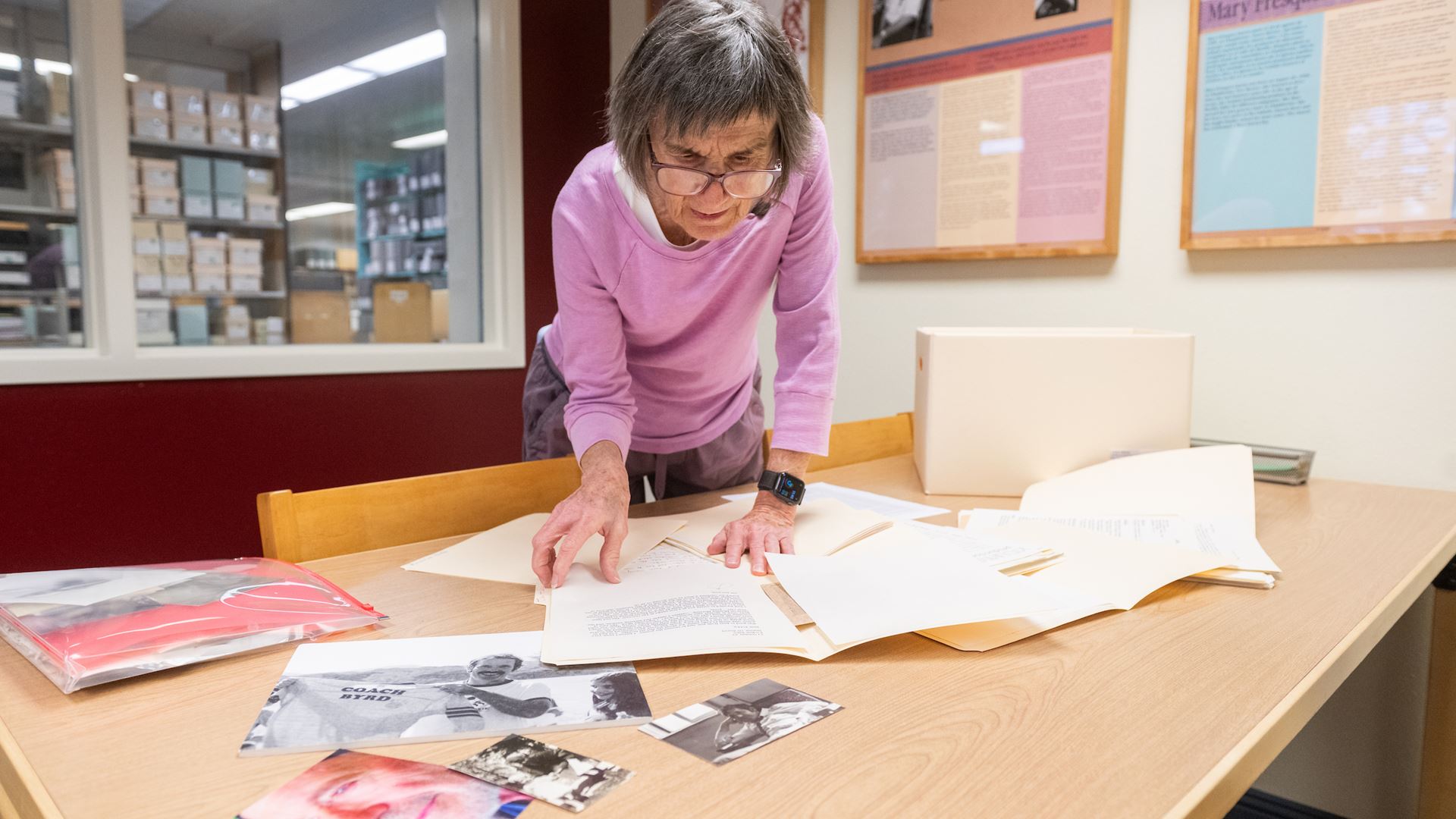

New Mexico State University has acquired the literary archives of poet and publisher Bobby Byrd, co-founder of the El Paso-based independent publishing house Cinco Puntos Press. The acquisition brings together Byrd’s personal papers with the press archives already housed at NMSU’s Archives and Special Collections, creating a comprehensive resource documenting a major literary voice of the U.S.-Mexico border.
Byrd, who passed away in 2022 at age 80, was widely recognized as a poet, mentor and advocate for multicultural literature. Founded in 1985 by Byrd and his wife, Lee Merrill Byrd, Cinco Puntos Press became an influential home for Latino and borderland writers, earning national recognition over its 35-year history before its sale in 2021.
“Being a poet and a publisher, both those vocations, were very important to Bobby,” said Lee. “And it was especially important to him that this work rose up out of his life here in El Paso, on the border. He often called it the center of the universe – at least it was of ours.”
NMSU first acquired the Cinco Puntos Press archives in the mid-1990s. When the press closed following its 2021 sale, the remaining records were transferred to NMSU. With the addition of Byrd’s personal literary papers, the collections are now united in one place.
“New Mexico State University wonderfully acquired our archives from Cinco Puntos Press in the mid-90s at a time when we really needed that kind of encouragement, and they took such good care of them,” said Lee. “I felt like Bobby’s (manuscripts and archives) needed to be here as well.”
“Bobby always seemed to me both a larger-than-life figure and at the same time about the most personable and down-to-earth human you can imagine,” said Dennis Daily, department head of Archives and Special Collections at the NMSU Library. “His poetry and the tremendous work he and Lee accomplished with Cinco Puntos Press were finely attuned to recognizing and celebrating our borderlands culture in all its diverse manifestations. We are honored to serve as the permanent home for these archives and to make them available to students, scholars and anyone with an interest in literature, art and life on the U.S.-Mexico border.”
The Bobby Byrd papers comprise approximately 25 cubic feet of material, including manuscript drafts, personal journals, unpublished writings, screenplays, photographs and extensive correspondence with writers, editors and readers. Together with the Cinco Puntos Press records, the collection offers scholars, students and the public insight into the literary, cultural and publishing history of the border region.
“Going through these boxes and seeing how many people Bobby knew and corresponded with has just brought back such good memories,” Lee said. “He really loved to write letters; he loved talking to people. People really loved him. He had a way of reaching out to them and talking about poems, trading poems with them. I feel a really loving presence from him and the people he wrote with. It brought back a lot of memories.”
Byrd authored nine books of poetry, including “Otherwise, My Life is Ordinary”; “The Price of Doing Business in Mexico”; “White Panties, Dead Friends & Other Bits & Pieces of Love”; “On the Transmigration of Souls in El Paso”; and “Get Some Fuses for the House”. He received a National Endowment for the Arts Fellowship, the D.H. Lawrence Fellowship from the University of New Mexico, an International Residency Fellowship awarded jointly by the National Endowment for the Arts and Mexico’s Instituto de Bellas Artes, and the Southwest Book Award.
Deeply influenced by the Beats, Black Mountain poets and the cultural landscape of the U.S.-Mexico border, Byrd in turn shaped and inspired generations of writers, earning praise from peers and contemporaries across the country.
Writer Luis Alberto Urrea described Byrd’s work as “a singular music over the years made of memory, love, place and a kind of bluesy Zen.” Author Philip Connors wrote that Byrd “made poetry from the texture of everyday life on the U.S./Mexico border, where the magical and the mundane coexist. In their grace and humility, his poems made the examined life seem like a form of prayer.” Poet Eileen Myles noted that Byrd’s poems are “epic – full of fiction, bullshit and beauty. He’s an emotional writer, haunted by personal tragedy, his own and anyone else’s. Existence verges on becoming a joke – if not for a sweetness that suffuses Bobby Byrd’s poems and says that a life lived, part by part, is holy.” And poet Diane Wakoski praised the “big mythic visions” in his work.
Born in 1942 in Memphis, Byrd came of age during the city’s vibrant music scene, an influence he often credited as formative. His father, a civilian pilot contracted by the U.S. Army to train airmen during World War II, was killed in a plane crash in 1945 when Byrd was 2 years old. He and his siblings were raised by their widowed mother alongside the family’s African American housekeeper, Darthula “Tula” Baldwin, who became a central figure in his emotional and moral upbringing.
Byrd often reflected on the profound influence of those two women. “They were feeding me woman-heart intravenously,” he once said. “They fed my heart and understanding. That’s where my path began.”
As a teenager, Byrd was introduced to the Beat poets and the New American poetry movement by his friend Harvey Goldner, an experience that shaped his approach to language and voice. He embraced what he described as the “weird and wonderful use of all kinds of language” – street talk, conversation, found words – an expansive, democratic sensibility that would define his poetry for decades.
Byrd earned a bachelor’s degree in English Literature from the University of Arizona in 1963 and a master’s degree in 20th century American poetry from the University of Washington in 1965. He met Lee Merrill at the Aspen Writers’ Workshop in 1966. After years of teaching, technical writing and frequent moves across the Southwest, the couple settled in El Paso in 1978, where they would ultimately build both their family life and their publishing legacy.
In 2005, the couple each received Cultural Freedom Fellowships from the Lannan Foundation in recognition of their work supporting intellectual diversity and multicultural literature. In 2010, Byrd was ordained as a Zen priest in the Order of Clear Mind Zen.
Lee added that she hopes the archives will serve future generations of writers and researchers.
“It’s just a great place for people to come to research anything that they have available,” she said. “It’s very important that it’s safe and taken care of.”
The Bobby Byrd collection is now available for research through NMSU’s Archives and Special Collections. For more information about accessing the collection, contact Dennis Daily, ddaily@nmsu.edu.
NMSU Archives and Special Collections acquires literary papers of poet, publisher Bobby Byrd
Release Date: 11 Mar 2026