

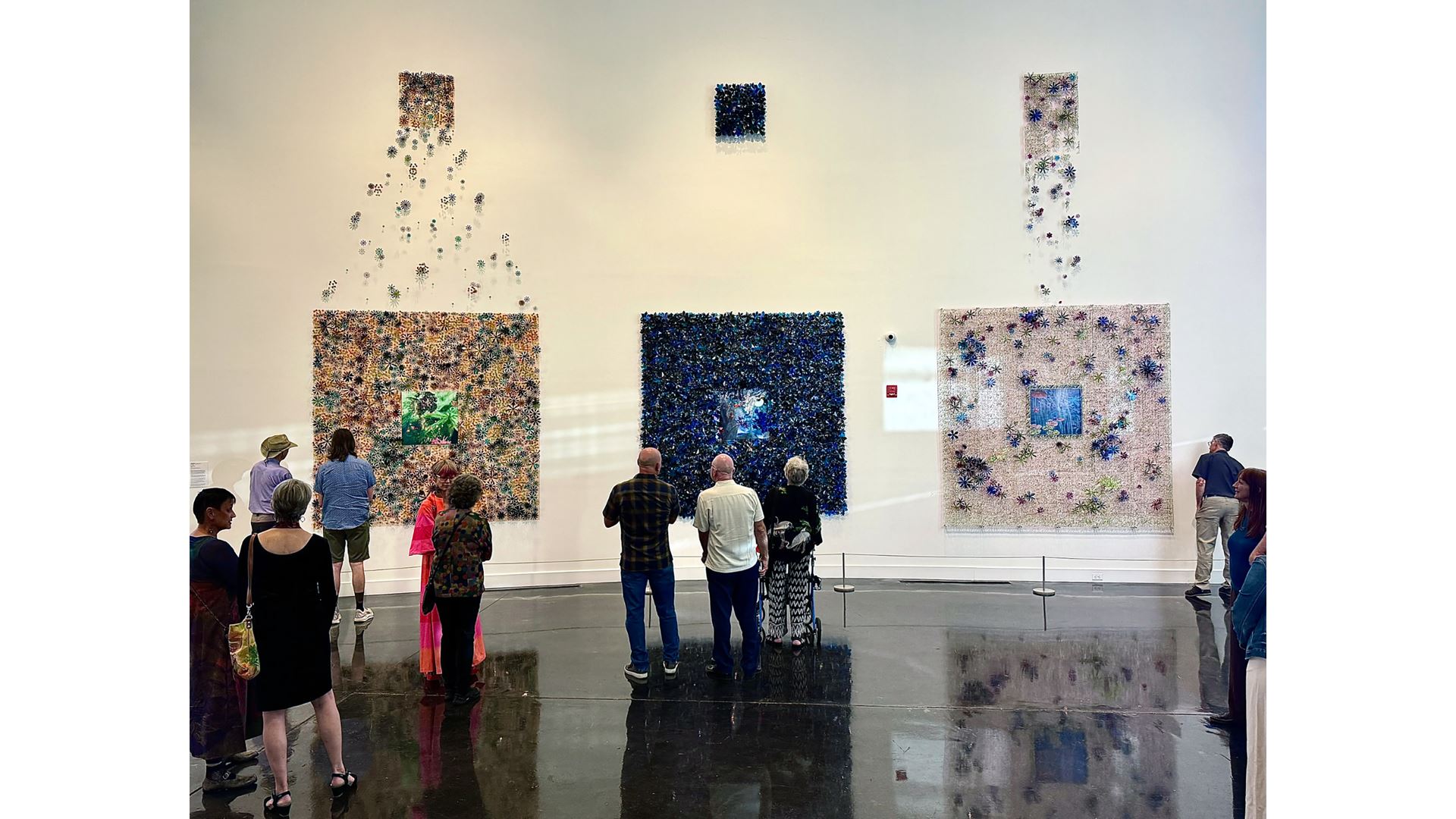
Mounted on the wall at the El Paso Museum of Art are three eight-foot suspended gardens, their colorful flowers made from recycled medical imaging film, with a “portal” resting in the center.
The installation, titled “Dislocations,” explores the space between growth and collapse, marking the first fully collaborative work produced by New Mexico State University art professor emerita Julia Barello and her colleague and friend, Craig Cully, an NMSU painting and drawing professor, alongside his wife, Kelly Leslie, as Cully + Leslie Studio. The exhibition opened Sept. 24 and will remain on display in the museum until 2029.
Each of the three installations contains Barello’s flowers made from X-ray imaging film and dyed in various colors. In the center of each installation lies Cully’s 24-by-24-inch painting. Together, the three pieces explore how individuals and communities exist within spaces shaped by connection, division and change.
Individually, “Cast” on the left, “Link” in the center and “Drift” on the right explore variation, unification and dissonance. The three works shift between order and fragmentation, surface and depth and finally, separation and connection. Rather than the canvases acting as separate pieces, they contribute to a larger conversation about how seemingly opposing forces can exist at the same time.
Cully’s paintings act as imaginary portals within the installation, while Barello’s flowers create a physical layer that surrounds them. The combination encourages viewers to consider the possibility of moving through spaces that may initially appear divided.
“I work with X-ray films, and these are real people's bodies represented on those films,” Barello said. “For me, it becomes about the multitude of people and us as individuals being brought together within the form of the artwork. So, here, we join in different ways within the form of the artwork.”
The artists also envisioned their piece as a depiction of dualities and polar opposites negotiating their way through time and space.
“Thematically, we look at these as suspended gardens, and simultaneously, they're a type of wall and we're looking at them as both sense of ascension and collapse simultaneously,” Cully said. “These are walls that are both rising and falling all at once. These gardens are rising, growing, and dying all at once. They're both inhabiting that simultaneity of space and possibility. Always alive, but always on the edge of failure.”
The artists drew inspiration for “Dislocations” from the fragility of life and the uncertainty surrounding the world affected by climate change, political instability, violence and mass migration.
“The border and the Southwest region, which we've lived in forever, it's hard not to be aware of the sort of tenuousness of life at this point in time in our world. There's so much going on that is so disturbing and uncertain, and we're at the front end of these mass migrations of people,” Barello said. “This has been happening, but it's accelerating, and so that was another sort of backstory in our mind as we were designing the work was this idea that there's this tenuousness about life.”
The installation grew out of a long-standing collaboration between Barello and Cully, who met in 2008. While they’ve been close friends and admirers of each other’s work since then, the two didn’t seriously envision collaborating until 2023.
During the summer, Barello was invited by the El Paso Museum of Art to display her work in its halls for three years. She quickly asked Cully to join her. The two began brainstorming what the installation could become, with some early ideas Cully described as ‘silly, wild ideas that incorporated astroturf or chandeliers.’
While they’ve previously had pieces up for consideration in Albuquerque and have another work soon on display at Indiana University Health, Barello said "Dislocations” pushed their collaboration a step further.
“His perspective on art, what he sees, what he's attracted to, how he perceives things, is so different than how I perceive things, and yet so complementary,” Barello said. “I found that quite unusual and a super-rich thinking environment.”
With only a few months to complete their vision, the artists faced a race against the clock to construct the large installation. Although the project required careful yet swift execution, the public can take its time viewing the finished piece.
“Life operates as a kind of palimpsest (a painting or story that hides older meanings under the surface), just briefly stable. We want viewers to understand that our experiences are oftentimes marginalized, and yet they're really quite powerful,” Cully said. “I think this piece gives hope, and ultimately, the ability to move forward from this moment in time.”
-30-
CUTLINE: Visitors at the El Paso Museum of Art view the three canvases “Cast” (left), “Link” (center), and “Drift” (right), part of “Dislocations,” a collaborative art installation by NMSU art professor emerita Julia Barello and NMSU painting and drawing professor Craig Cully, at the opening reception on Sept. 24. (Photo courtesy of artists Julia Barello and Craig Cully)
CUTLINE: NMSU art professor emerita Julia Barello discusses “Drift,” one of the pieces in the “Dislocations” installation, at the opening reception on Sept. 24. (Photo courtesy of artists Julia Barello and Craig Cully)
CUTLINE: A close-up view of one of the three pieces, “Link,” part of the “Dislocations” installation, at the El Paso Museum of Art. (Photo courtesy of artists Julia Barello and Craig Cully)
CUTLINE: A close-up view of one of the three pieces, “Cast,” part of the “Dislocations” installation, at the El Paso Museum of Art. (Photo courtesy of artists Julia Barello and Craig Cully)
CUTLINE: Collaborative art installation “Dislocations,” made by NMSU art professor emerita Julia Barello and Craig Cully, an NMSU painting and drawing professor, showing the three pieces: Cast (left), Link (center), and Drift (right) hanging at the El Paso Museum of Art. (Photo courtesy of artists Julia Barello and Craig Cully)