
WRITER: Carlos Cuesta, carlosic@nmsu.edu
SOURCE: Carlos Murguia, cmurguia@nmsu.edu
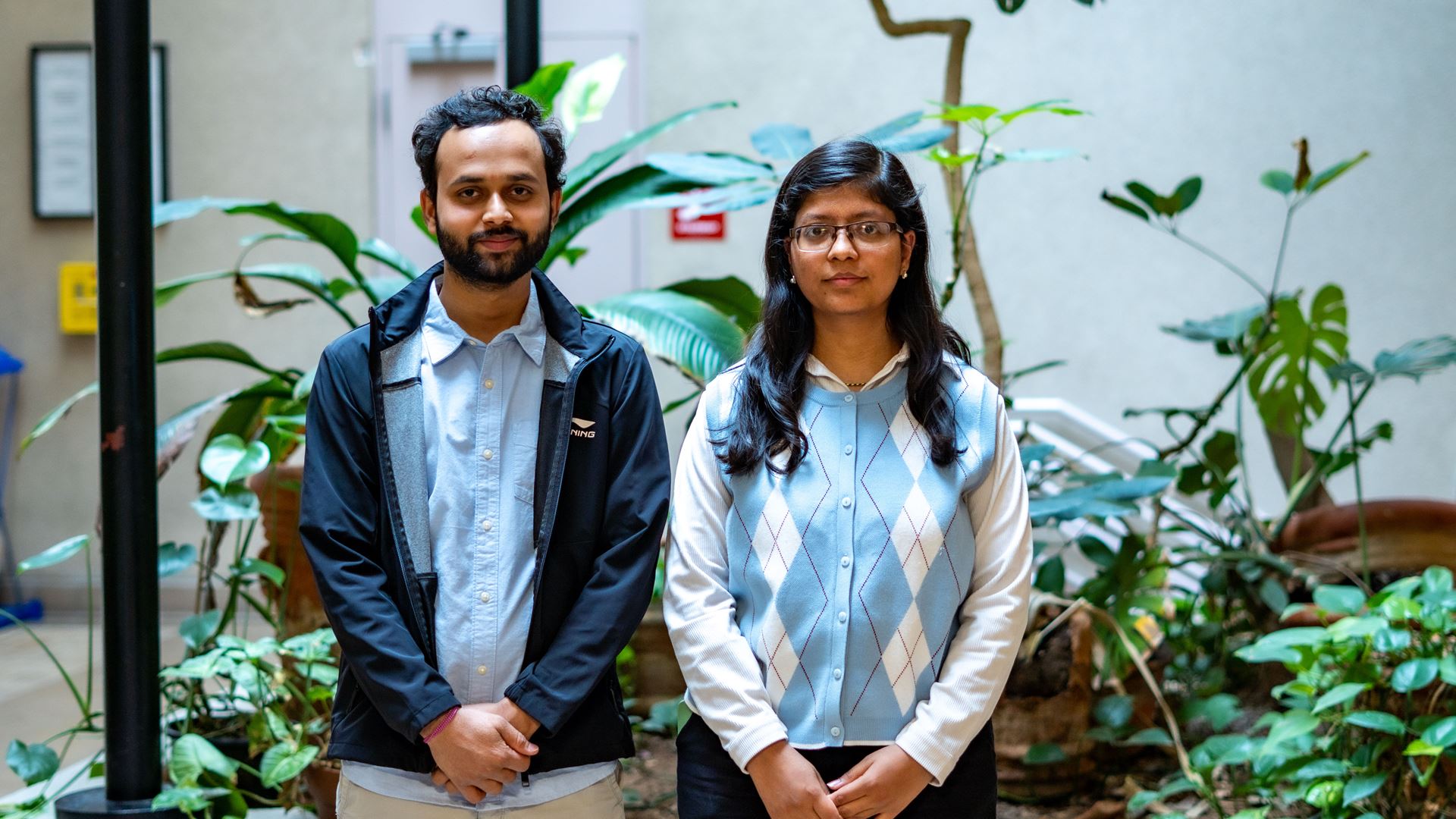
A team of New Mexico State University civil engineering students, competing as Concrete Coders, took first place in the Open Innovation category at Hack NMSU after building a software tool that predicts highway deterioration using real-time traffic and weather data.
Nelson Kandel and Samriddhi Ghimire arrived at the seven-hour build-and-demo competition on April 10, 2026, without a project and left with a working prototype capable of generating maintenance recommendations for road infrastructure. The event was held in Science Hall and organized by the Computer Science Student Association, bringing together 55 students from across the university.
Hack NMSU was sponsored by the NMSU Computer Science Department, the NMSU FinTech Lab powered by Nusenda Credit Union, and the Mike Hunt Construction Sprints, a cornerstone initiative of the Hunt Center for Entrepreneurship at Arrowhead Center that aims to accelerate business growth through innovative construction technologies.
Named in honor of Mike Hunt, vice chairman of the board of directors for Hunt Companies, the Mike Hunt Construction Sprints program equips NMSU civil engineering students with a robust platform to develop entrepreneurial skills and pioneer transformative ideas in the construction industry.
The Concrete Coders project addresses one of civil engineering’s most persistent challenges, determining when and where to maintain roads before they fail. Their system ingests data from load sensors embedded in highway infrastructure, capturing vehicle counts, load intensity, and speed, then pairs it with live weather data including temperature and precipitation readings for the specific highway section being analyzed. A processing layer interprets the combined dataset to model pavement deterioration over time and generates a plain-language recommendation on whether a road requires immediate attention, scheduled maintenance within the year, or can be monitored for now.
“We started with the idea of using a tool that takes data from load sensors, such as vehicle loads, intensity, and speed, and combines it with weather data like temperature and precipitation. From all that, we predict the possible deterioration of the highway and give a final recommendation on whether the pavement needs to be maintained soon or within a year. We start with traffic and weather data and end up with a decision for road maintenance,” Kandel said.
The team finished development around 4 p.m., leaving roughly thirty minutes to assemble their presentation and prepare a live demo before judging. Despite the compressed timeline, their presentation drew an engaged audience and substantive questions from attendees.
“We got an idea in the morning and had a working demo by the evening. We finished around four and had half an hour to put together the presentation and demo. We still managed the time and were able to do it well. We had a lot of audience members asking engaging questions, and we felt like we were able to convey our idea,” Kandel added.
“The Concrete Coders are exactly the kind of story we built the Mike Hunt Construction Sprints to tell. Two civil engineering students walked into a hackathon, applied what they know about infrastructure and data, and came out with a tool that could genuinely help transportation agencies make smarter maintenance decisions. That is what happens when engineers think like entrepreneurs. We could not be prouder to have supported this event and to see our students rise to the occasion,” said Carlos Murguia, director of the Hunt Center for Entrepreneurship.
The success of the Concrete Coders reflects how engineering education is evolving at NMSU and across the Borderplex. As infrastructure challenges grow more complex and data-driven, civil engineers who can build software tools, interpret sensor data, and communicate technical findings to non-technical audiences are increasingly in demand. Hack NMSU’s interdisciplinary format, open to all majors and designed to encourage cross-college collaboration, provided the environment for engineering students to demonstrate those capabilities alongside peers in computer science, nursing, mathematics, and other fields.
Fellow Aggies interested in entrepreneurship are encouraged to take advantage of the resources available through the Arrowhead Center and the Hunt Center for Entrepreneurship.
For more information about the Hunt Center for Entrepreneurship, contact Carlos Murguia at cmurguia@nmsu.edu or visit https://arrowheadcenter.nmsu.edu/program/the-hunt-center/.
NMSU Civil Engineering students win open innovation category at Hack NMSU
Release Date: 23 Apr 2026