

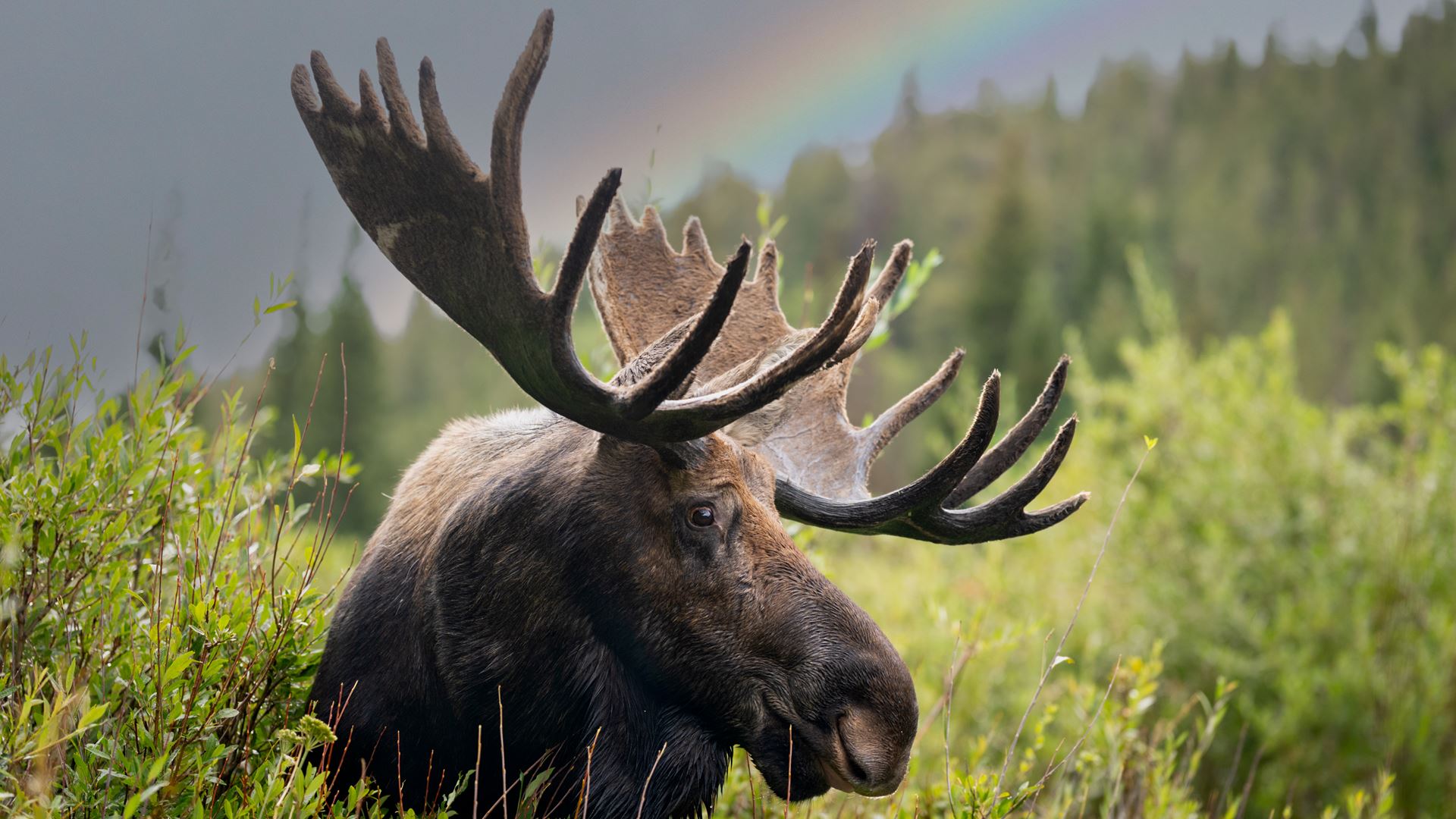
A New Mexico State University researcher was part of an interdisciplinary team of archaeologists, paleontologists, paleoecologists, archivists and tribal cultural heritage leaders who collaborated on a new study suggesting moose inhabited Colorado’s southern Rocky Mountains centuries before state wildlife reintroductions began in the late 1970s.
The study, published in the Journal of Biogeography and led by the University of Colorado Boulder, included researchers from NMSU, Crow Canyon Archaeological Center, University of Alabama, Tuscaloosa, Northern Arapaho Tribe, University of Utah, History Colorado, University of New Mexico, and University of Cincinnati. NMSU’s contributions came from John Wendt, assistant professor of rangeland ecology and paleoecology in the College of Agricultural, Consumer and Environmental Sciences.
The study brings together information from historical accounts, Indigenous knowledge, archaeology and paleontology. The researchers analyzed newspaper archives, archaeological site reports, scientific journals, photo archives and museum collections to study where and when moose were reported in earlier eras of Colorado. They found records describing groups of multiple animals together and examples of female and juvenile animals, providing strong evidence that these animals were living and reproducing locally, not just wandering in occasionally.
“The historic record shows clearly that moose were established in Colorado’s mountain landscapes as far back as we have written documents, and the archaeological record probably pushes that many centuries beyond,” said study’s lead author, William Taylor, associate professor of anthropology at the University of Colorado-Boulder and CU Museum curator of archaeology.
According to the study, other lines of evidence, such as placenames and oral traditions, show moose were well-known and deeply integrated into the traditional knowledge of Native people in the southern Rockies, from northern Colorado down as far as northern New Mexico.
Co-author Crystal C’Bearing, tribal historic preservation officer among the Northern Arapaho, noted that societies within the Northern Arapaho “utilize many animals, including moose, in their clothing, society items and regalia. This tradition continues today.”
Co-author Jonathan Dombrosky of the Crow Canyon Archaeological Center and the University of Alabama added that the study “shows the power of multiple independent lines of evidence converging on the conclusion that moose were part of southern Rocky Mountain ecosystems long before modern reintroductions. More broadly, the study demonstrates how historical sciences can help us better understand the origins of modern ecosystems and make more informed decisions about their future.”
The researchers caution that their findings do not suggest that changes to mountain ecosystems should be ignored. Rather, they argue that moose impacts should be understood through a deeper ecological and historical view, especially in national parks where many processes that once shaped large herbivore populations have been altered.
“Rocky Mountain National Park is dealing with ecological impacts from moose, but treating moose as a non-native species changes which management responses seem justified,” said Wendt, who joined NMSU in 2025.
Large mammals and the landscapes they inhabit have never been static, Wendt added, and large herbivores like moose have historically been controlled by things like predators, habitat change and human hunting.
“When modern park systems operate without these regulating processes, high impacts don’t necessarily mean that an animal is ecologically out of place,” he said. “Instead, they may be a sign that our management frameworks themselves should be reconsidered.”
The study results may influence how wildlife managers think about managing modern ecosystems, which have been destabilized by major changes over the past two centuries, including the removal of natural predators. C’Bearing said tribes may be willing partners in solving this issue.
“It would be beneficial not only to the tribes to utilize the moose again for cultural practices,” C’Bearing said, “but to assist in the co-management of moose in Colorado and the Southern Rockies.”
The interdisciplinary nature of this study demonstrates that combining evidence from different disciplines can enhance the understanding of wildlife in a variety of ways.
“The veil of time is often our biggest obstacle in understanding wildlife,” said co-author Joshua Miller of the University of Cincinnati. “Compared to the thousands of years that a species can live in a particular place, data from wildlife surveys might only extend a few decades into the past. We can learn a lot from that data, but some questions require more expansive time horizons. Weaving together different threads of historical evidence can fill important knowledge gaps and help us develop strategies for managing and conserving plants and animals from around the world.”
To read the study, visit https://doi.org/10.1111/jbi.70279
Rachel Sauer from the University of Colorado-Boulder contributed to this report.
-30-
Cutline: A New Mexico State University researcher was part an interdisciplinary team of scientists who found that moose have long existed in Colorado for at least centuries. John Wendt, assistant professor of rangeland ecology and paleoecology at NMSU was a co-author on the study. (Courtesy Deena Sveinsson)