

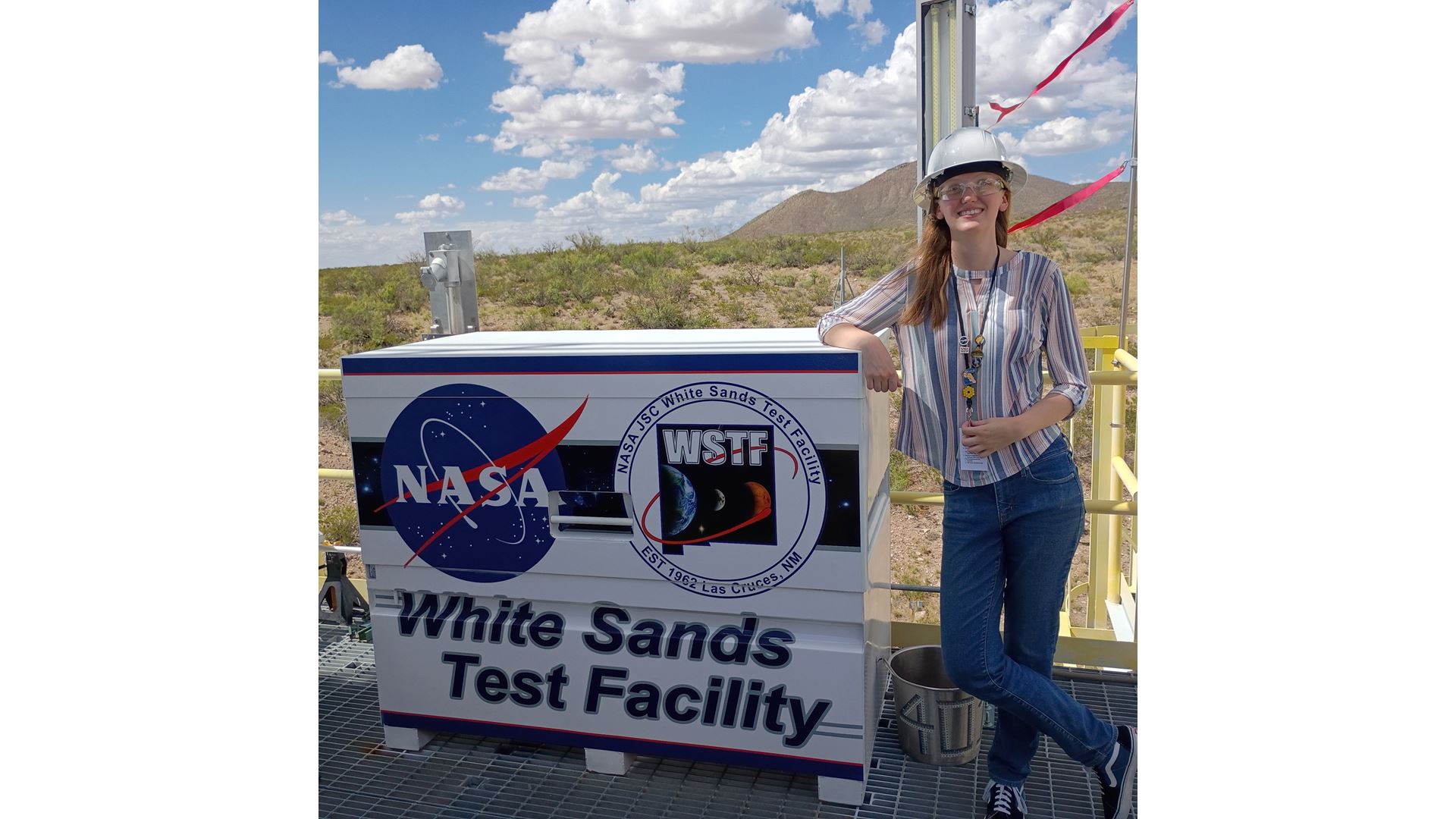
CUTLINE: Annelise Bingham, a mechanical and aerospace engineering student at New Mexico State University, got the chance to intern at White Sands Testing Facility over the summer through the NMSU Office of STEM Engagement internship program. During her time at WSTF, Bingham worked with the Safety and Mission Assurance team. Due to the skills she showed during the summer, WSTF offered her a part-time position with the SMA team while she continued her studies during the academic year at NMSU. (Courtesy photo) Description: A woman leans on a sign that reads “White Sands Test Facility.”
WRITER: Allison Brady, engr_media@nmsu.edu
Internships are often an integral part of someone’s academic experience. To make the most of their time during higher education, students are encouraged to go beyond just doing coursework.
Amanda Madrid, the program manager for career development in the Office of Engineering Outreach at New Mexico State University, said internships don’t simply give students hands-on experience in their field of study, but they also help establish themselves in the industry.
“In my experience working with students over the years, those who participate in internships are often better positioned for success after graduation,” Madrid said. “They typically have stronger professional networks, more relevant work experience, and a clearer understanding of industry expectations. As a result, they are often more competitive candidates and are more likely to secure employment shortly after graduation.”
NMSU offers many opportunities for students to find internships and build their professional image. Employment networking sites like Handshake, LinkedIn and many others are often a good place for students to start. Throughout the year, the university hosts multiple events that bring employers to campus, including career fairs and employer-sponsored events, giving students the chance to interact with employers.
Aggie Career Studio offers many services for students from resume reviews to professional development programming. Students can also visit the Office of Engineering Outreach, which provides individualized career guidance.
Annelise Bingham, Daniela Reyes Pipper, and Leigh Mayers are three of the seveal students who took on an internship over the summer. All gained imperative insight and opportunities in their respective fields.
Bingham is a mechanical and aerospace engineering student. Over the summer, she was able to intern at White Sands Test Facility’s Safety and Mission Assurance team, an opportunity she received through the Office of STEM Engagement internship program, where students can apply to spend a summer or semester at a variety of NASA centers. From there, she was matched with the WSTF to work in their hazardous testing site.
“Having two internships in NASA can help me apply to future positions as a civil servant or contractor for NASA right out of college,” Bingham said. “I know the culture, have completed a lot of training, and know people across the site that have seen my work. It also gave me a better idea of what an engineer does day-to-day at WSTF. I can also apply to other OSTEM or Pathways NASA internships at other facilities to expand my network and experience using my past internships.”
During her summer internship, WSTF recognized her skills and dedication, offering for her a part-time job after her internship. At the beginning of the fall semester, she started at SMA as an employee.
Prior to her internship at WSTF, she worked for the Aggie Innovation Space, which she said helped her build skills she could take into her future endeavors. Bingham talked about how often skills learned in one job can bleed into the next, even if they are different.
“My role at the AIS helped prepare me for that in two key takeaways: hands on skills and soft skills,” Bingham said. “I was taught hands-on skills like manufacturing processes, diagram reading, tolerances and assembly. I also strengthened soft skills at the shop like asking questions, professional confidence and project management. WSTF encourages all interns to ask questions and problem-solve on each project and across the center. These skills, of course, came in handy with this internship.”
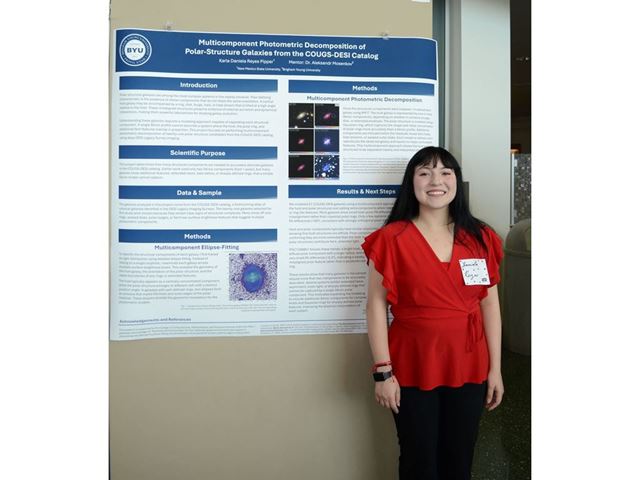
CUTLINE: Daniela Reyes Pipper, an aerospace engineering student at New Mexico State University, interned at Brigham Young University for the department of astronomy. There, she studied multi-component structure galaxies, an old and rare form of galaxy. Learning how they are formed can help better understand the early stages of the universe. (courtesy photo) Description: A woman stands in front of a research poster that reads, “Multicomponent Photometric Decomposition of Polar-Structure Galaxies from the COUGS-DESI Catalog.”
Students who intern have the opportunity to prepare themselves for graduate school and beyond.
Through internships, Pipper, an aerospace engineering student, was able to travel to Brigham Young University in Provo, Utah over the summer. There, she worked in the astronomy department researching multi-component structure galaxies.
On rare occasions, galaxies will develop two components where one component it is completely perpendicular to the other component. For example, a galaxy can have a disk shape surrounding its center, while simulations have a nuclear bulge shape coming from a perpendicular angle.
“They’re really rare to find,” Pipper said. “I think we found out that only 2.9% of all galaxies are like that, and since they are really weird, we are wondering why makes it why they are formed like that. Also, since they are the redshift is really big that means they are really old. We don't know if the universe was like that when it was first formed. So that can also help us understand what the Big Bang was like and how matter distributed.”
After interning, Pipper emphasized the importance of going out of one’s comfort zone and trying different areas of a field.
While working at BYU, she was one of only a few engineering summer interns. Her experience there only strengthened her confidence in pursuing the engineering side of space and aerospace research.
Pipper said coursework only cannot replace real-world experience, and interning helped to prepare her for graduate school and her career. Having them on a resume shows employers that engineer not only understands the materials, but also what to do with it.
“Even though studying an engineering major can be really hard, it’s not enough to only study the theoretical part of your field, but also have hands-on experiences and do things outside the class,” Pipper said. “I think having those experiences can, even though it really helps your resume or your curriculum, it can also tell you if that's something you would like or if you want to pursue another path.”
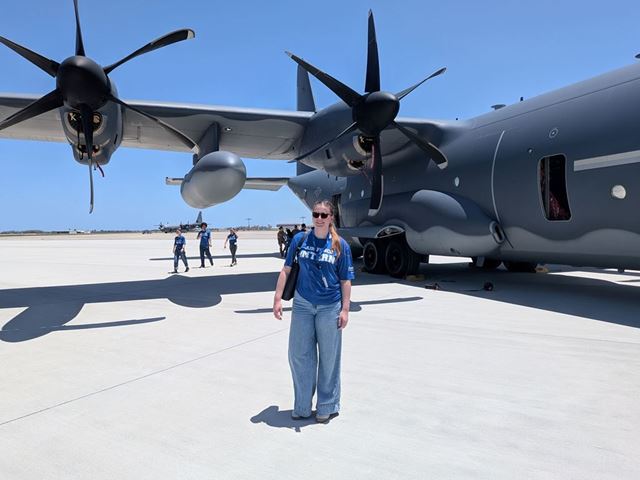
CUTLINE: Leigh Mayers, a mechanical and aerospace engineering student at New Mexico State University, stands in front of one of the planes at Holloman Air Force Base. Mayers spent her summer interning at the base with the 586th Flight Test Squadron. There, she worked on flight testing the aircraft on the base. (Courtesy photo) Description: A woman stands in front of a plane.
Internships have the unique ability to give students direct insight into their chosen profession.
Mayers is a mechanical and aerospace engineering student who found a summer internship at one of NMSU’s career fairs. One of many opportunities for students to meet employers in-person, all in one place.
“I went and talked to the Air Force Civilian Service booth, and they were saying that they have they had not necessarily a new program,” Mayers said. “The program is Premier College Interns through the Air Force, and it’s not a new program, but it was going to be the first year that they were going to be at Holloman in Alamogordo. He said, ‘You should apply and give me your resume, and we'll see. We'll call people up.’ And I got a call in November asking if I was still interested.”
Mayers encouraged all students to go to every career fair. While she did not receive any internships her freshman year, she said by going she was able to figure out what skills employers wanted and what they were looking for in an intern.
During her time at the Air Force, she worked on small flight testing on the aircraft at the Holloman Air Force Base with the 586th Flight Test Squadron. Mayers said her internship with the Air Force contrasted with her previous internship, which was more industry-focused rather than testing-focused. She was able to explore several mechanical and aerospace practices before going into a full-time job.
“I think internships are a really cool opportunity to get a view into the real world, and I think that it’s good to have an internship with your interests, but it’s okay if it’s not specific because you never really know,” Mayers said. “I feel it’s hard to know exactly what you want to do because if you’ve never been in the workforce, and even if you think that this might not be a great fit, it could still give you lots of learning opportunities.”