

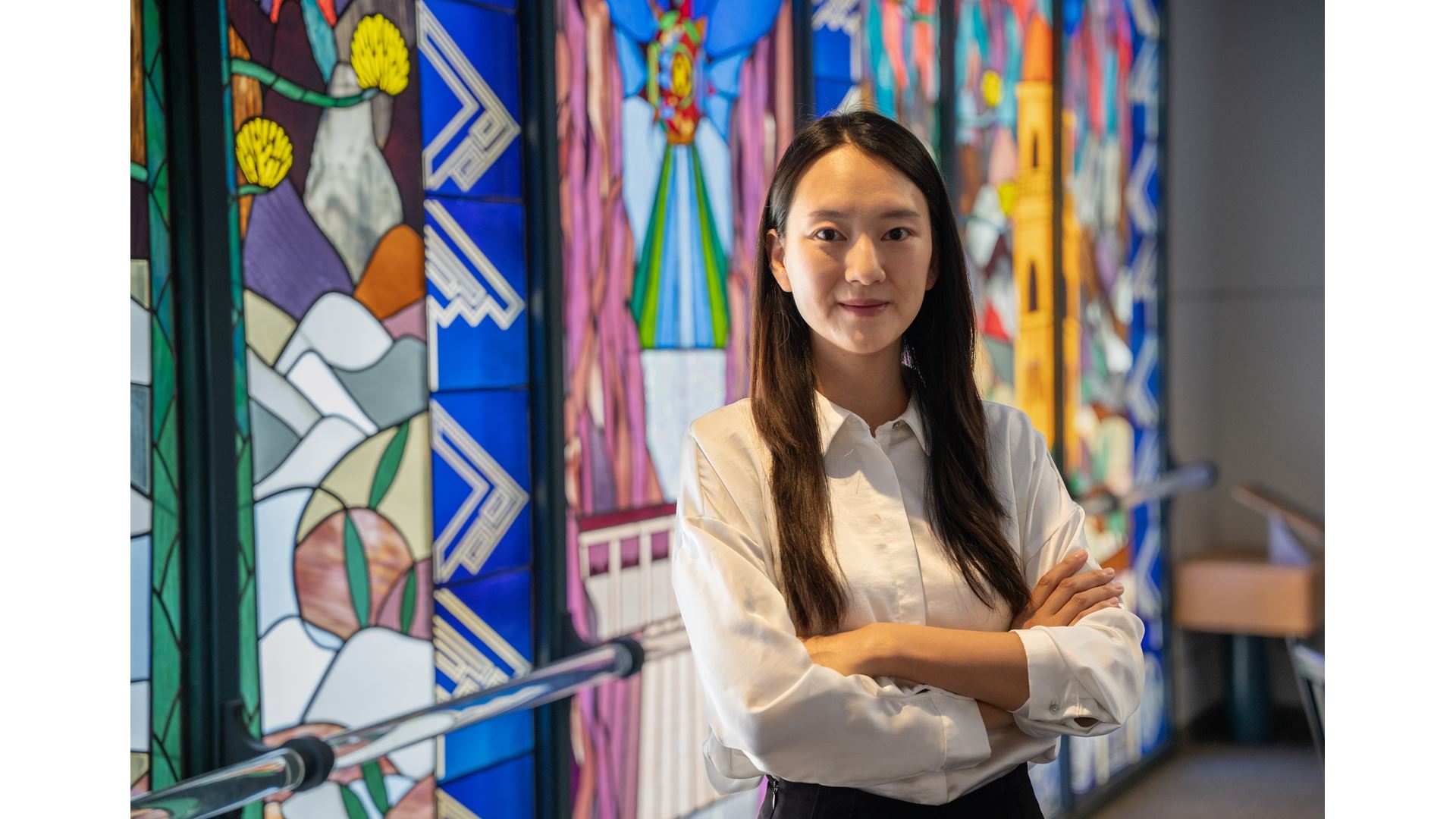
PHOTO CAPTION: New Mexico State University Civil Engineering Assistant Professor Qianyun (Gloria) Zhang is a recipient of the National Science Foundation CAREER Award, the foundation’s most prestigious award in support of early-career faculty who have the potential to serve as academic role models in research and education. (NMSU photo by Vladimir Avina) IMAGE DESCRIPTION: A woman standing with her arms crossed in front of her.
New Mexico State University Civil Engineering Assistant Professor Qianyun (Gloria) Zhang is well known on the NMSU campus for her work in mentoring engineering students. Recently, the National Science Foundation recognized Zhang’s mentorship and research work with the NSF CAREER Award.
The Faculty Early Career Development (CAREER) Program is the National Science Foundation’s most prestigious award in support of early-career faculty who have the potential to serve as academic role models in research and education, and to lead advances in the mission of their department or organization. Activities pursued by early-career faculty build a firm foundation for a lifetime of leadership in integrating education and research.
“I was deeply honored and excited to be named an NSF CAREER Award recipient,” Zhang said. “The award provides an extraordinary opportunity to establish and expand my research program, mentor the next generation of researchers, and make a meaningful impact on both my field and the broader professional community.”
The award allows Zhang to develop a new class of smart materials called adaptive modular circuit metamaterials, or AMCMs. The long-term goal is to create materials that can sense their surroundings, generate their own energy, process information and automatically adjust to changing conditions.
Zhang said that unlike conventional electronics that rely on separate components and external power sources, AMCMs will combine multiple functions within the material itself. They will harvest heat and mechanical energy, such as motion or vibration, and use that energy to power their responses.
“Ultimately, this work could lead to devices that are more adaptable, self-powered and responsive,” Zhang said. “Because AMCMs use a modular design, they could be customized for many applications, including medical devices, robotics, human–machine interfaces, miniature sensors and machines, and flexible electronics.”
The proposed program will deliver comprehensive education and hands-on training in advanced materials and energy systems, Zhang said, while fostering STEM engagement and capacity-building throughout New Mexico.
“A central goal is to strengthen STEM education in New Mexico, with a particular focus on encouraging community college and undergraduate students to participate in interdisciplinary research and pursue graduate education,” Zhang said. “Drawing on feedback from previous students, I will implement two integrated initiatives: mentoring undergraduate researchers through hands-on experience in cutting-edge research and developing an interactive learning module for middle and high school students that uses practical experiments and game-based computational tools for materials design to spark an early interest in STEM.”
Last year, Zhang was recognized with the 2025 New Mexico Established Program to Stimulate Competitive Research Mentor Award for her exceptional dedication to student mentorship and inclusive research training.
Also in 2025, the Hunt Center for Entrepreneurship at NMSU’s Arrowhead Center presented Zhang with the inaugural Aggie Construction Innovator of the Year Award.