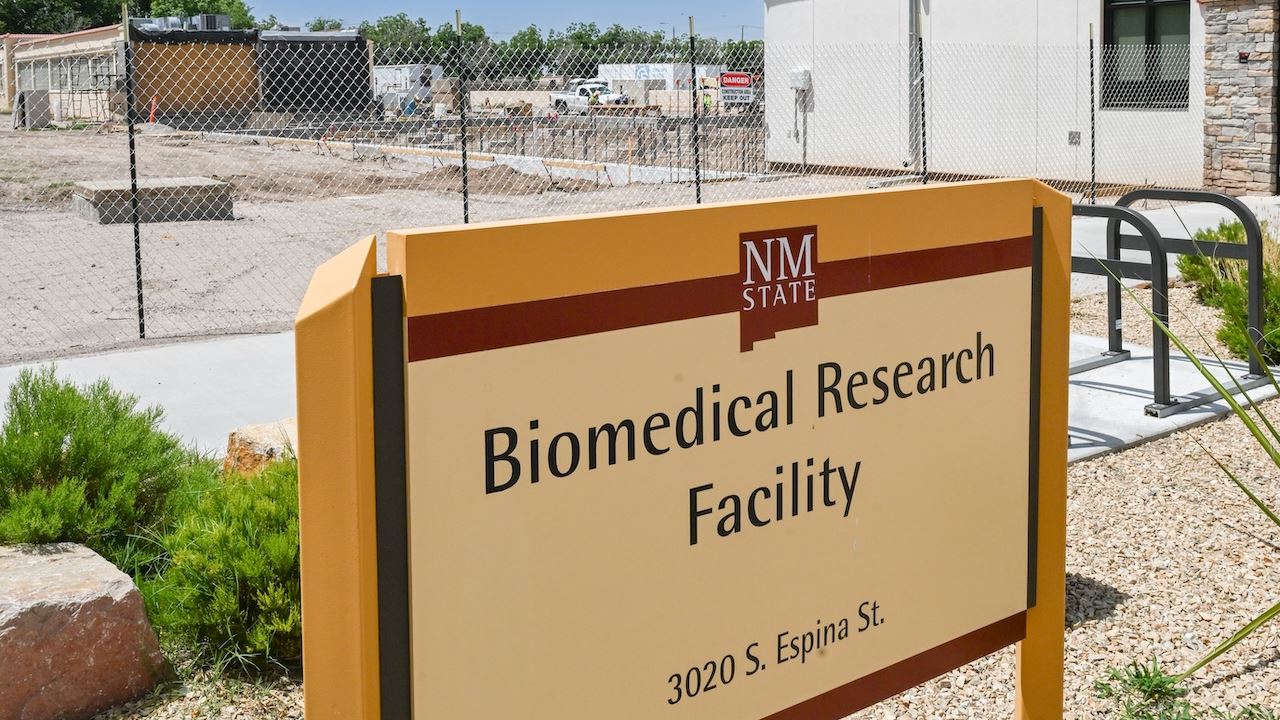

New Mexico State University is moving forward with a major expansion of its Biomedical Research Building, a project designed to significantly enhance the university’s research capabilities in areas critical to public health.
Supported through a combination of funding from the National Institutes of Health and State of New Mexico capital appropriations, the project represents a strategic investment in advancing biomedical innovation and education in the region. In October, the New Mexico Board of Finance and Administration approved $16.3 million in capital expenditures to double the size of the building, which was initially funded by a general obligation bond approved by voters in 2020 as well as an NIH grant.
The Biomedical Research Building has been developed in multiple phases. Phase I included construction of the building’s shell, followed by Phase II, which completed the interior buildout. The facility is now fully operational and actively supporting ongoing research.
Phase III, currently underway, will expand the building to accommodate growing research needs.
“This expansion marks an important step forward in strengthening NMSU’s biomedical research infrastructure,” said Berta Zubiate, university architect at NMSU. “By building on the success of the first two phases, we are creating a space that will support more advanced, collaborative and impactful research.”
Construction for the expansion began in November 2025, with full completion projected by March 2027. The expansion will introduce several specialized research environments, including a vivarium, aviary and insectary – facilities essential for studying infectious diseases, cancer and aging.
“These types of research environments are critical for advancing scientific discovery,” Zubiate said. “They allow researchers to better understand disease progression and develop new treatments that can improve lives, particularly in communities like those along the U.S.-Mexico border.”
The facility will serve a wide range of researchers and students, including those in the College of Agricultural, Consumer, and Environmental Sciences, as well as the Departments of Chemistry and Biology in the College of Arts and Sciences. The shared space is expected to foster interdisciplinary collaboration across multiple scientific fields. University leaders say the expansion also addresses the need to modernize and centralize research operations.
“Currently, many of these research activities are dispersed across campus,” Zubiate said. “This project brings them together into a purpose-built facility that meets evolving scientific and regulatory standards.”
The expansion aligns with NMSU’s land-grant mission by supporting research that addresses health disparities in border and minority communities, while also creating enhanced training opportunities for students pursuing careers in STEM and biomedical fields.
“This is about more than just adding space,” Zubiate added. “It’s about creating opportunities – for discovery, for collaboration and for the next generation of scientists.”
NMSU expands Biomedical Research Building to boost research capacity
Release Date: 25 Jun 2026