

When a once-eradicated parasitic fly reemerged in parts of Mexico and Panama three years ago and began infecting cattle and other animals with flesh-eating maggots, it set off alarm bells hundreds of miles away in the United States.
Caleb Hubbard, Ph.D., an assistant professor of urban entomology in New Mexico State University’s Department of Entomology, Plant Pathology and Weed Science, was among the many concerned as New World screwworm infections began spreading across Mexico.
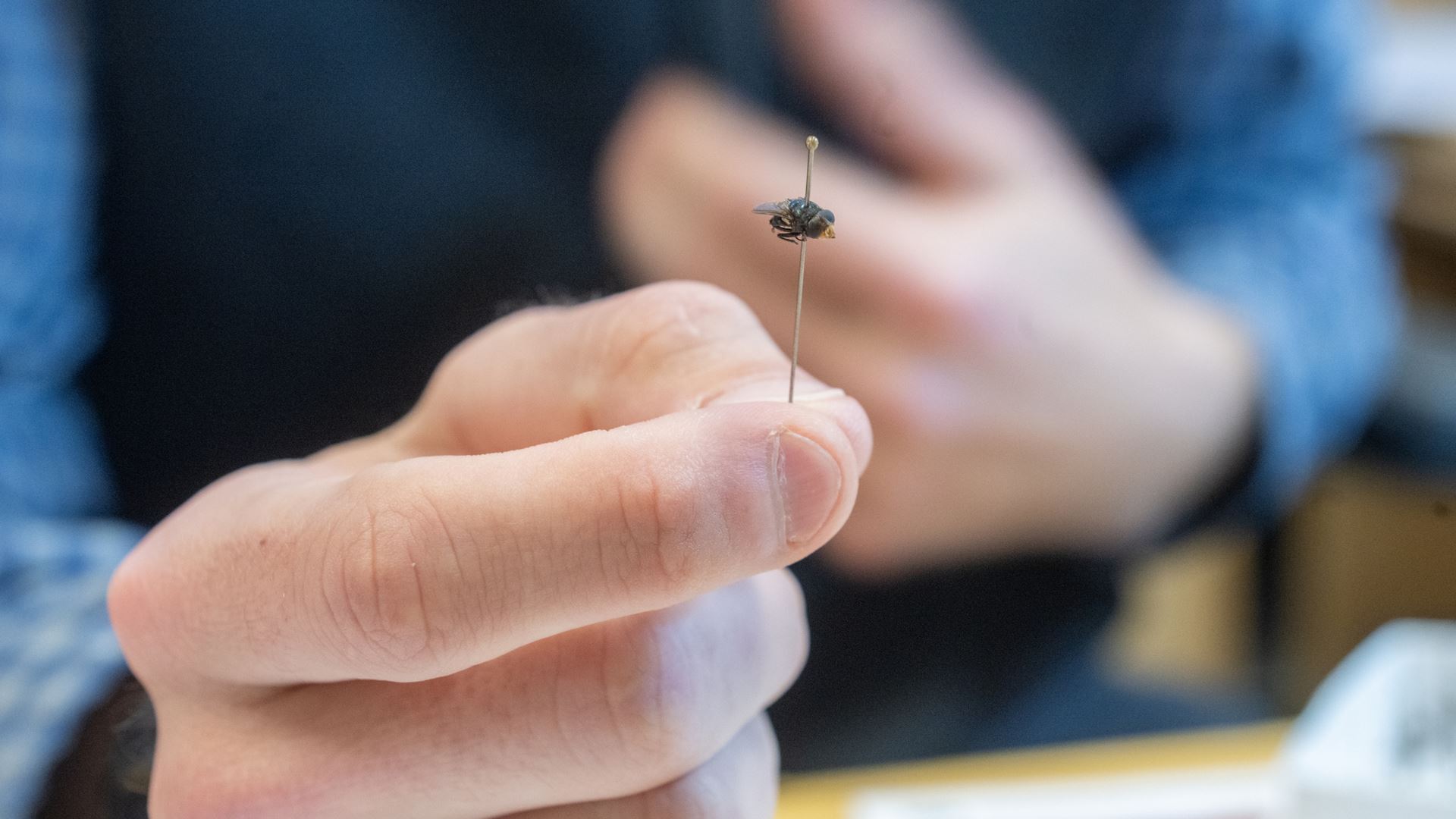
With a deep blue to blue-green metallic color, the New World screwworm is about the size of a housefly, but it poses an outsized threat to animals and humans. Females lay hundreds of eggs in open wounds, and 12 to 24 hours later, maggots will hatch and begin to eat and burrow deeper into their host’s flesh, causing death if untreated. Livestock and wildlife are especially vulnerable.
“In 2022 and 2023, there were outbreaks that started occurring in Panama that then slowly moved into Mexico,” Hubbard said. “We now have seen widespread numbers of cases.”
Aside from two contained cases, New World screwworm has not been detected in the U.S. But the number of reported cases across Mexico continues to balloon, reaching nearly 17,000 by the first week of March, according to the Mexican government. The pest has also been found in the state of Nuevo Leon, about 70 miles from the South Texas border.
The southern U.S. border remains closed to livestock trade, and the federal government is ramping up production of sterile males to help control the spread, among other actions.
At NMSU, Hubbard is part of a team working to coordinate a statewide response to the ongoing outbreak. A key component of the effort is raising public awareness and providing New Mexico communities with up-to-date, accurate and trusted information. The group includes staff and faculty from the Cooperative Extension Service, the Southwest Border Food Protection and Emergency Preparedness Center, the New Mexico Department of Agriculture and the New Mexico Livestock Board.
“My focus right now is working with ranchers, producers, hunters, and the general public to educate them on the threats of this fly,” Hubbard said.
Since last fall, Hubbard has presented at multiple workshops to provide insights about the New World screwworm, working alongside Brandon Smythe, a research assistant professor and director of NMSU’s Veterinary Entomology Research Laboratory. Hubbard also recently appeared on the MeatEater podcast to discuss the outbreak.
Jason Banegas, an NMSU Extension economist, wrote a publication last year about the economic impacts of the New World screwworm.
He said New Mexico livestock producers should prepare for an outbreak in the state and consider their risk exposure and mitigation options. He also noted that the state’s beef cattle, dairy, small ruminant and other related sectors could be negatively impacted because of close business connections with and proximity to Mexico.
The border closure has resulted in trade disruptions, market volatility and increased operating costs. Banegas found that the number of cattle imports from Mexico in 2025 was 229,055 head versus 1,249,202 head in 2024, a decrease of about 82% year-over-year.
“In New Mexico, many producers depend on a steady inflow of Mexican cattle to meet demand and maintain throughput in operations,” he said. “When imports are disrupted, local markets experience logistical bottlenecks, while downstream buyers may face inventory shortages and rising procurement costs.”
Although it is difficult to estimate the pest’s potential cost to New Mexico producers should it arrive in the U.S., Banegas has reason to believe it would be costly.
He pointed to a USDA report that found that a New World screwworm outbreak on the scale of the 1976 outbreak could cost Texas producers $732 million per year and the Texas economy a loss of $1.8 billion. Using data from the USDA, Banegas estimated than an outbreak of comparable size could cost New Mexico producers $128 million, with an overall economic impact of about $316 million to the state.
Hubbard and others at NMSU remain hopeful that efforts underway to keep the fly out of the U.S. will remain successful. Still, as cases increase with warming temperatures, they want New Mexico residents to prepare as much as possible for any unwelcome arrivals.
Education is key, Hubbard said. That’s why he, Smythe and Madison Dyment, an assistant professor in NMSU’s Department of Agricultural and Extension Education, developed a survey to gather information from ranchers, producers, hunters, land stewards and community members.
“Stakeholder input will directly inform state-level communication and preparedness plans, and contribute to protecting livestock, wildlife and rural livelihoods across the state,” Smythe said.
To complete the 15-minute survey, visit https://nmsu.news/NWS-Survey.
NMDA has also increased statewide surveillance efforts, with support from the state Department of Game and Fish, Department of Health, New Mexico Livestock Board and the Cooperative Extension Service.
State officials say New Mexicans should regularly inspect animals, monitor open wounds that do not heal or worsen, and watch for other warning signs, such as animals exhibiting restlessness, licking or biting at a wound, or isolating themselves; visible maggots in wounds; and swelling, discharge, foul smell or unusual tissue deterioration.
New Mexicans should consult a veterinarian for diagnosis and treatment options approved for use in New Mexico. All suspected New World screwworm cases should be reported immediately to the New Mexico Livestock Board by calling 505-841-6161or filling out a reporting form at https://nmsu.news/NWS-Reporting.
In addition to setting up tracking nets in vulnerable communities, NMDA also started a free testing program. Testing kits are available at all 33 county Extension offices in New Mexico. Samples should only be submitted if New World screwworm is strongly suspected.
“We’re asking New Mexicans to stay alert, not alarmed,” New Mexico Agriculture Secretary Jeff Witte said. “Early detection and reporting are key to protecting our livestock, pets, wildlife and rural communities, and if you suspect New World screwworm, contact your veterinarian right away. Public awareness is one of our strongest tools to keep New World screwworm out of New Mexico.”
-30-
Cutline: Caleb Hubbard, an assistant professor of urban entomology in New Mexico State University’s Department of Entomology, Plant Pathology and Weed Science, is part of a team at NMSU working to educate New Mexico residents about the New World screwworm. (NMSU photo by Josh Bachman)
Cutline: The New Mexico Department of Agriculture has started a free New World screwworm testing program. Testing kits are available at all 33 county Extension offices in New Mexico. (NMSU photo by Josh Bachman)
Cutline: The New World screwworm is about the size of a housefly and has a deep blue to blue-green metallic color. Females lay hundreds of eggs in open wounds, and 12 to 24 hours later, maggots will hatch and begin to eat and burrow deeper into their host’s flesh, causing death if untreated. Livestock and wildlife are especially vulnerable. (NMSU photo by Josh Bachman)