
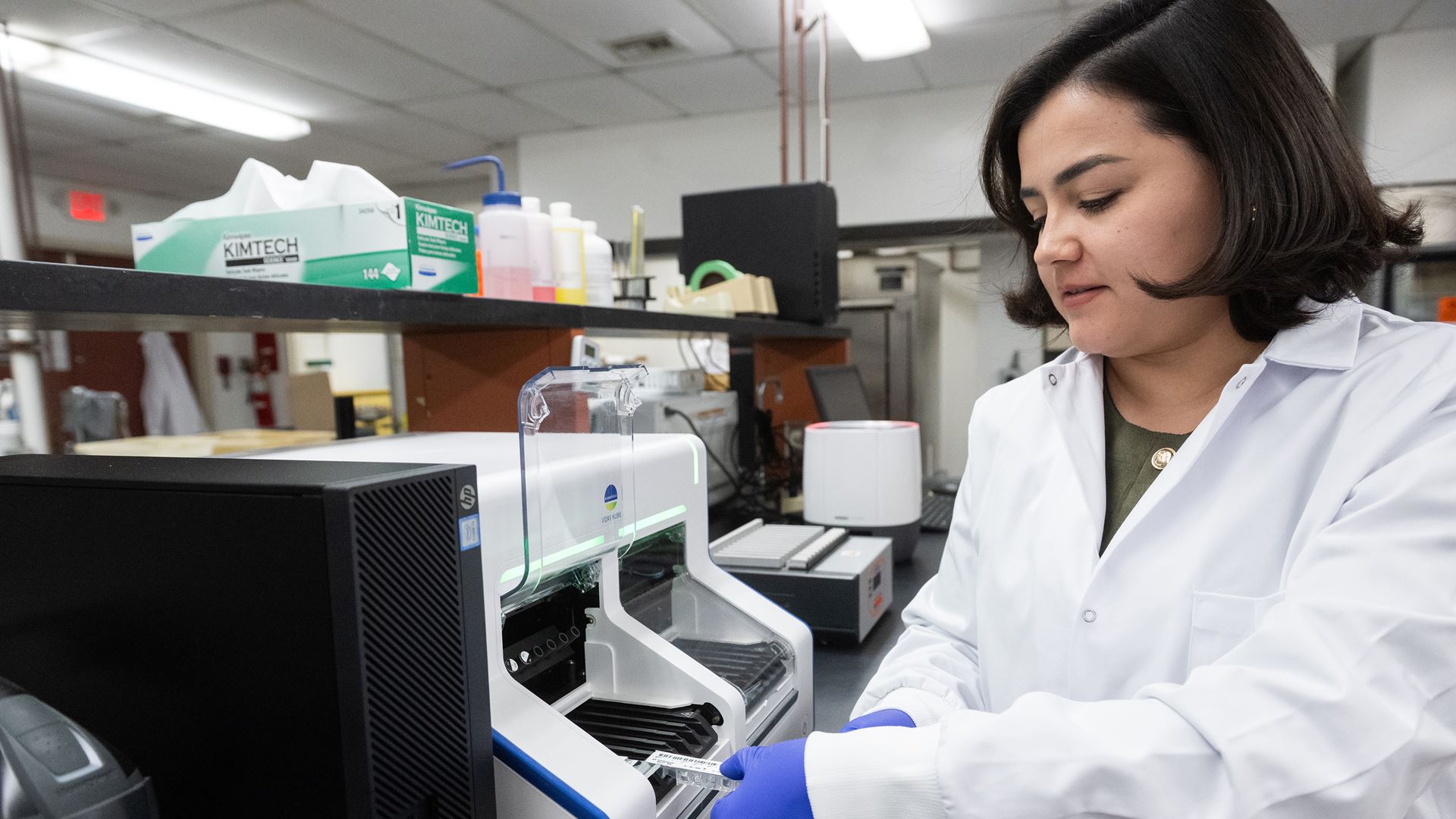
Karla Villalobos Porras considers it an honor and a great responsibility to be the first Ph.D. student in food science at New Mexico State University, working alongside her adviser at the NMSU Food Safety Laboratory.
“My motivation to pursue a Ph.D. in food science stems from a strong commitment to food safety, research and service to society,” said Villalobos Porras, a native of Delicias, Chihuahua, Mexico. “I have always believed that scientific research should extend beyond the laboratory and translate into real-world impact.”
Villalobos Porras has found those opportunities at NMSU, where agriculture, food systems and community engagement are central not just to the university’s mission, but to the mission of the Food Safety Laboratory.
As part of NMSU’s Center of Excellence in Sustainable Food and Agricultural Systems, the lab has a long, impactful history of serving as a trusted technical and scientific resource not only for New Mexico but also across the entire Southwest region and the United States, said Luis Sabillón Galeas, the laboratory’s new director and assistant professor in the Department of Family and Consumer Sciences.
The lab has also played a critical role as part of the Food and Drug Administration’s Food Emergency Response Network, which conducts method validation and verification studies for the detection of foodborne pathogens. During the COVID-19 pandemic, the lab pivoted to supporting emergency response needs.
“Our ability to adapt quickly, maintain analytical rigor and deliver high-quality data under pressure led to formal recognition from the FDA for excellence in emergency response,” Sabillón Galeas said. “These experiences helped shape the strong quality culture, technical depth and collaborative mindset that define the FSL today.”
Over the years, the lab has maintained partnerships with federal agencies such as the FDA and U.S. Department of Agriculture, as well as state agencies and regional producers. These partnerships have positioned the lab as a bridge between regulatory science, applied research and real-world industry needs.
Currently, the lab is undergoing a strategic transformation to better align with the evolving needs of the food industry, while strengthening student training and workforce development.
“Central to this effort is what we call a student-powered laboratory model,” Sabillón Galeas said. “In this model, graduate students at the M.S. and Ph.D. levels serve as trained analysts under the supervision of experienced laboratory professionals and faculty leadership.”
Moreover, he added, this model will allow industry partners to access high-quality, university-backed testing services, while giving students hands-on work experience in a regulated, client-facing laboratory environment. Students learn microbiological methods, documentation, traceability, data integrity and professional communication – all skills that are critical for careers in food safety.
Villalobos Porras calls her experience working in the lab “incredibly positive and meaningful.”
“From day one, I have felt welcomed, supported and valued, and the lab truly feels like a family,” she said. “I am very grateful for the patience, kindness and guidance I have received while learning and growing in a new research environment.”
Villalobos Porras said she hopes to use her experiences in the lab to build a research-focused career in food safety, contributing at a national or international level as she returns to her home state of Chihuahua.
“Research, education and outreach can have a meaningful and lasting impact,” she said. “Being able to apply science to support and serve my community is one of my greatest motivations.”
As of January 2026, the lab was pursuing ISO/IEC 17025 accreditation, which is the gold standard for laboratory competence, Sabillón Galeas said.
“Achieving this accreditation will ensure that our analytical results are legally defensible, globally recognized and fully aligned with regulatory and commercial expectations,” he said.
The accreditation also means that New Mexico producers will have access to world-class laboratory services without the cost or delays associated with out-of-state commercial labs.
“My vision is for the NMSU Food Safety Laboratory to become the premier hub for food and feed safety innovation in the Southwest,” Sabillón Galeas said.
For more information about the lab, visit fsl.nmsu.edu.
-30-
Cutline 1: Karla Villalobos Porras works in New Mexico State University’s Food Safety Laboratory with her adviser, Luis Sabillón Galeas. Villalobos Porras is the first student in the NMSU’s new Ph.D. program in food science. (NMSU photo by Josh Bachman)
Cutline 2: New Mexico State University’s Food Safety Laboratory team includes, starting from left, Villalobos Porras, Yatziri Presmont, Sabillón Galeas, Ruben Zapata and Juan Olea. (NMSU photo by Josh Bachman)