

In 2024, a team of paleontologists published a high-profile study in “Scientific Reports” announcing a newly discovered older sister species to Tyrannosaurus rex, Tyrannosaurus mcraeensis, that lived millions of years before T. rex. This study by Sabastian G. Dalman and colleagues received international media attention at the time.
A new paper by New Mexico State University researchers published this month in “Geology,” a publication of the Geological Society of America, contradicts that claim. The paper is titled “High-precision U−Pb zircon geochronology establishes a mid-Maastrichtian age for the Hall Lake tyrannosaur of southern New Mexico.”
Co-authors Jeffrey Amato, an NMSU geology professor, Timothy Lawton, emeritus professor, and NMSU master's student Emma Schantz, set out to date ancient volcanic rocks near Elephant Butte Lake. While there, they discovered a volcanic ash bed directly below the fossil excavation site that has fundamentally disrupted the timeline of North America’s most famous apex predator, using zircon geochronology and stratigraphy.
The fossil at the center of the debate is a jawbone pulled from the shoreline of Elephant Butte Lake at the Armendaris Ranch in 1983. Paleontologists initially identified the specimen as T. rex because their anatomy was so similar. Only when the 2024 team inferred an age of 73 to 74 million years old based on an older study by Amato and colleagues on a tuff from a different area did they argue the dinosaur was too ancient to be T. rex.
NMSU research team concentrated on dating zircons from sedimentary layers at the dinosaur site in the McRae Basin, which would more directly determine the age of the fossil. Zircon geochronology is one of the most reliable and widely used methods in geology for dating Earth's history. It relies on microscopic zircon crystals trapped in rock layers. Because these minerals act as tiny radioactive clocks by locking uranium that predictably decays to lead, scientists can measure isotopes to determine a rock's precise age. Sedimentary stratigraphy is the study of how layers of sand and silt accumulate over millions of years.
“So, we went in and did a more focused study to try to figure out the ages of the rocks below, at, and above the dinosaur fossil level,” Amato said. “We were dating zircons in sandstones, and we came up with an age for the dinosaur strata that was 69 million, not 74 million years ago.”
Amato sent his samples to Jim Crowley, research scientist at Boise State University in Idaho, for testing. Crowley’s lab uses a technique to obtain the most precise ages possible from zircons. And this age of 69.4 million years is still older than known T. rex ages, but not nearly as old as T. mcraeensis was postulated to be.
The NMSU team’s findings mean this fossil may be an old T. rex, or a precursor species as previously suggested.
“This species is kind of up for grabs in terms of how paleontologists are going to identify it,” Lawton said. “Because suddenly, if it's a different animal that was living at the same time as T. rex, then there were two giant predators at the same time.” One problem is the lack of a complete skeleton, and the other is that it’s hard to determine the age of fossils directly.
"Most dinosaurs are not dated very well," Lawton explained. "You have to get an age from one part of a of a sedimentary section somewhere in the region, and then you have to figure out how those rocks can be correlated to where the dinosaurs are found, so that you usually don't have the dinosaur and the volcanic layer in the same place. But here we found just that, and it was, ‘oh my God’ too good to be true!"
While Amato, Schantz, and Crowley focused on the isotopic clocks inside zircon crystals, Lawton and Amato brought their field geology expertise to provide context to the zircon dating. They discovered discrepancies in the previous research, which had inferred the dinosaur fossil age based on a location 2.2 miles from the fossil site.
“This opened up a whole new ball game because we had a volcanic bed right at the dinosaur quarry, right at the place where these bones were discovered and we started becoming aware of how controversial all this was,” Lawton said. “My job was to figure out how this dinosaur fossil related to the ages that Jeff had from the beds in the succession. Somebody had previously measured the succession of rocks relating to the age of the fossil, but there was some confusion. They made several mistakes, that's where I came in.”
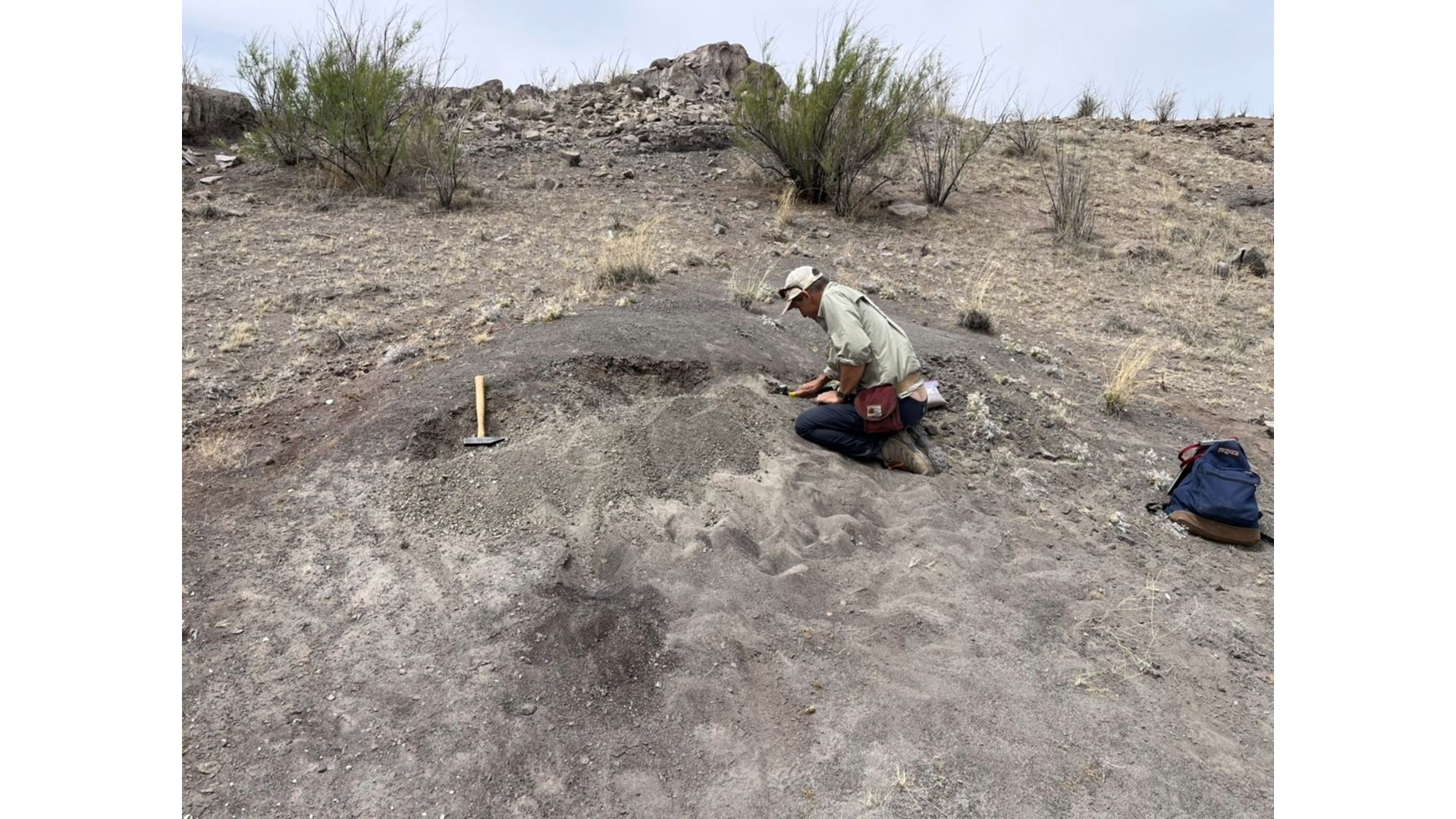
The mystery unraveled during field surveying around the Armendaris Ranch hillside, when Lawton spotted an easily overlooked white band directly inside the fossil quarry.
"We were sort of scratching around on the hillside, and I said, 'Jeff, look at this white stuff. I think this is a tuff.'" Lawton recalled. "By a tuff we mean a layer that basically was deposited by the fallout of ash from a volcanic eruption, so it contains those zircons."
Finding a tuff (a consolidated ash bed) sitting right alongside the fossilized bones provided the team with primary volcanic zircons deposited around the time the dinosaur died, an extreme rarity in paleontology.
By dating zircons from the sandstone layers and the newly discovered tuff layer, the NMSU team established a refined, high-precision age of 69.4 million years old for the dinosaur strata. Despite the breakthrough, part of the ongoing debate surrounding the fossil stems from its exact biological classification. Still, Amato and Lawton agree that their discoveries have reopened the debate about the nature of T. rex in southern New Mexico, and opportunities for other researchers to follow.
“This is how science works, right? We have a finding. Someone says this is interesting. Someone says, ‘You might be wrong.’ We return to collect more data, and it goes back and forth,” Amato said. “We're all working towards a better understanding of whatever scientific problem. In this case, we think it’s the best dated tyrannosaur in North America, but we still don’t know whether it’s the oldest T. rex in North America or something different.”
-30-
CUTLINE: Jeff Amato, NMSU Geological Sciences Department professor, a unit of Cretaceous volcanic ash (gray layer below hammer), referred to as tuff, that underlies a siltstone layer (brown) that hosted a tyrannosaur fossil east of Elephant Butte Reservoir that was formerly identified as T. rex. This fossil was subsequently postulated to be an earlier ancestor of T. rex. The study by Amato, Tim Lawton, Emma Schantz and Jim Crowley, newly published in the journal “Geology”, showed that the dinosaur lived and died around 69.4 million years ago. Paleontologists will use this information to reevaluate the significance of this site for tyrannosaur evolution in western North America. (Photo by Tim Lawton)
CUTLINE: Scanning electron image of polished grains of the mineral zircon, which contains minor amounts of uranium (U) that decays to lead (Pb). Each crystal is approximately 200–300 microns in length, or about one one-hundredth (0.01) of an inch. (0.01”). These crystals were extracted from a unit of Cretaceous volcanic ash, referred to as tuff, that underlies a siltstone layer east of Elephant Butte Reservoir that hosted a tyrannosaur fossil formerly identified as T. rex. This fossil was subsequently postulated to be an earlier ancestor of T. rex. The study by Jeff Amato, Tim Lawton, Emma Schantz and Jim Crowley, newly published in the journal “Geology”, showed that the dinosaur lived and died around 69.4 million years ago. Paleontologists will use this information to reevaluate the significance of this site for tyrannosaur evolution in western North America. (Photo by Jim Crowley)
CUTLINE: Jeff Amato from the NMSU Geological Sciences Department is sampling a unit of Cretaceous volcanic ash (white layer), referred to as tuff, that erupted into an area with dinosaur and leaf fossils. He and his colleagues used a mineral in this ash, zircon, to determine the age of eruption of a similar unit to determine the age of a tyrannosaur fossil near the eastern edge of Elephant Butte Reservoir. The study by Jeff Amato, Tim Lawton, Emma Schantz and Jim Crowley, newly published in the journal “Geology”, showed that the dinosaur lived and died around 69.4 million years ago. Paleontologists will use this information to reevaluate the significance of this site for tyrannosaur evolution in western North America. (Photo by Tim Lawton)
CUTLINE: Tim Lawton, Emeritus Faculty member from the NMSU Geological Sciences Department is looking over the Cretaceous sedimentary rocks of the Hall Lake Formation, exposed on the east side of Elephant Butte reservoir. These rocks are host to numerous dinosaur fossils, including a tyrannosaur whose age was not accurately known until the newly published study by Jeff Amato, Tim Lawton, Emma Schantz and Jim Crowley, in the journal “Geology”, that showed the dinosaur inhabited the area of southern New Mexico around 69.4 million years ago. Paleontologists will use this information to reevaluate the significance of this site for tyrannosaur evolution in western North America. (Photo by Jeff Amato)
CUTLINE: NMSU Geological Sciences Master’s Degree student Emma Schantz is hiking up a ridge of the McRae Group sedimentary rocks, which were deposited in river systems along the edge of the Cretaceous Western Interior Seaway. These rocks are host to numerous dinosaur fossils, including a tyrannosaur whose age was not accurately known until the newly published study by Jeff Amato, Tim Lawton, Emma Schantz and Jim Crowley in the journal “Geology”, that showed the dinosaur inhabited the area of southern New Mexico around 69.4 million years ago. Paleontologists will use this information to reevaluate the significance of this site for tyrannosaur evolution in western North America. (Photo by Jeff Amato)