

Ice cream is a summertime staple and a favorite dessert among Americans, with innovative flavors and recipes being consistently introduced into the marketplace. But you might not realize that some of the big secrets to producing a high-quality ice cream come from a small lab at New Mexico State University.
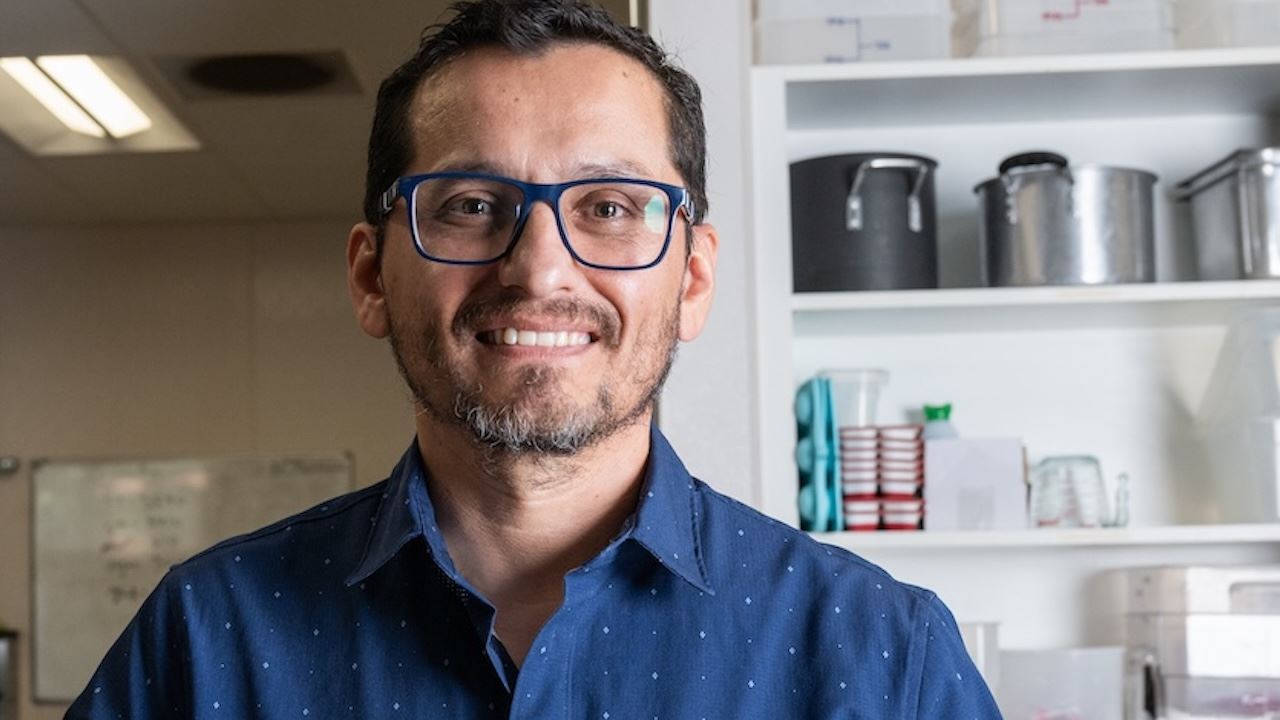
Sergio Martinez-Monteagudo leads the food science dairy lab housed in NMSU’s College of Agricultural, Consumer and Environmental Sciences and operated as part of the Center of Excellence in Sustainable Foods and Agricultural Systems. Most recently, the dairy lab has partnered with ice cream company Blue Bunny to research how to improve ice cream quality by exploring formulations that prevent it from melting too quickly.
“We came up with the idea that we can modify the proteins in a different way where water will remain attached, or chemically bound, to the proteins so that when they melt, it takes longer to separate and therefore melt slower,” said Martinez-Monteagudo, who holds a double appointment as assistant professor of bioprocessing in the NMSU Department of Family and Consume Sciences and the NMSU Chemical and Materials Engineering Department. “The project started with a lot of trial and error, and once we saw the potential, companies were really interested.”
While studying ice cream may seem like a fun topic, Martinez-Monteagudo said he and his graduate students maintain a productive research agenda. When Martinez-Monteagudo started at NMSU in summer 2020, in the midst of the COVID pandemic, the university had been producing and selling gelato made on campus.
The lab has been involved in a number of successful collaborations with companies nationwide. Currently, the lab is working with 12 companies on finding solutions to such problems as what to do with ice cream production waste and how ice cream quality is affected by storing at slightly higher freezer temperatures.
“The first project I started working on at NMSU I got $300,000 for three years,” Martinez-Monteagudo said. “Right now, I’m getting close to half a million dollars directly put into NMSU from the industry.”
According to the International Dairy Foods Association, the average American consumes about four gallons of ice cream annually. To produce that ice cream consistently and safely, processors go through startups, product rotations and cleaning for allergens at shutdown daily. This results in about a 5% loss of all the ice cream produced.
That loss has become a high-priority topic within the industry. Since 2024, Martinez-Monteagudo and his lab have been working with companies on how to reuse fat that has been removed from ice cream products.
“The fat has been encapsulated and stabilized in such a way that while you can still enjoy the ice cream, separating it is such a challenge,” he said. “Our process separated 99% pure fat with no allergens, so potentially you can reuse that fat and put it back into ice cream the same as any ingredient.”
That project has resulted in two patents pending and consistent communication with the Food and Drug Administration on how companies should label ingredients like the reused fat. Yet another project is examining how to turn lactose removed from ice cream into a low-calorie sweetener.
“It turns from research-oriented to now I have to deal with the regulatory side, and it’s been an amazing experience in terms of dealing with research, the owners of the factories, the agencies and communicating with everybody,” Martinez-Monteagudo said. “Not many universities do the research that I do.”
Recently, Martinez-Monteagudo was given the opportunity to send batches of NMSU-produced ice cream for the Association for Public and Land-Grant Universities’ Scoops for Science event coming up June 2 at the U.S. Capitol in Washington, D.C. The event will feature 21 universities from across the country showcasing the creativity, agricultural innovation, and research happening at public and land-grant universities.
Events like Scoops for Science allow NMSU and other universities to promote their research and are sure to attract the attention of students looking to delve deeper into a beloved treat.
“Once you communicate your research, anyone around the world can see what you’re doing and that captures interest,” Martinez-Monteagudo said.
-30-
PHOTO CAPTION: New Mexico State University assistant professor Sergio Martinez-Monteagudo shows a carton of ice cream produced at the food science dairy lab on campus. On June 2, NMSU-produced ice cream will be featured at the Scoops for Science event in Washington, D.C. (NMSU photo by Josh Bachman)
IMAGE DESCRIPTION: Man in a laboratory holding a container of ice cream.
PHOTO CAPTION: New Mexico State University graduate students make ice cream at the food science dairy lab on campus. On June 2, NMSU-produced ice cream will be featured at the Scoops for Science event in Washington, D.C. (NMSU photo by Josh Bachman)
IMAGE DESCRIPTION: Three men in a laboratory opening food products to make ice cream.