
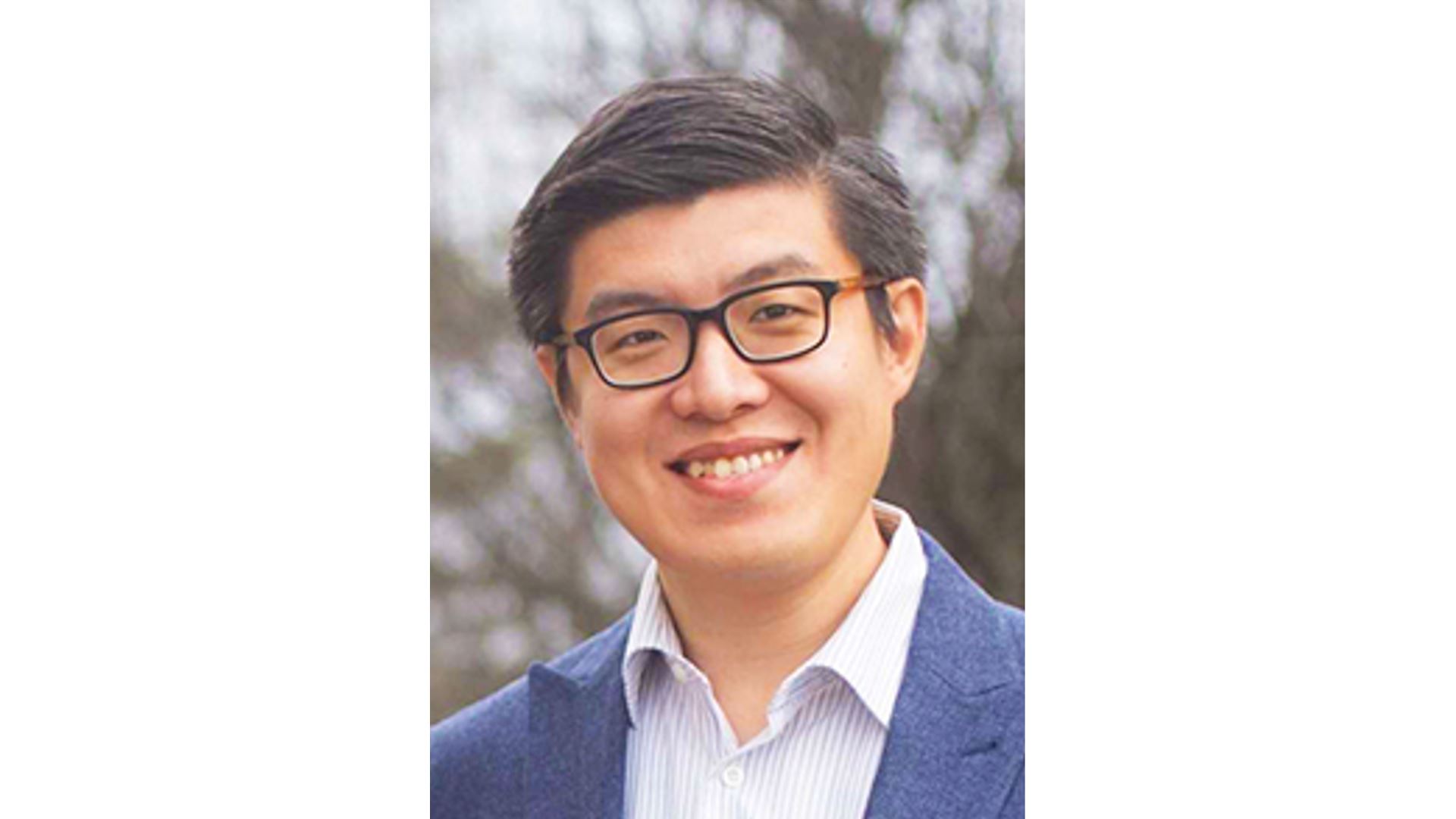
Over the next five years, a National Science Foundation CAREER award of nearly $600,000 will support New Mexico State University physicist Ludi Miao’s research on quantum materials that could build future revolutionary technologies.
The CAREER award is the National Science Foundation's most prestigious award for early-career faculty. It recognizes tenure-track assistant professors who effectively integrate excellent scientific research with innovative educational leadership.
Miao works with materials with exotic properties, meaning behaviors that are directly driven by the weird, rule-breaking laws of the quantum scale rather than the predictable rules of everyday physics. Some of materials that he is studying are magnetic and some are superconductors, which are both useful for ultra-fast and energy-efficient quantum computers, advanced power grids and medical sensors that can map magnetic fields with extreme precision.
Miao’s NSF award will support the magnetic materials side of his work.
“My research explores what happens when we bring two different materials together. At their interface – the very thin boundary where they meet – new and unexpected behavior can emerge,” said Miao, assistant professor in the Department of Physics. “They will demonstrate properties that neither of these parent layers show. New behavior appears. Discovering these new behaviors is what my research is about.”
Miao’s NSF CAREER award supports his collaboration with Sandia National Laboratories. His research also involves partnerships with Los Alamos National Laboratory, Cornell University, the University of California, Santa Barbara, the University of Arkansas and Texas Tech University. These collaborations bring together complementary expertise and specialized facilities to advance his research on quantum materials and devices.
“These will be Ph.D., master’s and undergraduate students getting experience over the course of the grant,” Miao said. “I sent three students up to Los Alamos and one student to Cornell University over the summer, which resulted in success toward workforce development.”
Miao’s research under the grant has three objectives. One is to explore an emerging class of magnetic materials known as “altermagnets.” In these materials, opposing magnetic moments cancel, yet electrons with different spin orientations can behave differently. This unusual combination could offer new ways to control information in future electronic devices.
Miao theorizes this material can be produced artificially. He predicts that stacking certain materials in a particular order can result in “altermagnetic” material. In materials science and physics research, the ability to artificially design these materials from the ground up – rather than mining them or discovering them by accident – is considered a holy grail for physicists.
Achieving this with artificial materials at room temperature would lead to virtually heat-free, ultra-dense computer memory and processors that run exponentially faster while using a fraction of the electricity.
Miao’s second hypothesis is about engineering magnetic skyrmions.
“A skyrmion is like a whirlpool of electron spins,” Miao said. “In magnetic materials, collective spin orientations can be used to store information as ones and zeros. Interactions between spins also can cause them to form a swirling pattern called a skyrmion. This is an active area of research, and scientists hope to use skyrmions in the next generation of memory and computing devices. My hypothesis is that we can stabilize skyrmions and control their properties through a process of training.”
Miao’s third objective involves materials topology. Semiconductors use positive and negatively charged electrons as the elementary building blocks of computer chips. Miao’s idea is to use material’s topology features to build positive and negative junctions instead of electrons.
“You can think of topology by imagining a knot in a closed loop of rope,” Miao explained. “You can bend or stretch the rope, but you cannot remove the knot without cutting it. Magnetic spin patterns can have a similar kind of protection. My goal is to create a two-layer material in which the spin patterns carry opposite topological charges. This could open new ways to store and process information using magnetic structures.”
Through June 2031, Miao’s NSF CAREER grant will support his search for magnetic behavior that emerges when materials meet – behavior neither material exhibits alone. By learning to create and control these effects, his team aims to lay the groundwork for new ways to store and process information. The promise is to turn discoveries at boundaries just atoms thick into building blocks for future computing technologies.
The grant will also help Miao bring magnetism to new audiences. He will develop and teach a new course on magnetism and invite local middle and high school students to NMSU’s Department of Physics for laboratory tours and demonstrations. He also plans to launch a YouTube channel exploring magnetism and quantum materials, making these topics accessible to the public and connecting discoveries in the laboratory to everyday technologies.
-30-
CUTLINE: Ludi Miao, NMSU physics assistant professor, received the National Science Foundation's most prestigious award for early-career faculty. (Courtesy photo)