
American third grade classrooms are filled with natural-born scientists – children obsessed with asking why and treating the world as an open-ended laboratory. But as they cross the threshold into fourth grade, a quiet, data-backed crisis begins to unfold in U.S. schools known as the “Grade 4 Dip.” Recent National Assessment of Educational Progress (NAEP) data reveals that nearly 40% of U.S. eighth graders now score "below basic" in science, marking a historic drop in proficiency and a widespread collapse in student engagement.
To reverse this trajectory before the middle school window closes, New Mexico State University education professor Suparna Chatterjee and astronomy professor Juie Shetye joined forces to inspire and sustain New Mexican students’ curiosity through sun and space science.
Over the next five years, they will take heliophysics into classrooms across New Mexico.
Their project, titled “Solar Stories Studio: Place-Based Heliophysics STEAM Engagement for Grades 4-8,” is part of a nationwide network designed to bridge the gap between community-embedded learning and authentic NASA science. NASA is investing $1.225 million in Chatterjee and Shetye’s project over five years as part of a cooperative agreement under NASA's Science Mission Directorate (SMD) under the Research Opportunities in Space and Earth Sciences (ROSES)-25 Science Activation (SciAct) program.
“We want teachers to critically use the NASA visualization and related tools,” said Chatterjee, principal investigator of the grant. “We really want these not to be a standalone activity in the teacher's work, we want this to be integrated with the content that they are already teaching in ways that that align with their instructional goals and classroom contexts. We recognize that “one size fits all’ will not work. We support teacher agency and encourage teachers to adapt these resources to meet the needs of their classrooms, students and teaching practices."
Over the five-year performance period, the NMSU team plans to execute several major initiatives across New Mexico: develop the curriculum, establish a teaching academy, provide a website, expand the project to the broader community and publish research on what works best. The grant, which received its first funding this month, will support a project manager, stipends for teachers to attend summer academies and outreach activities.
The first step is to develop a heliophysics curriculum – interactive learning experiences focused on solar science and space-weather observations tailored specifically for upper elementary and middle school students (grades 4-8).
“It’s easy for students to study solar astronomy,” said Shetye, whose focus is solar research. “During the school day, students can look at the sun, they can learn about the sun, sun dials, features on the sun, magnetic fields and other aspects. That’s why we chose heliophysics. To build up to our main goal, we will have to create 10 experiments that involve solar physics or space weather-based educational materials for schools.”
Step two is building a multi-year teaching academy, dedicated to boosting local educator capacity, enabling teachers to effectively lead data-rich STEAM lessons. Chatterjee is working with partner schools and curriculum development is already underway. The project will establish a school-based foundation through educator cohorts, refinement of instructional modules, repeated classroom implementation and formative evaluation. This approach intends to support educators as they build experience with heliophysics learning and provide opportunities to refine project materials based on classroom implementation.
“Yes, I am the PI, but the teachers are the heart of this project,” Chatterjee said. “They are the ones who will bring it to life in their classrooms. This is truly collaborative work, and we are designing it together.”
Step three will create a website in the first nine months with materials to provide students with hands-on opportunities to interact with actual scientific datasets and transform their findings into public-facing, creative storytelling products.
Step four will include expanding the program to the broader community. This is where the program manager and outreach educators will coordinate events at libraries, museums and other family meeting places.
Step five involves research studies and publishing papers ongoing throughout the program to evaluate which specific STEM/STEAM engagement frameworks produce the best outcomes, under what conditions, and for which student demographics.
“In Dr. Shetye’s five years in NMSU’s Astronomy Department, she has spearheaded numerous NASA and other grants to inspire student researchers in solar physics,” said Enrico Pontelli, dean of the College of Arts and Sciences. “This year, she received the prestigious National Science Foundation CAREER award to continue her inspirational leadership for undergraduates, empowering them to become involved in research and pursue advanced degrees.”
“Dr. Chatterjee is a sheer force in strengthening STEM pathways while inspiring the next generation of collaborative scientists, cutting-edge educators and innovative problem solvers,” said Rick Marlatt, dean of the College of Health, Education and Social Transformation. “This significant investment from NASA will connect students, teachers, families and communities across New Mexico with authentic scientific learning opportunities that are culturally relevant and socially transformative.”
Chatterjee and Shetye chose heliophysics for their “Solar Stories Studio” for reasons they hope will resonate with teachers, students and families across the state.
“We chose the sun, not only because I am a solar physicist but because it is New Mexico’s symbol,” Shetye said. “The Zia symbol is the sun. There are sacred places like Chaco Canyon, where ancient peoples created solar alignments more than a 1,000 years ago. The sun, the seasons and the connection to agriculture, to life and community is deeply rooted in New Mexico culture.”
“I first learned about the sun as a source of life, energy, and wonder from my grandmother, everyday offering prayers with water and hibiscus flowers to the rising sun, taught me that some of our most meaningful lessons begin at home and stay with us for a lifetime,” said Chatterjee, recalling the memory from childhood in her native India. “Shared sense-making happens when we bring the whole community together; students, parents, families, and others to share their cultures, connections, and experiences, so students can see how astronomy relates to their lives and communities.”
Both professors hope these “Solar Stories” will rekindle a sense of wonder and curiosity about science that will stay with students far beyond their fourth to eighth grade classrooms.
-30-
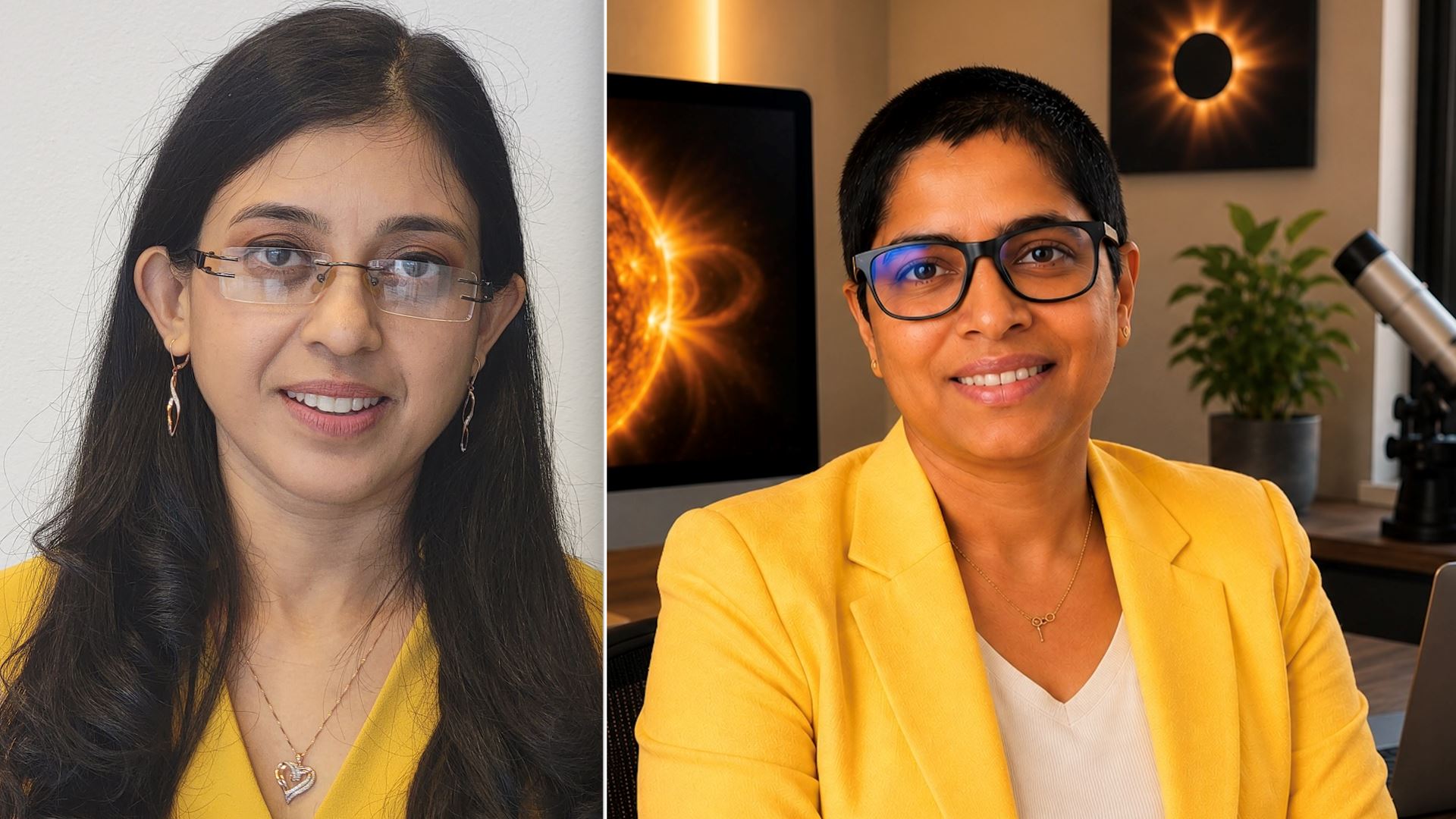
CUTLINE: Suparna Chatterjee, assistant professor of STEM Education and principal investigator, and Juie Shetye, astronomy assistant professor, are collaborating on a $1.2 million NASA grant. The five-year grant is part of a cooperative agreement under NASA's Science Mission Directorate (SMD) under the Research Opportunities in Space and Earth Sciences (ROSES)-25 Science Activation (SciAct) program. (Courtesy photo)
CUTLINE: Suparna Chatterjee, assistant professor of STEM Education and principal investigator of a $1.2 million NASA grant. The five-year grant is part of a cooperative agreement under NASA's Science Mission Directorate (SMD) under the Research Opportunities in Space and Earth Sciences (ROSES)-25 Science Activation (SciAct) program. (Courtesy photo)
CUTLINE: Juie Shetye, astronomy assistant professor and collaborator on a $1.2 million NASA grant over five years as part of a cooperative agreement under NASA's Science Mission Directorate (SMD) under the Research Opportunities in Space and Earth Sciences (ROSES)-25 Science Activation (SciAct) program. (Courtesy photo)