

Think of the Earth as a giant, natural slow cooker. Deep underground, the Earth’s mantle and crust generate about 47 Terawatts of energy – an immense amount of heat. Geothermal energy can be tapped from the upper layers of the Earth and converted into domestic or industrial energy.
The New Mexico Energy Conservation and Management Division (ECAM) has awarded $17.3 million in grants to four projects designed to harness and expand geothermal energy resources across the state, driving clean energy development and reducing energy costs for New Mexicans.
The Department of Geologic Sciences at New Mexico State University received $2.85 million from that fund for geologic and geophysical characterization of geothermal sources near Las Cruces. This project will allow the department to acquire a desktop scanning electron microscope to be used by NMSU geology students and faculty to conduct specific research in areas of the project. It also will cover the cost of a passive seismic survey of the area and inversion of aeromagnetic data.
“We want to minimize risk and maximize the science,” said Eric Ferré, NMSU geological sciences department head, professor and principal investigator for the grant. “We structured the project as both scientifically driven, and from an industrial viewpoint in the sense that every step of the project, we have three main phases to the project. We are starting with things that are low cost, low investment. Then for the second phase, we’re going into something more expensive to do, essentially snowballing into a project that hopefully will culminate with a pilot drill hole near the NMSU campus.”
NMSU’s research includes studying data for the surface area around Las Cruces, then the subsurface area using seismic data, holes already drilled in the area and rocks brought to the surface by nearby volcanoes.
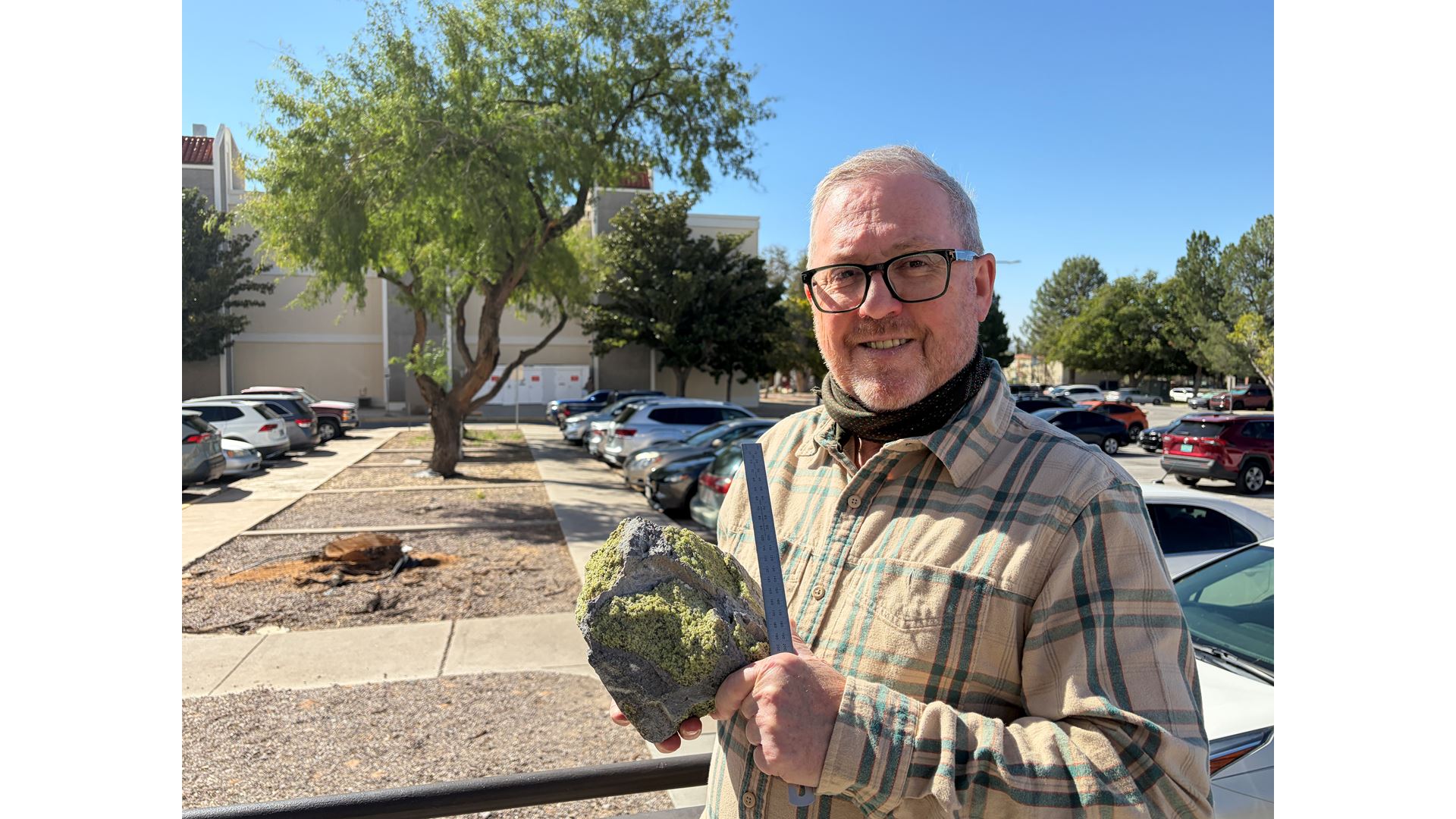
“So, pieces of rock like this come from 25, 30 kilometers depth,” Ferré explained, displaying a large, rounded rock known as a mantle xenolith. “And you may not believe this, but these rocks came up from 20 miles depth at the velocity of a galloping horse. They come up very, very fast. So, we don’t have to drill. Rocks coming from that depth carry with them all the information that was at depth. We collect samples in the field, bring the rocks back to the labs, measure their magnetic properties, thermal properties, seismic properties, everything we can, and then we build our model.”
Researchers will develop a 3D model based on all the data they gather. Ferré and his team recently submitted their first paper on the project to the journal “Geophysical Research Letters.”
In November 2026, during the second phase, the team will deploy a volunteer-based seismic array in the region, installing small seismometers in residents’ front yards. They will bury the seismometers for a month, then pick them up a month later to record the data.
“We are studying the ambient noise between two stations, Ferré said. “This is a ‘Green’s function.’ It's a mathematical function that describes body waves between two neighboring stations. And this is really the cutting edge of seismology applied to geothermal energy because you can see absolutely everything below the surface of the ground.”
The next phase of the project is a plumbing mystery for researchers to reveal.
“The third phase will focus on fluids,” Ferré said. “We need to measure temperature, and we need to measure the chemistry of the fluids to find out at what temperature the fluid interacts or mingles with the rock and at what depth.”
When most people think of geothermal energy, what comes to mind are the geysers at Yellowstone National Park. Those high temperature fluids can be captured and are used for geothermal energy across the U.S. and in other countries like Iceland and Italy. This is considered “conventional” geothermal. A new approach, referred to as “dry rock” geothermal energy, is being pioneered in Utah.
“So you go to a place that does not have fluid, that is as dry as possible, but at a certain depth, you have a hot rock so you inject water into the ground until the water meets with the hot rock, and then you pump the hot water out,” Ferré explained. “This method is absolutely amazing because it produces 10 times more energy than the conventional method.”
The goal is to generate a model that can make consistent predictions about what areas in the region can support geothermal energy. The team will also collaborate with industries in the area to look at potential internships or a pipeline to create future employment opportunities for NMSU students.
“Our approach is fundamentally different because we look at it from a de-risking viewpoint and from a science first viewpoint,” Ferré said. “Whether we find or do not find a geothermal resource is not the point. What we care about is producing good science that will pave the way for future public use.”
-30-
CUTLINE: Eric Ferré, NMSU geological sciences department head, professor and principal investigator for a $2.85 million geothermal research grant from the New Mexico Energy Conservation and Management Division, holds up a sample of a mantle xenolith. It's a piece of the Earth’s deep mantle that was ripped away by rising magma and brought to the surface during a volcanic eruption. Ferré and his team will study rocks like these and use other methods to determine the viability of geothermal energy in the area around Las Cruces. (NMSU photo by Azure Mitchell)
CUTLINE: From Left: NMSU Geology professor Frank Ramos in his lab with Eric Ferré, NMSU geological sciences department head. Ramos will be examining the age of rocks as part of the geothermal energy research under a $2.85 million grant from the New Mexico Energy Conservation and Management Division. (NMSU photo by Azure Mitchell
CUTLINE: Two samples of travertine in a lab at New Mexico State University. Scientists hunting for clean, geothermal energy find this rock important because a line of travertine rocks on the surface tells scientists exactly where the deep underground cracks are located. These cracks are the perfect spots to drill for geothermal energy. (NMSU photo by Azure Mitchell)