

New Mexico State University has long been known for advancing research that strengthens lives, fuels innovation, and aligns with New Mexico’s most pressing priorities. Three high-profile research projects currently underway at NMSU combine the reach of a land-grant university with the university’s commitment to advancing a culture of excellence in research, scholarship and creative activity.
In early 2025, the Carnegie Classification of Institutions of Higher Education announced that NMSU achieved the prestigious R1 classification due to its high research spending and doctorate production. Receiving the RI designation has already begun to expand paid research opportunities and career pathways for students, strengthen competitiveness for federal, state, and industry funding, and attract new industries, create jobs, and anchor innovation ecosystems across New Mexico. Research findings will translate to industry innovation, inform public policies and address global challenges with local implications.
Over the last eight years, NMSU has seen more than $150 million in research infrastructure investment, underscoring the health of the university’s research enterprise. Here are three examples of the impact NMSU programs are having on communities statewide:
$10 million research project delves into water management solutions
Since 1963, the New Mexico Water Resources Research Institute, based at NMSU, has conducted research to address critical water issues in the southwest, including New Mexico. A new $10 million grant will help the institute collaborate with researchers and experts across four states to find solutions to water problems driven by increased demand and a changing climate.
The grant is funded by the U.S. Department of Agriculture’s National Institute of Food and Agriculture Agricultural Food Research Initiative Strengthening Agricultural Systems program. It was awarded in January 2025, and work is well underway to provide communities with research-based tools to participate in sustainable water management as part of the Resilient Agricultural Water Community Systems project.
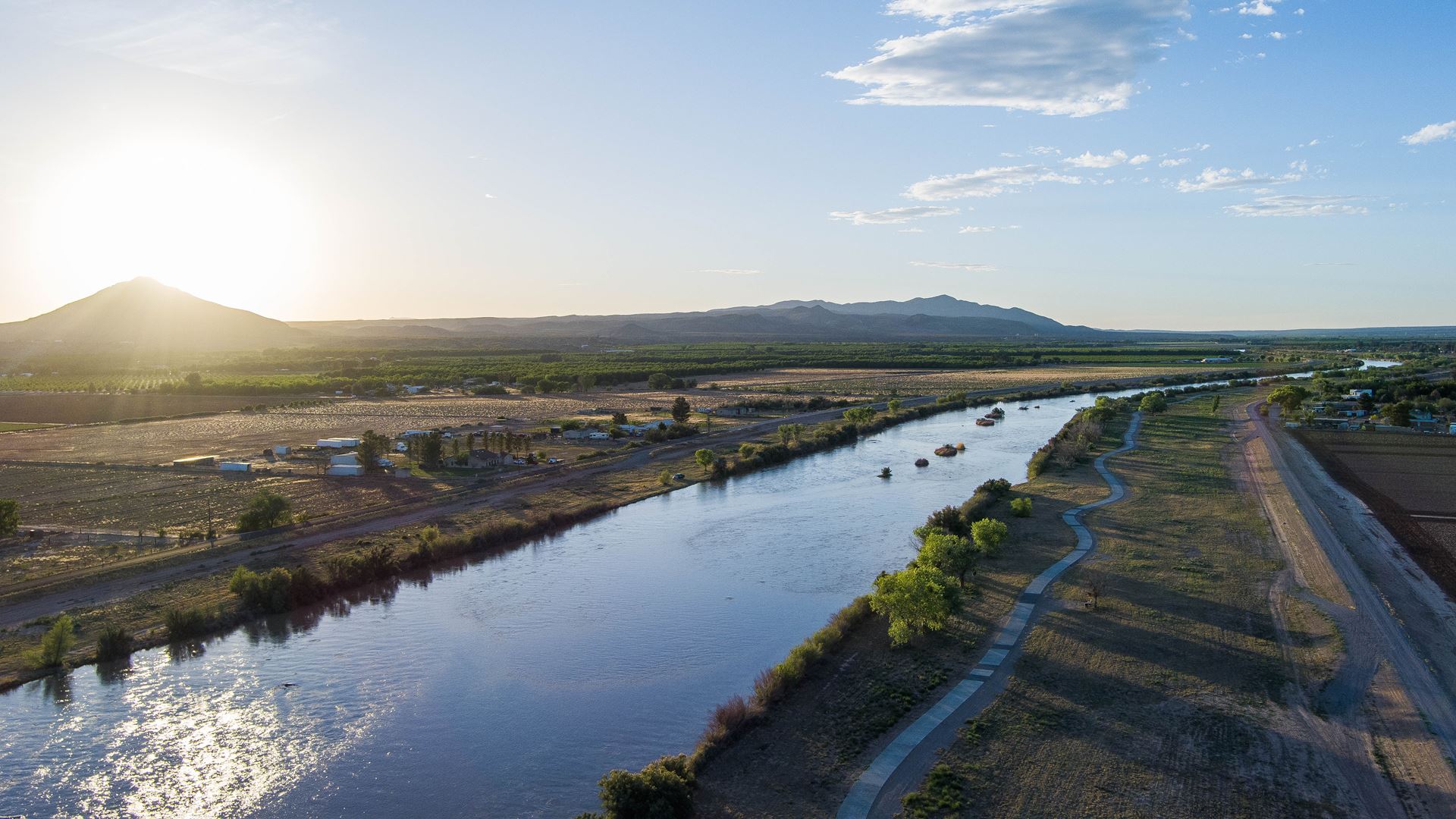
In New Mexico, the project has two focus areas: one in the lower Rio Grande area that includes Las Cruces, and another in the upper Rio Grande area of northern New Mexico.
Multiple researchers are looking at ways to grow crops with less water. For example, one aspect of the project examines whether drought-tolerant pistachios can be a profitable crop instead of pecans, while another examines whether alfalfa growth stage matters under deficient irrigation.
“These projects are looking at making agriculture more resilient and enabling it to continue to thrive in a situation where we not only have less water for crops, but as our climate gets hotter and drier, the evaporative demand also increases,” said Angus Aney, the Resilient Agricultural Water Community Systems project manager. “Research is only one part of it – we also get the research to the people doing the growing as well as the decision-making.”
Getting that information to growers and stakeholders includes hosting field day presentations and irrigation water management training. A training that took place in March drew more than 30 producers, some from as far away as northern New Mexico, Colorado and Wyoming.
“The key thing is it builds a future for agricultural communities and ecosystems,” said Sam Fernald, the grant principal investigator and director of the NM WRRI.
Over the past 40 years, Fernald said, there has been a 15% increase in evaporative demand in the atmosphere from increased temperatures. Ground water demand to grow crops has increased in that time, but management of ground and surface water has not been sufficient to increase resilience.
“This research allows us to support the agriculture and ecosystems that we want,” Fernald said. “We have an amazing part of this program which is specifically targeted at finding out what the community needs are for better water management.”
The program is also involved in helping the budding Western Water Network flourish and grow, Aney said. The network was initiated by other entities involved in multi-state Western Extension Research Activity, and the RAWCS project is working to install a delegate in each of 13 Western states who will dedicate time to help the network expand.
There are also plans to offer a Water Management Certificate program through NMSU, as a standalone certificate and as an option in the NMSU Water Science and Management Graduate Degree Program.
For more information about the Resilient Agricultural Water Community Systems program, visit https://rawcs.nmsu.edu/index.html.
Long-standing program promotes biomedical research in NM
Since 2001, the New Mexico IDeA Networks of Biomedical Research, or NM-INBRE, has acquired $87 million in funding from the National Institutes of Health. The program collaborates with 10 partner institutions across the state, and is the sister program to the National Science Foundation’s New Mexico EPSCoR program housed at the University of New Mexico.
Although NM-INBRE began as a funding mechanism to promote biomedical research in New Mexico, it has expanded to include a program focused on elevating student research, supporting faculty development and building robust research enterprises at institutions through the state.
“Even at small schools, especially in a state like ours, rural students can get a bona fide research experience in their area,” said Shelley Lusetti, director of NM-INBRE and the program’s principal investigator. “There’s a reason we have small schools all over the state, because students need to be educated where they are. We provide those services right there at their institution so they can get those skills and move on to jobs or advanced degrees in biomedical research.”
The program is designed to provide the resources students and faculty need to conduct research projects, including instruments and training. The program runs in five-year cycles, and all supported research must be biomedical in nature. Projects range from assessing novel cannabinoid derivatives in mitigating breast cancer invasiveness to the characterization of western wildfire smoke, lung toxicity and health risks.
NM-INBRE also has formal programs, including a bootcamp program to help ensure that even students with no previous research experience are prepared to thrive and an internship program at both NMSU and UNM that enriches the educational experience of 60 to 80 students each year.
“We’re continuously expanding the pool of students trained to do biomedical research coming out of New Mexico,” Lusetti said. “To date, almost 1,700 students have been through our training programs. We also tracked those students and found that 60 percent are still in the STEM (science, technology, engineering and mathematics) pipeline.”
For more information, visit https://nminbre.org/.
Carlsbad-based CEMRC provides environmental monitoring, community warnings
The Carlsbad Environmental Monitoring and Research Center in Carlsbad, New Mexico, was established in 1991 to be the environmental monitor for Carlsbad’s Waste Isolation Pilot Plant, or WIPP site, which is the only underground geological repository for the storage of radioactive waste generated by defense-related activities.
The idea for CEMRC was born out of the need to help the people of Carlsbad and the surrounding communities feel safe living in close proximity to the radioactive waste repository. Though the center is funded by the U.S. Department of Energy and is currently negotiating a contract renewal between $15 million and $20 million, CEMRC is an independent monitor and part of NMSU.
“Community leaders promised the citizens of Carlsbad and surrounding communities there will be independent environmental monitoring of the site and surrounding areas,” said Lambis Papelis, director of CEMRC. “We collect, analyze and report the data showing the level of radioactivity in WIPP exhaust air, as well as radioactivity in airborne particulates, soil, sediment, surface water, groundwater, drinking water and vegetation.”
All findings are published in the center’s annual report. In addition, anyone living within a 100-mile radius from the WIPP site can participate voluntarily in the Lie Down and Be Counted program, where people are scanned for the presence of a wide range of radioisotopes.
The center has been monitoring environmental media dating back to before WIPP accepted its first waste package in 1999.
“Given that early on, nuclear testing was conducted above ground, global fallout of radioactive material is a fact. We wanted to establish the baseline for what existed in the area before WIPP started accepting waste,” Papelis said.
Traces of radioactivity from incidents such as the 2011 nuclear accident in Fukushima, Japan, have been detected at CEMRC, contributing to the confidence that even minor quantities of radioactivity are detectable using CEMRC’s established monitoring procedures.
“Fortunately, at WIPP we do not have any high levels of radioactivity, and there’s nothing that comes even close to the level of radioactivity in a nuclear power plant,” Papelis said. “The type of radioactive materials (at WIPP) are mostly contaminated work-related things like rags and tools. The waste is considered low- or mid-level waste.”
The center is currently looking at examining the reuse of reclaimed water produced from oil drilling in the Permian Basin, another type of monitoring that would be beneficial to New Mexico.
“Southeastern New Mexico is by far the most productive oil and gas producing region in the state and has a tremendous impact on the economy of New Mexico,” Papelis said. “We’re looking at figuring out ways of using the produced water from the oil extracted, instead of pumping that water back underground and causing earthquakes.”
For more information about the center, visit https://www.cemrc.org/index.html.