

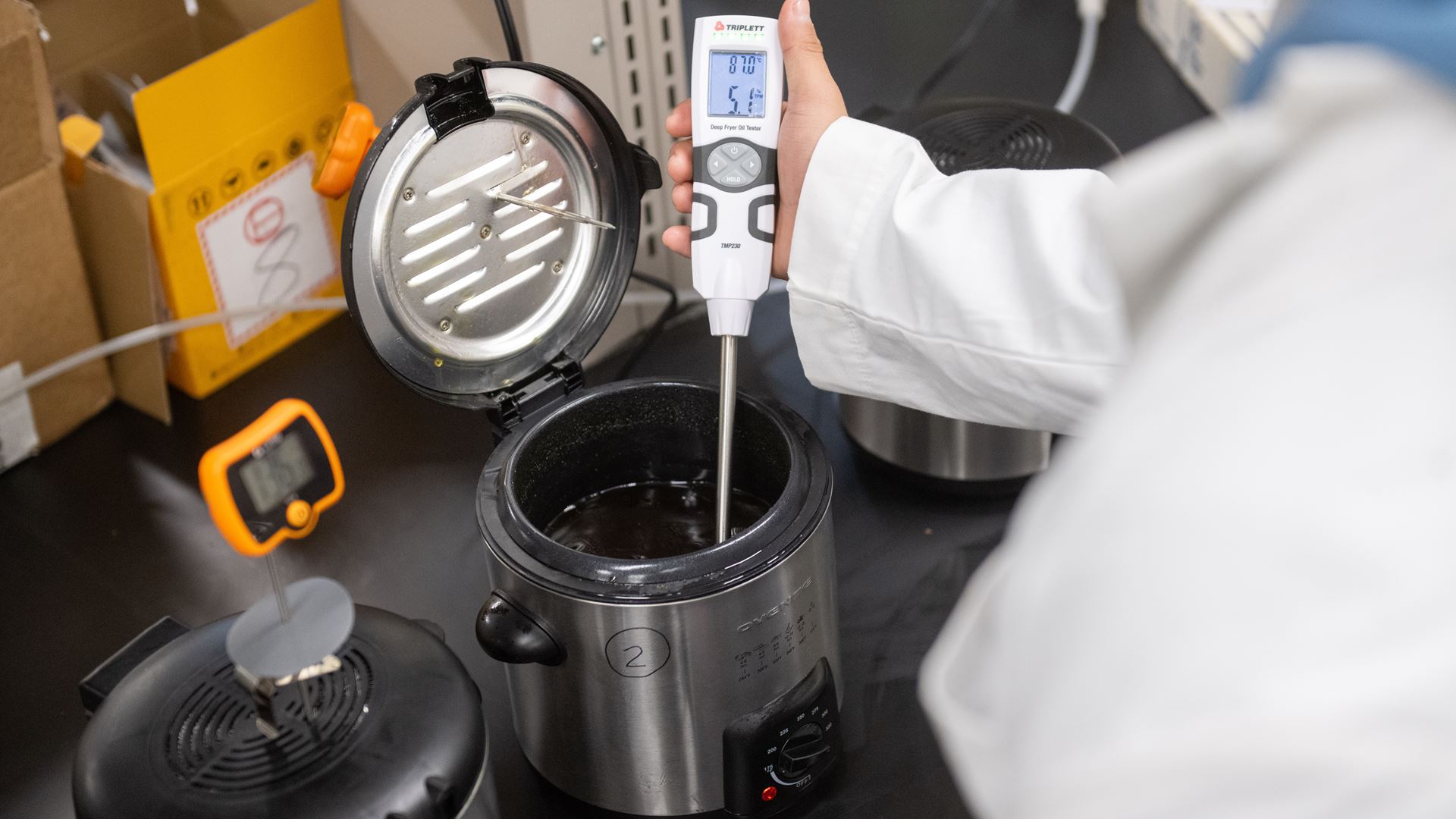
As animal fats become increasingly popular alternatives to seed oils, a research team at New Mexico State University is working to improve how beef tallow performs under the pressures of fast-food restaurants.
The project is a collaboration between Francine Mezzomo Giotto and Gonzalo Miyagusuku-Cruzado, and one of several interdisciplinary studies supported by NMSU’s Agricultural Experiment Station and Center of Excellence in Sustainable Food and Agricultural Systems.
“Beef tallow is in high demand right now,” said Mezzomo Giotto, an assistant professor of meat science. “It’s not only popular for cooking purposes, but also in the beauty industry.”
The research team attributes the rising popularity of beef tallow to the growing scrutiny of seed oils. Seed oils are vegetable oils extracted from the seeds of plants such as rapeseed, soybean, corn, grapeseed, sunflower, safflower and others. These oils are commonly used to prepare fast foods and as an ingredient in many packaged snack foods.
Seed oils are high in unsaturated fats like omega-3 and omega-6. Although considered healthier than the saturated fats found in dairy and meat products, seed oils have become maligned in recent years due to their high omega-6 content and oxidative instability, fueling a greater interest in animal fats – especially beef tallow.
Mezzomo Giotto and Miyagusuku-Cruzado, an assistant professor of food science and technology, saw an opportunity to position NMSU as a leader in beef tallow research, an area lacking in academic scholarship. Now, they are working to improve the oxidative and frying stability of beef tallow via antioxidant and surfactant combinations.
“Tallow offers superior thermal stability, reduced oxidation risk and favorable sensory attributes, making it a promising alternative for quick-service restaurants,” Gonzalo-Miyagusuku said. “Yet, research on tallow degradation during frying remains limited and often relies on advanced analytical techniques, which may be impractical for restaurants.”
He and Mezzomo Giotto launched their project earlier this year, working with an undergraduate student, Ismael Trevizo, a food science and technology major.
They first established a frying methodology in a lab on the Las Cruces campus that accurately replicates fast-food restaurant conditions, using a series of semi-industrial fryers. Next, they began testing tallow under various conditions, evaluating antioxidant and surfactant systems, with the goal of limiting oxidative and hydrolytic degradation. Since water and protein are two of the main drivers of oil degradation, their tests primarily involve frying batches of tofu or hot dog links at different temperatures and times.
“We’re frying faster, hotter and more cycles per hour,” Miyagusuku-Cruzado said, “and we’re getting the answers that we need much faster.”
He added, “We have a lot of understanding of how seed oils degrade, but tallow is a little different because of its chemical characteristics. Our research is trying to expand that understanding.”
Over the coming months, the team will pivot to explore correlations between total polar materials – a metric used to assess oil quality – color and other degradation parameters to establish practical indicators of oil quality. Based on their preliminary data, the researchers aim to target long-term funding via the U.S. Department of Agriculture’s Agriculture and Food Research Initiative.
“By the time the project concludes, we want to deliver a validated rapid frying protocol, stable tallow formulations and share our research via publications, presentations and outreach activities,” Mezzomo Giotto said. “We anticipate that our outcomes will provide economic, environmental and public health benefits, positioning NMSU as a leader in sustainable frying research and laying the foundation for future USDA funding proposals.”
A version of this story appears in the spring 2026 issue of ACES Magazine. For more stories, visit https://nmsu.news/ACES-Magazine-Spring-2026.
-30-
Cutline: Ismael Trevizo, an undergraduate student majoring in food science and technology, takes the temperature of hot beef tallow in a research lab on New Mexico State University’s Las Cruces campus. (NMSU photo by Josh Bachman)
Cutline: Left: The research team examining beef tallow degradation includes, from left, Gonzalo Miyagusuku-Cruzado, Ismael Trevizo and Francine Mezzomo Giotto. (NMSU photo by Josh Bachman)