

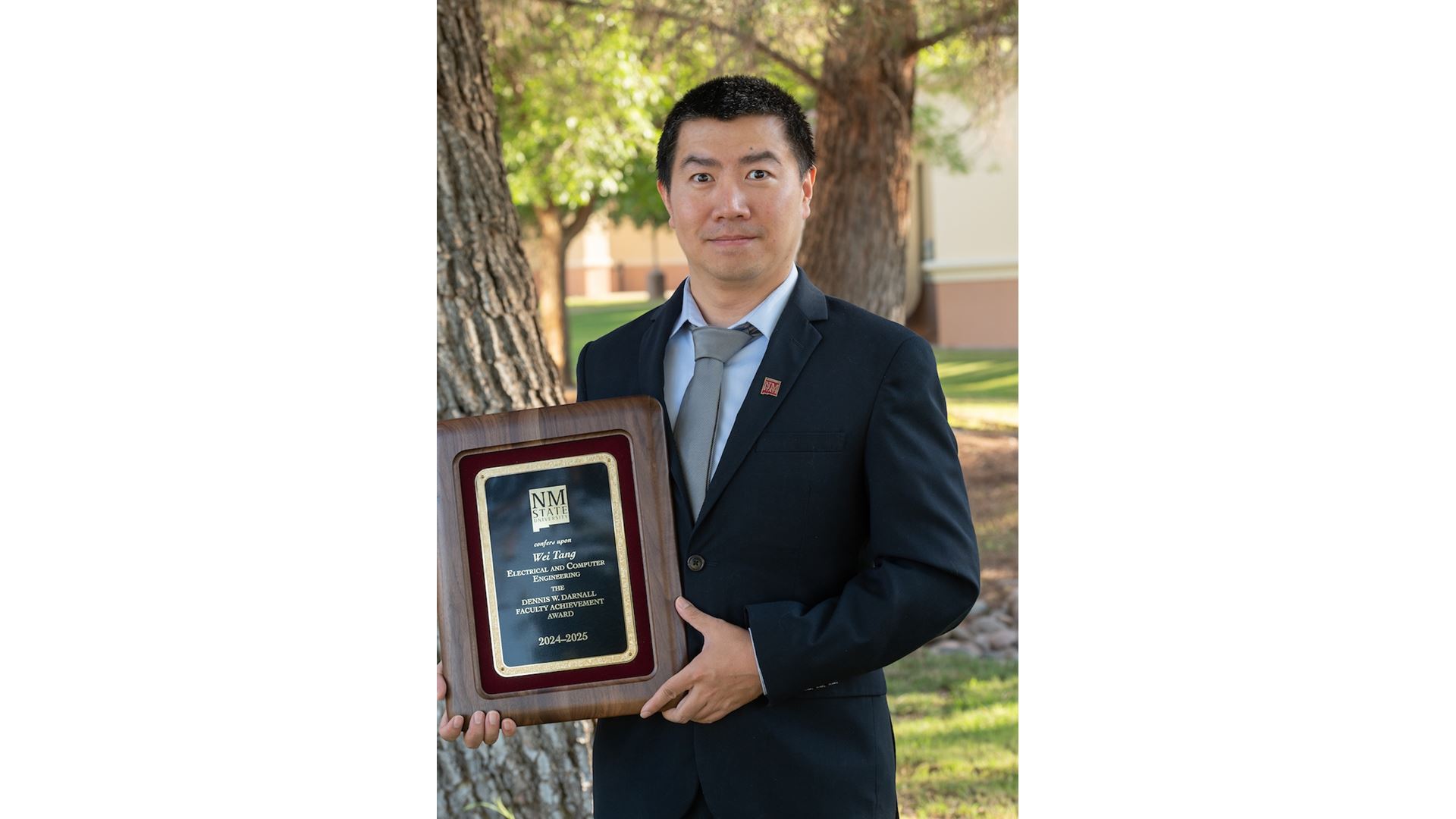
PHOTO CAPTION: New Mexico State University engineering professor Wei Tang, who received the Dennis W. Darnall Faculty Achievement Award in 2024, is leading a research team focusing on wearable sensors for people with neurological motor disorders. The team recently received a $1 million grant from the National Science Foundation. (NMSU photo by Josh Bachman)
A New Mexico State University engineering professor is leading a multi-university research team to help advance the rehabilitation of people with neurological motor disorders.
Wei Tang, NMSU Paul W. and Valerie Klipsch Distinguished Professor in the Klipsch School of Electrical and Computer Engineering, and his research team recently received a four-year, $1 million grant from the National Science Foundation’s Smart and Connected Health program, which involves researchers from NMSU, the University of Texas at El Paso and the University of Tennessee at Chattanooga. The team will focus on people with traumatic brain injury and autism spectrum disorder, both of which can affect movement, balance and coordination. Tang is the project’s lead principal investigator.
The project will develop wearable sensing and artificial intelligence technologies to monitor rehabilitation, which can continue for months or years. Commonly, recovery is evaluated only during occasional clinic visits, making it difficult for medical staff to understand how patients function during daily activities.
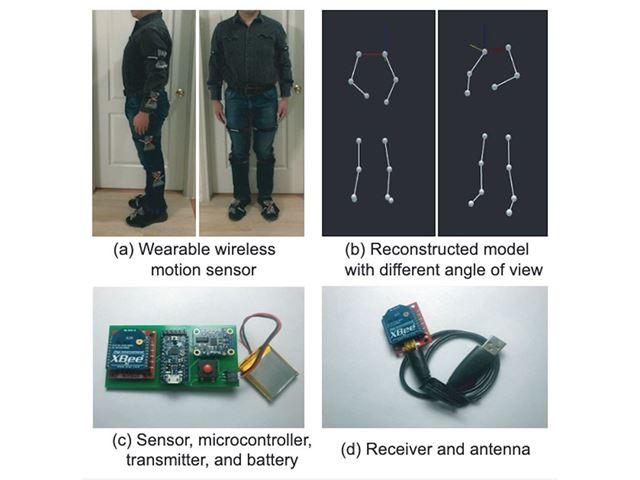
PHOTO CAPTION: The fully wireless wearable motion sensors and the real-time reconstructed 3D human model development taking place in New Mexico State University engineering professor Wei Tang’s lab on the main campus. Tang is leading a research team focusing on wearable sensors for people with neurological motor disorders. (Courtesy photo)
“Most rehabilitation assessments give clinicians a snapshot of a patient’s condition during a clinic visit,” Tang said. “Our goal is to use wearable sensors and artificial intelligence to provide objective information about how an individual moves and functions over time and outside the clinic.”
Researchers will investigate multimodal wearable sensors that collect information about body movement, pressure distribution, muscle activity and other physiological signals. Machine-learning methods will analyze data to identify movement patters associated with neurological motor disorders and develop quantitative biomarkers that can be used to evaluate progress.
Tang said a key aspect of the team’s research is patient-specific artificial intelligence. Rather than evaluating each patient against the population average, the team will develop models that combine reference data with measurements collected from a patient over time. The studies will compare people with traumatic brain injury and autism spectrum disorder using the wearable sensors to patients with established clinical evaluations.
“Every patient is different, even when the diagnosis is the same,” Tang said. “We want to develop technologies that complement the expertise of physicians and physical therapists by giving them additional quantitative and individualized information about a patient’s recovery.”
The project builds on Tang’s previous research on low-power biomedical sensors, wearable motion sensing and machine-learning-enabled sensing systems. Tang will lead NMSU’s development of energy-efficient wearable sensor hardware and its integration with machine-learning technologies. Mark Lawrence, an associate professor in engineering with more than 30 years of industrial experience in information and communication technologies, will help develop hardware prototypes and system implementation, as well as educational outreach.
At UTEP, principal investigator Jeffrey Eggleston, associate kinesiology professor, and Michelle Gutierrez, clinical associate professor of physical therapy and movement sciences, will lead clinical data collection and studies of gait-based biomarkers. At UTC, principal investigator Ziwei Ma, an assistant professor of statistics who earned his Ph.D. in mathematics from NMSU, will lead the development of machine-learning algorithms and high-dimensional time-series data analysis.
The project will also provide interdisciplinary research opportunities for undergraduate and graduate students, and engage high school students through STEM outreach activities, including NMSU’s Pre-Freshman Engineering Program. Ultimately, researchers said they hope their work will provide a foundation for smart and connected health technologies that make rehabilitation assessment more continuous, individualized and accessible outside traditional clinical settings.