

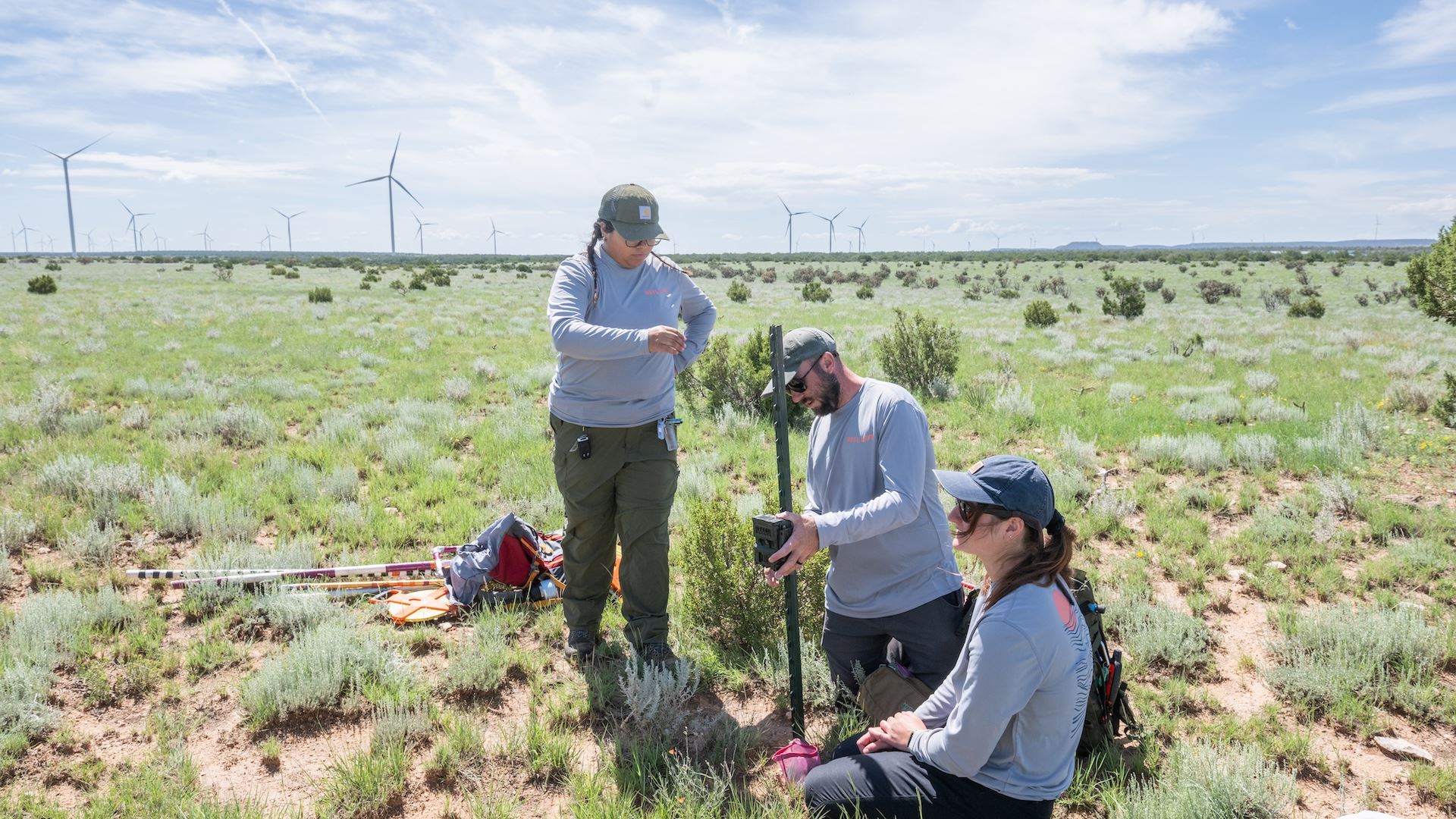
Home to Pattern Energy’s Western Spirit Wind, the largest single-phase renewable energy build-out in the Western Hemisphere, central New Mexico has quickly become a hub for wind energy development.
Wind farms like Western Spirit Wind – a portion of which sits on New Mexico State University’s Corona Range and Livestock Research Center – consist of dozens, if not hundreds, of towering wind turbines.
However, little is known about the effects of turbines on wildlife, particularly mammals living on the ground. Conversely, scientists around the world have extensively studied turbines and their effects on birds and other flying animals.
A project led by two researchers in the College of Agricultural, Consumer and Environmental Sciences and funded by the Bureau of Land Management aims to shed some light on how turbines can potentially change the habits of ground-dwelling mammals, either positively or negatively. The study has been underway at the CRLRC since 2023.
“There has been a massive proliferation of wind turbines that have very much altered the landscape out there,” said Jennifer Frey, a co-principal investigator on the project and professor in the Department of Fish, Wildlife and Conservation Ecology. “Science has already established that wind turbines can be a problem for animals that fly because they have collisions or are impacted by the propellers. What we don’t know is whether or not the wind infrastructure has an impact on wildlife living on the ground.”
Frey is collaborating on the project with Theresa Laverty, an assistant professor in the Department of Fish, Wildlife and Conservation Ecology, and three students: Iona Rohan, Matthew Becker and Gabrielle Gayton. To understand how ground animals are affected by the turbines, the researchers have set up dozens of remotely triggered cameras across the wind farm.
“Some of the species we’re focusing on are game species, since the Bureau of Land Management wants to know about impacts on species that are economically important to the state,” said Laverty, a co-principal investigator on the project. “By using cameras, we’re able to look at a wide variety of species and how they are all being affected, or maybe not being affected.”
The research team initially set up about 70 cameras equipped with infrared sensors that can detect and photograph moving wildlife. In 2025, the team placed an additional 20 cameras on public and private lands. Rohan worked with private landowners to get permission to install cameras on their land.
“We’re trying to determine what kind of behaviors we can categorize from the photos, whether the animals are foraging, being vigilant, moving quickly, or if they’re bedded down and relaxed,” said Rohan, a graduate student studying wildlife science.
“It’s important to look at ground-dwelling animals because the turbines are very large structures on the landscape that might affect their movement,” she added. “While ungulates, or hooved animals, in the northern United States are migratory, here ungulates are not, so they may experience different effects based on the turbines being on their home range year-round.”
Becker, another graduate student studying wildlife science, began working on the project this summer. He said the team is also looking for avoidance behaviors and working to understand if those behaviors are related to the turbines’ proximity and density.
“When I first came out here, I was really struck by seeing the wind turbines and getting a feel of their magnitude,” Becker said. “If wind energy is part of the future, it’s important to understand how the overall environment is impacted.”
According to Frey, past research found species like pronghorn and mule deer have negatively reacted to the presence of humans, roads and oil development in other areas, all of which have been a concern to the Bureau of Land Management.
“They’re mandated to manage livestock grazing and wildlife, and make sure there’s healthy and vibrant populations of wildlife,” Frey said. “We want to understand the specifics of how wildlife species are reacting to the wind turbines. Wildlife might change the habitats that they’re using, they might change where they occur as a reaction to the wind turbines, or they might alter their behavior and suddenly become more active at different times of the day. This kind of information can help with the planning of how wind facilities are built in the future.”
The project will continue through summer 2027.
A version of this story appears in the fall 2025 issue of ACES Magazine. For more stories, visit https://nmsu.news/aces-magazine-2025.
Photo 1 cutline: From left, Gabriella Gaytan, Matt Becker and Iona Rohan assemble a camera as part of a research project to track ground animals at the Corona Range and Livestock Research Center. (NMSU photo by Josh Bachman)
Photo 2 cutline: Gabrielle Gaytan, left, is an undergraduate student studying fish, wildlife and conversation ecology. Matthew Becker, center, and Iona Rohan, right, are both pursuing master’s degrees in wildlife science. (NMSU photo by Josh Bachman)
Photo 3 cutline: Still image of wildlife roaming across the Corona Range and Livestock Research Center. Jennifer Frey and Theresa Laverty are leading a research project to understand how ground animals are affected by wind turbines at the center. (Courtesy photo)