

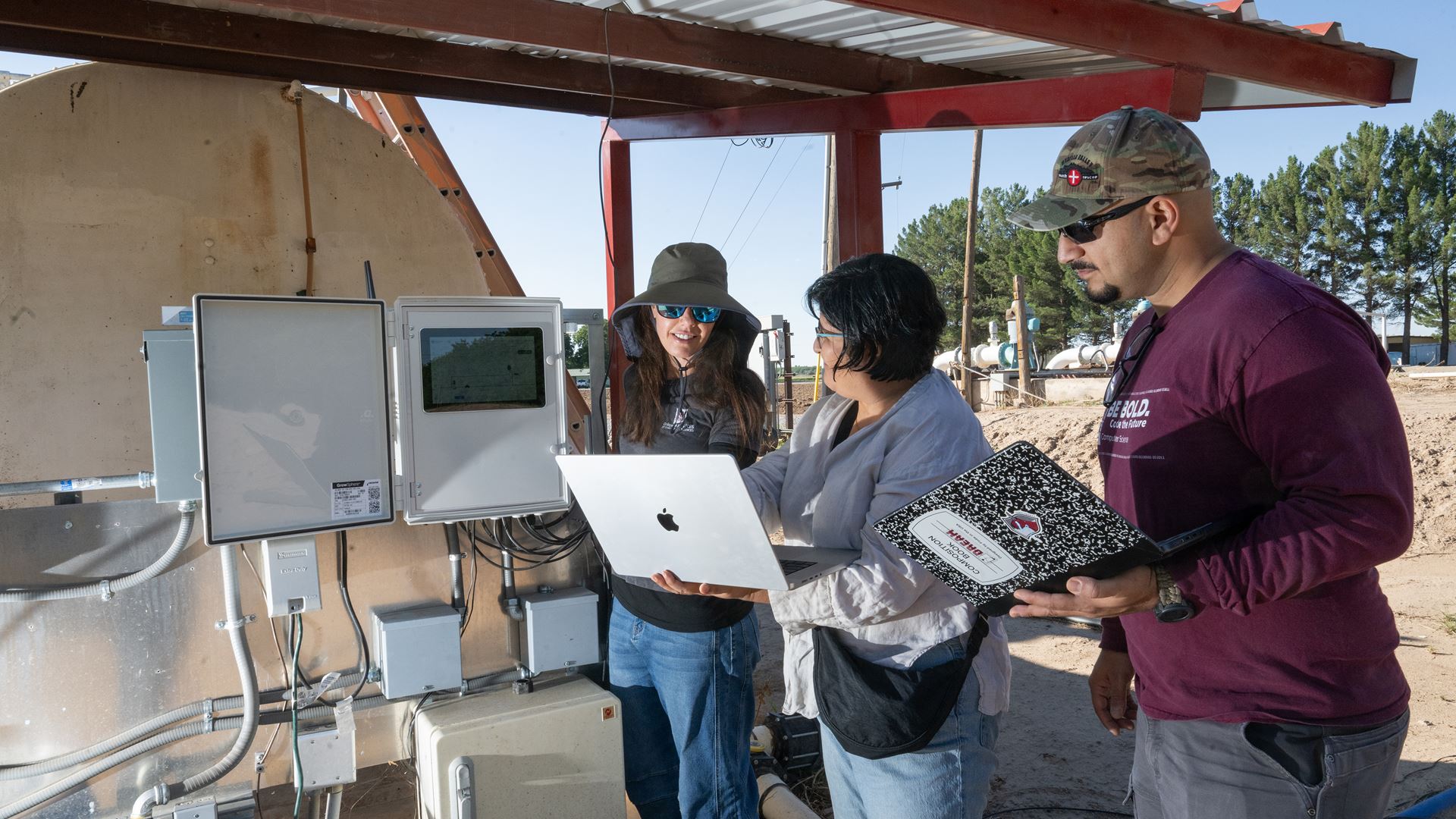
Israel Joukhadar has dedicated much of her career at New Mexico State University to leading research that seeks to answer existential questions like “How do we grow more with less water?” and “How can we adapt to warmer temperatures?”
“The theme of my work is centered on actionable science for growers,” said Joukhadar, an assistant professor in NMSU’s Department of Plant and Environmental Sciences who studies areas like water-smart agriculture, agrivoltaics and greenhouse systems. “By testing solutions through rigorous, logical trials, my goal is to deliver clear, practical results that directly enhance productivity and profitability.”
In one of her latest projects, Joukhadar is working with an interdisciplinary research team to test artificial intelligence in a study of irrigation scheduling methods.
In arid regions like the Southwest, where water supplies are becoming scarce, highly efficient irrigation scheduling strategies can help crop growers optimize their water use, Joukhadar said. Moreover, access to research-based irrigation scheduling methods would equip growers with the information they need to make precise decisions, she added.
But could an AI-powered irrigation scheduling method be more efficient than traditional methods? That’s the question Joukhadar and her team are trying to answer.
“AI is reshaping agriculture on all fronts,” she said, “and in this study, we want to see if AI has any advantages when it is integrated into irrigation scheduling.”
For the project, Computer Science faculty member Christabel Wayllace and her student Sarah Thomas developed an AI agent-based smart-irrigation methodology that uses reinforcement learning with-in a simulation environment that incorporates real-time volumetric soil moisture and meteorological data. Reinforcement learning is a branch of AI in which an agent learns to make decisions by taking actions in an environment to maximize cumulative reward.
Computer Science faculty member Gaurav Panwar, meanwhile, led the project’s privacy and security efforts, focusing on protecting users’ data and privacy by incorporating privacy-preserving machine learning frameworks and implementing cybersecurity best practices for data collection and processing systems.
The team is testing the AI system against three other irrigation scheduling methods at NMSU’s Leyendecker Plant Science Research Center. The other methods include a soil sensor-based system that uses volumetric soil moisture, soil water potential and meteorological data; a commercial scheduling platform that uses real-time meteorological data; and the feel-and-appearance method, which uses human-based hand soil moisture measurements.
“The goal of this study is to evaluate different irrigation scheduling methodologies,” Joukhadar said. “The specific objective is to quantify the impact of these four irrigation scheduling methods on the water use efficiency, physiological and vegetative biomass response of winter wheat cultivated as a cover crop.”
Joukhadar and the team conducted the study’s first trial with winter wheat over the fall 2025 semester. For each irrigation method, the team measured applied water, water use efficiency, chlorophyll content, stomatal conductance, normalized different vegetation index, plant and root growth, and yield.
Preliminary observational results showed that physiological and growth indicators remained relatively uniform across all methods during the early establishment phase. However, each method applied different total irrigation volumes. The soil sensor-based system was the most water-efficient, while the commercial scheduling platform was the least efficient. The AI system, meanwhile, fell somewhere in between.
“As this research is currently ongoing, yield will be harvested and response variables quantified to identify the method that achieves target biomass with the lowest water input,” Joukhadar said. “Results will provide essential guidance for regional resource conservation in arid regions.”
The researchers attempted a second trial with chile peppers over the spring 2026 semester, but soil conditions and unseasonable weather hampered their efforts. Still, the team began conducting another trial with winter wheat this fall and plans to continue collecting data through 2027.
Although it’s too soon to reach a definitive conclusion about AI and irrigation scheduling methods, Joukhadar is all but certain that such systems will play a role in agriculture in the not-too-distant future.
“This technology is here, and it promises a lot of benefits, but we want to make sure it can work for growers,” she said.
-30-
Cutline: From left, Gaurav Panwar, Christabel Wayllace, Israel Joukhadar and Isaac Medrano. The researchers are in their second year of a project testing irrigation scheduling methods, including one built with artificial intelligence. (NMSU photo by Josh Bachman)
From left, Israel Joukhadar, Christabel Wayllace and Gaurav Panwar discuss an artificial intelligence-based smart-irrigation methodology developed by NMSU graduate student Sarah Thomas. They are testing the AI system against three other irrigation scheduling methods. (NMSU photo by Josh Bachman)