

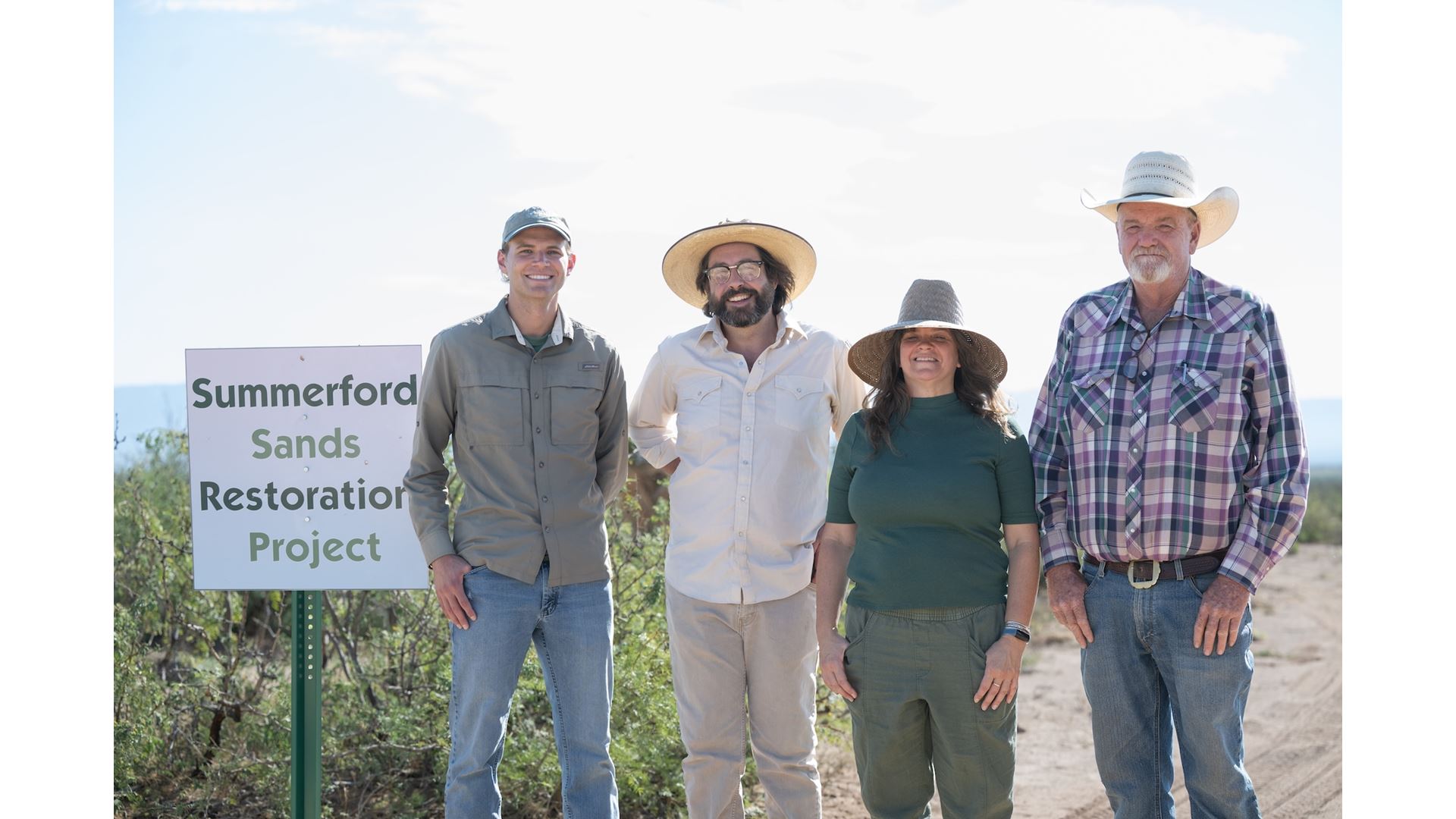
PHOTO CUTLINE: New Mexico State University’s Chihuahuan Desert Rangeland Research Center will host its annual field day Nov. 13. Among the projects to be highlighted is ongoing research on rangeland restoration at Summerford Sands. Those involved in the project are, from left, Greg Cooper, Conrad Nelson, Sheri Spiegal and Andrew Cox. (NMSU photo by Josh Bachman) DESCRIPTION: Three men and a woman standing by an outdoor sign that reads, “Summerford Sands Restoration Project.”
At first glance, the desert expanses in New Mexico may seem dry, barren, harsh and beautiful. But that wasn’t always the case.
Over the past 150 years, rangelands in the Southwest have experienced dramatic changes in vegetation. A research project based at New Mexico State University’s Chihuahuan Desert Rangeland Research Center is exploring ways to restore rangelands to what they once were: expanses of perennial grasslands.
The project will be one of four presented at this year’s CDRRC field day, which takes place from 8 a.m. to noon Nov. 13 at the center, located at 9912 County Road E079 in Las Cruces. The event is free and open to the public.
NMSU researchers are collaborating with the U.S. Department of Agriculture to find ways to promote the growth of native perennial grasses in hopes of not only providing more forage for cattle and wildlife but also keeping soil in place and preventing erosion and dust. Research on rangeland management dates to 1908, when E.O. Wooton, who engineered the establishment of the Jornada Experimental Range, published a report known as the “The Range Problem in New Mexico.”
“There was an issue with overgrazing even then, along with some changes in climate and the obvious need for management. Research and working with ranchers to figure out how to properly raise and manage cattle in the Southwest became a priority,” said Conrad Nelson, research site manager for the Jornada Basin Long Term Ecological Research site. “We’re continuing those efforts and trying to refine and answer those questions.”
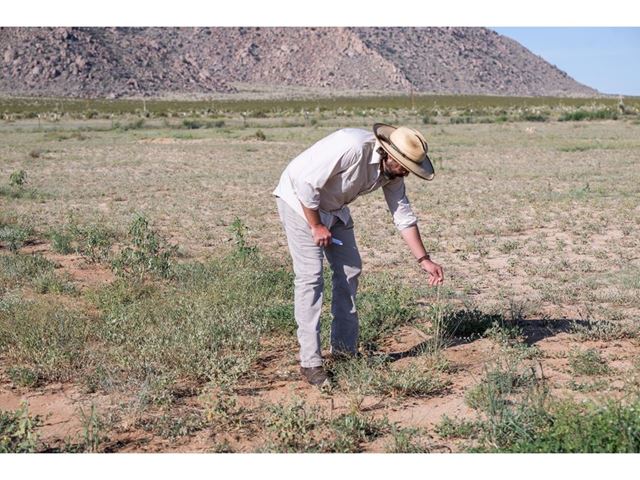
Conrad Nelson, research site manager for the Jornada Basin Long Term Ecological Research site, points out the perennial grass growing at New Mexico State University’s Chihuahuan Desert Rangeland Research Center. The center will host a field day Nov. 13 to highlight the center’s ongoing research projects. (NMSU photo by Josh Bachman)
Sheri Spiegal, the rangeland management specialist for the USDA Agricultural Research Service’s Jornada Experimental Range, said that the late 1800s to early 1900s saw an influx of cattle, major drought and cold snaps, which created a shift from grass to the shrubbery that now exists, including mesquite and creosote.
“We seek to restore more of the perennial grasses for a range of functions, not just for cattle,” Spiegal said. “We’re super lucky that we have monitoring plots and data that tell a picture of what this place used to look like, and we’ve been able to see that change over time.”
Spiegal said that since about 40% of the world also consists of arid regions, the research could have a global impact on how findings are applied.
“Rangeland restoration could potentially create more perennial grasses, better overall rangeland health and a more robust ecosystem,” said Andrew Cox, research coordinator at the CDRRC. “Ideally, applied rangeland restoration techniques, in conjunction with grazing management, will provide better water efficiency, an increase in forage production and ultimately more food production through an increase in grazeable land.”
The project is taking place at the CDRRC’s Summerford Sands site, which consists of several plots overseen by Greg Cooper, an NMSU Ph.D. student and research scientist at the Jornada LTER. The researchers are using two techniques: soil imprinting and nutrient input using composted dairy manure collected from dairy producers in Doña Ana County. They applied compost in combination with soil imprinting, and initial findings indicate most success in grass restoration in the composted treatments versus plots that were seeded without the compost.
“When we implemented this last summer, this landscape looked totally different,” Cooper said. “There was nothing on the ground. The only thing we had were the shrubs. So, when we came out here, we took pieces of the puzzle from previous and ongoing research going on at the CDRRC and the LTER, and we wanted to combine different restoration techniques.”
While the perennial grass growth remains limited so far, researchers hope their preliminary findings will lead to more widespread growth in the near future.
“There’s a lot of limitations to seeding projects out here in the desert,” Cooper said. “Seeds can be taken away by rodents, ants and wind, so we’re really happy that we are seeing a bunch of seedlings come up.”
Other research projects to be presented at the field day include what seed dispersal through space and time can teach us, distribution and herbivory of oryx at the CDRRC, and assessing bat activity and movement before and after small-scale solar development in the Chihuahuan Desert.
For more information about the CDRRC and this year’s field day, visit https://chihuahuansc.nmsu.edu/.
A version of this story first appeared in the fall 2026 issue of ACES Magazine. To read more, visit https://aces-about.nmsu.edu/resources/magazine.html.