

WRITER: Allison Brady, engr_media@nmsu.edu
New Mexico State University’s Atomic Aggies saw a successful launch at the 2026 International Rocket Engineering Competition, the largest international rocketry competition in the world.
Every year, colleges from across the globe send their rocketry teams to compete in the event hosted by the Experimental Sounding Rocket Association. This year, more than 100 teams traveled to Saragosa, Texas from over 15 countries including Brazil, India, Italy and others to launch the rockets they worked on.
“It means a lot to be able to compete on such a global stage,” said Justin Bonds, NMSU aerospace engineering student and project manager for the Atomic Aggies. “We get to see how our designs work and get the opportunity to meet and learn from teams from around the world. It was also extremely meaningful as we launched the first two-stage rocket the team has ever built.”
This event marked the Atomic Aggies’ first successful launch at ESRA’s competition in two years. Previous NMSU teams won the Chile Cup twice when IREC was branded as the Spaceport America Cup and hosted in New Mexico. For this year’s competition, the team constructed an 18-foot rocket, the Crimson Comet II.
The Atomic Aggies spent a year designing and building the rocket. Every aspect of the rocket, except the motors, was designed by the team, from concept to creating all the parts in-house.
“The team builds the airframe completely custom out of fiberglass and carbon fiber,” Bonds said. “The avionics team has been developing custom flight computers to measure the rocket’s performance in flight and send that data to the ground.”
Not only was the Crimson Comet II the largest rocket the Atomic Aggies have ever created, but it was one of the largest rockets in the competition. It was also the team’s first two-stage rocket, one of only six at the competition. This meant the rocket had to successfully ignite twice: once on the ground and once while it was in the sky.
Building the rocket gave team members the chance to apply what they have been learning in their engineering class to something in real life. Felicity Melendrez, the media manager for the Atomic Aggies, said she was able to take knowledge she acquired from her classes and directly apply it to her work on the rocket.
“It was super awesome to apply what I had learned in some of my classes into how I could play a part into the rocket,” Melendrez said. “For instance, my Engineering 110 class, which is Introduction to Solid Works, helped me to practice and get experience in while seeing how it is used to help develop some parts of the rocket.”
Once the team arrived at the competition and went through the proper safety evaluations, the rocket was ready for takeoff. The Crimson Comet II took to the sky, marking a successful launch.
“I had worked hard, and everybody else around me had worked so hard and put so much effort and time into this rocket,” Melendez said. “That moment when it went up, every instance of stress we had came off me. It was beautiful, I think I started crying.”
NMSU’s Department of Mechanical and Aerospace Engineering is home to Atomic Aggies, and many other engineering-focused groups like the American Society of Mechanical Engineers and American Institute of Aeronautics and Astronautics, to name a few. Learn more about the program at mae.nmsu.edu.
-30-
CUTLINE: New Mexico State University’s Atomics Aggies had a successful launch in the 2026 International Rocket Engineering Competition, which is hosted by the Experimental Sounding Rocket Association. More than 100 teams from across the globe come together to test their rockets against one another. (Courtesy photo)
Description: The team stands together in two rows. The members in the top hold up the rocket the team designed, the Crimson Comet II, and the members on the bottom hold up a banner that reads, “NM STATE ATOMIC AGGIES.”
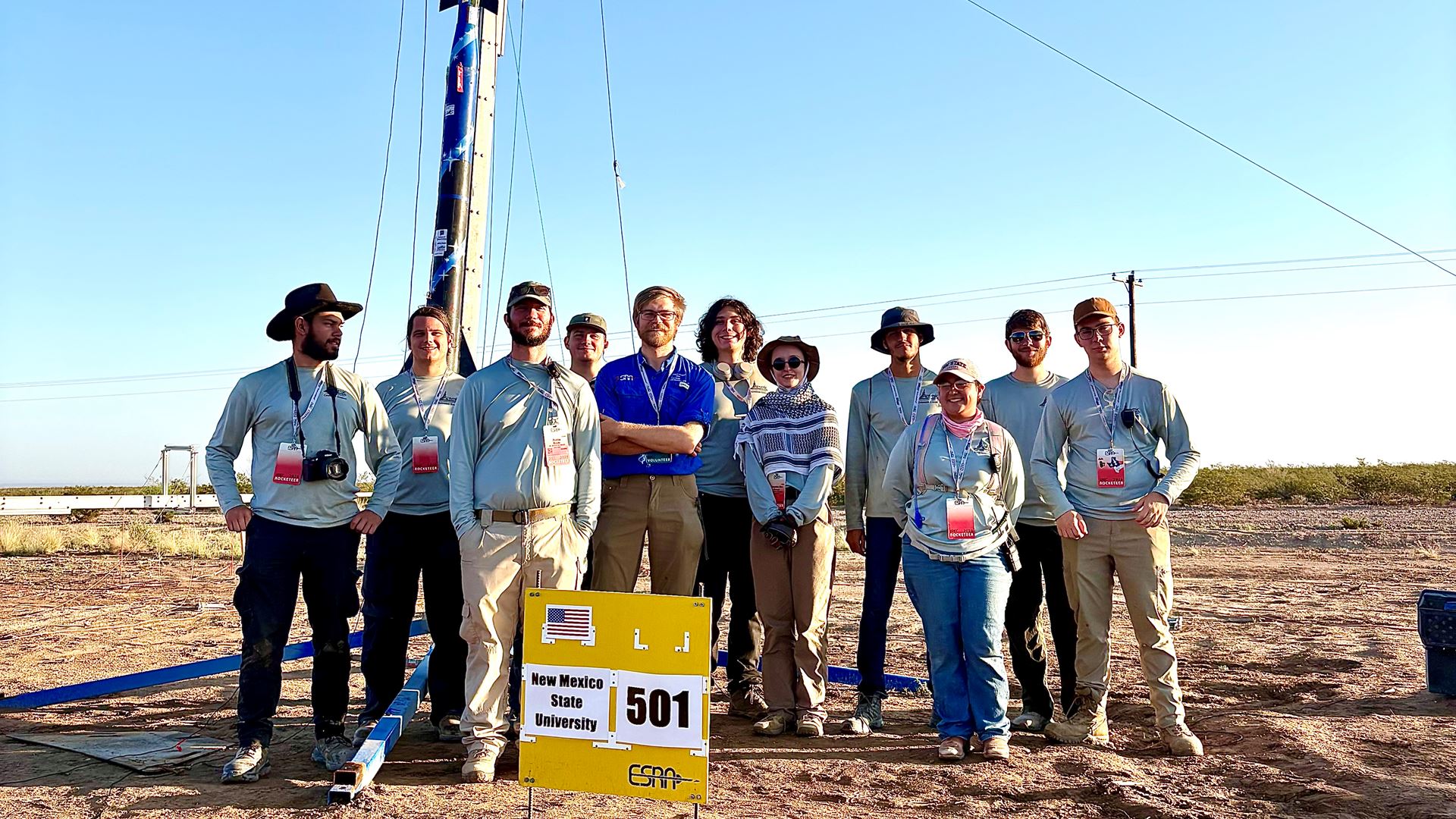
CUTINE: The New Mexico State University Atomic Aggies stand with Experimental Sounding Rocket Association second stage lead Adam Knippa, who worked to safety-check their rocket, the Crimson Comet II. The competition took place in Saragosa, Texas. (NMSU photo)
Description: The team stands with their safety check lead in front of the rocket they built.
CUTLINE: Members of New Mexico State University’s Atomic Aggies hold up their 18-foot rocket, the Crimson Comet II. The team participate in the International Rocket Engineering Competition. (NMSU photo)
Description: The team stands in a line holding the 18-foot rocket they built. Under the rocket, some members are also holding a banner that reads, “NM STATE ATOMIC AGGIES.”