

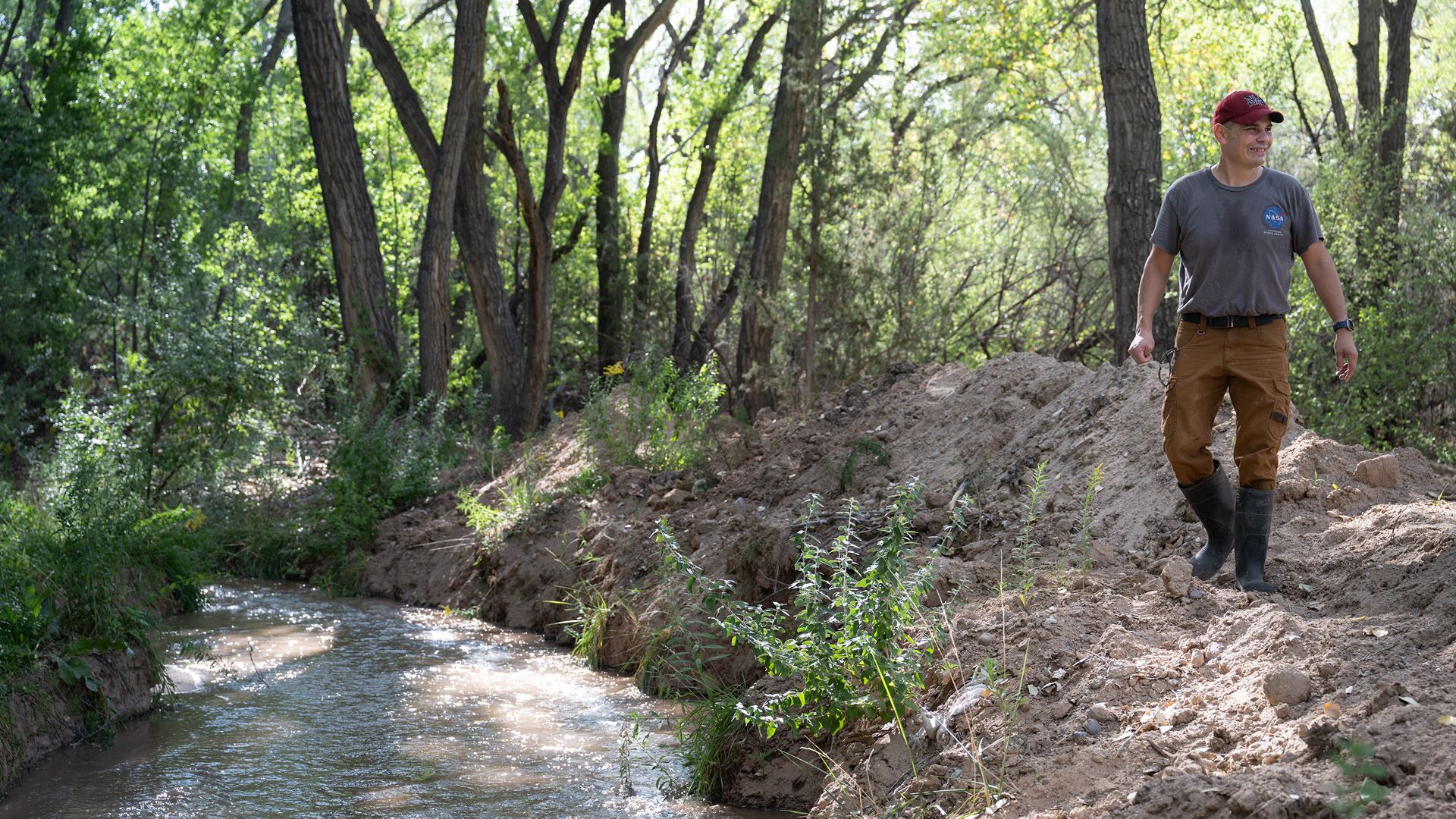
Jacob Torres stands on the edge of a tree-covered acequia in Española, New Mexico, as water from Santa Cruz Dam fills the earthen canal below. Under an August morning sun, he spends several minutes raking stubborn debris from the centuries-old irrigation system before releasing a precious resource that will soon flow through his hometown.
Torres, a 2014 NMSU graduate and current Ph.D. student in New Mexico State University’s College of Agricultural, Consumer and Environmental Sciences, is no stranger to solving problems. Before returning to New Mexico, he was a NASA scientist who helped develop the experiment that grew the first fruit – New Mexico chile – in microgravity in 2021. But no matter the issue – whether it’s managing a historic acequia network or growing crops in a controlled environment with or without gravity – Torres relies on his education from NMSU.
“When you get hired to do something, usually it’s in a system that’s already existing, and you don’t get training on how to use it. You just get thrown in there and have to figure it out,” he said. “The playbook I learned at NMSU is to: One, get the system running; two, make an assessment of that system; and three, drive improvements based on that assessment. My education is key to everything.”
In a similar way, Torres was unexpectedly thrust into his role as a mayordomo – a community member elected to keep the acequias in working order. Those entrusted to this role also maintain the desagüe – the acequias’ ability to move flood waters away from homes and properties – and ensure that water-rights holders receive their share of water released from the dam.
Torres said he initially felt ill-prepared to take charge of the acequias, which this small community has depended on since the 17th century. But he did what he was taught to do: He learned the system, assessed it and made improvements – and he quickly grew into the role once held by his great-great-grandfather, Policarpio Valencia, 100 years ago.
Now accustomed to the role and responsibilities, Torres said one of his goals is to modernize the acequia for future generations. He’s working with Atinderpal Singh, an assistant professor and Extension water management specialist at NMSU, on a proposal to get funding to automate the gate at the dam, or presa, of the acequia system.
“This will give me more control over the amount of water entering the system, which means I can address excess flooding more quickly,” Torres said. “It can literally save tens of thousands of gallons a year.”
When he is not tending to the acequias, Torres is a saffron farmer and full-time Ph.D. student in NMSU’s Department of Plant and Environmental Sciences. NMSU’s Center of Excellence in Sustainable Food and Agricultural Systems is funding his Ph.D., and he works closely with the Sustainable Agriculture Science Center at Alcalde on research related to growing chile in a controlled environment, an area that ties back to his days at NASA.
Indeed, when he applied to the Ph.D. program, he wrote an essay about his long-held dream to return to NMSU to carry on the work of scientists like Roy Nakayama, Frank Mata and Paul Bosland, who led decades of groundbreaking research on chile peppers, some of which factored into the NASA effort to grow chile in space.
“I’m living my dream,” Torres said. “I just harvested my first round of ‘Española Improved’ green chile that I grew in the same field that this cultivar was derived from 40 years ago. That means the world to me. It’s never lost on me how cool it is that I get to do this.”
-30-
Cutline: New Mexico State University’s Ph.D. student Jacob Torres walks along an acequia in Española, New Mexico. (NMSU photo by Josh Bachman)
Cutline: New Mexico State University’s Ph.D. student Jacob Torres rakes debris near an acequia in Española, New Mexico. (NMSU photo by Josh Bachman)
Cutline: New Mexico State University’s Ph.D. student Jacob Torres discusses the acequia system in Española, New Mexico, with Ann Martinez. (NMSU photo by Josh Bachman)