

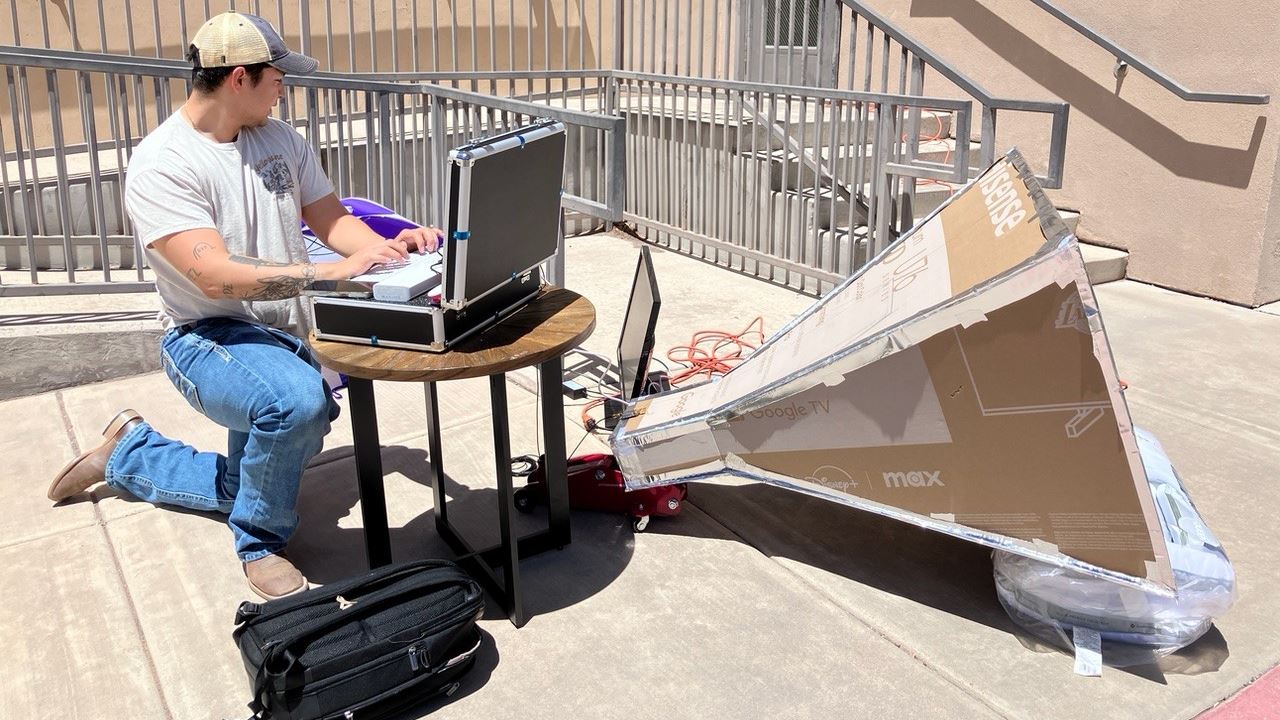
Saul Hernandez, a New Mexico State University senior studying physics and linguistics with a minor in astronomy, has turned recycled materials into a backyard radio telescope capable of detecting the rotation of the Milky Way.
“This is just something under 200 dollars, using average materials that anyone would find around their homes, and it’s taking data from the galaxy,” Hernandez said. “It shows that anyone can do it, and that’s really exciting.”
When Hernandez realized he was interested in pursuing a minor in astronomy, he approached Moire Prescott, NMSU astronomy associate professor, to ask if she had a research project he could join. She introduced him to the idea of a recycled, do-it-yourself radio telescope developed by the Completely Hackable Amateur Radio Telescope (CHART) team at Winona State University and Arizona State University, and together they began mapping out a construction plan.
“I love the connection between the sublime and the trivial in one project,” Prescott said. “It is so empowering to think that you could actually detect our galaxy just with a couple of things you have around the house and a few well-chosen components.”
Radio telescopes are not the kind of telescope you look through with your eyes. Instead, they collect radio waves emitted by the gas in our galaxy and redirect them to an antenna that processes those signals into data. Radio waves have long wavelengths, allowing them to travel uninterrupted through the galaxy and Earth’s atmosphere, with some eventually ending up at their homemade radio telescope.
Hernandez, having just bought a new TV, used the sturdy cardboard box to build the main structure of the telescope. He lined the inside with aluminum foil to help bounce the incoming radio waves toward the antenna, which is made from a tuna can lid, copper wire and a connector. From there, the antenna transmits the radio waves to a laptop. Even this component is simple – they put a Raspberry Pi 400 keyboard and a monitor inside a suitcase and named their portable computer “Upcycled Astronomer.”
“This project is not like other research I’ve done,” Hernandez said. “It’s more exciting, I’m building something that can teach me more about a subject that is new to me. I learned a lot about radio astronomy from the project.”
After assembling the assorted materials into telescope form, Hernandez put it to work. He was able to use the data from his radio telescope to pinpoint the part of the galaxy they were observing and identify the rotation speeds of the galaxy’s spiral arms at different distances from the center of the galaxy. His measurements mirrored those from other telescopes, giving him a glimpse into the way the Milky Way spins – all from his backyard.
“Considering everything, like the materials, setup and little errors, I think it came out really well,” Hernandez said.
“I was really impressed,” Prescott added. “All the major features are there in the data, which is really neat to see.”
Next, Hernandez and Prescott plan to refine the construction and operation procedures and then introduce the thrifty telescope into the classroom.
“I myself learned more about radio astronomy by approaching it in this much more hands-on way,” Prescott said. “The idea that you could bring this to different levels of students is very exciting.”
“We can use this to teach coding skills in a hands-on way,” Hernandez said. “It’s also teaching astronomy, which is something I think everyone thinks about because they look into the night sky. It’s a sense of everything, like every discipline in one project, which is why I really liked it.”
-30-
CUTLINE: Saul Hernandez, a New Mexico State University senior studying physics and linguistics with a minor in astronomy, detected the Milky Way using a homemade radio telescope he built out of recycled materials. (Courtesy photo)
CUTLINE: Saul Hernandez, a New Mexico State University senior studying physics and linguistics with a minor in astronomy, works with Moire Prescott, NMSU astronomy associate professor, on the radio telescope they built from recycled materials. (NMSU photo by Sarah Kimmerly)
CUTLINE: Saul Hernandez, a New Mexico State University senior studying physics and linguistics with a minor in astronomy, works on the interior of the recycled radio telescope. (Courtesy photo)