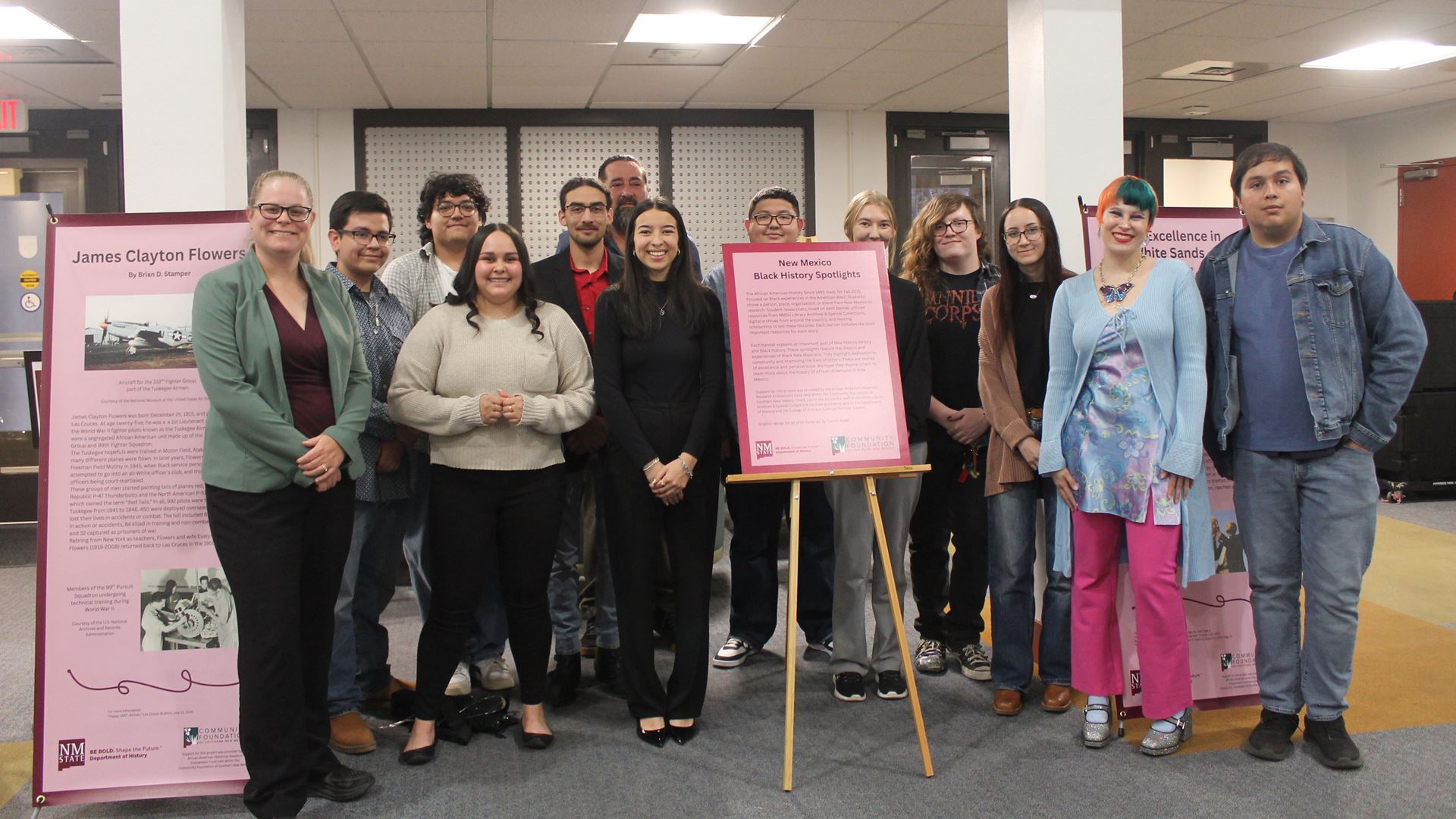

Stories of Black life in New Mexico and the United States-Mexico borderlands took center stage at Branson Library this month as New Mexico State University students unveiled a new archival exhibit shaped by months of research, oral histories and hands-on work in the university’s Archives and Special Collections. Community members filled the space to view the students’ panels, many of which highlighted histories rarely spotlighted in the region.
The exhibit was developed by 12 students in NMSU’s African American History: 1865 to the Present course, taught by history professor Laura Hooton. Support for the project was provided by the African American Historical Research Endowment Fund, held within the Community Foundation of Southern New Mexico.
For many students, the project marked their first experience conducting original historical research. Junior psychology major Xavier Perez-Martini, who focused his spotlight on Garland E. Allen, an African American police officer in Alamogordo in 1968, said the process shifted how he understood the stories he encountered.
“We learned not just how the Black community struggled but how they pulled themselves together and pulled through,” he said. “They really made a name for their culture and their ethnicities regardless of the struggles they went through in history.”
Students described connecting deeply with archival materials. “It was so interesting to sit down and read these personal letters and articles,” Perez Martini said. “Finding real, personal sources from the archives motivated me to bring this history forward in a meaningful way.”
“I love the archives. I’m a very eclectic person, and I love to physically get my hands on something that’s older than me, especially if it was in the ’50s or ’60s. I love it,” said senior Marissa Page, a secondary education major.
Senior Guinivere Mayse, a history and art history major, focused on Black queer history in New Mexico through an oral history interview with author Brian Lush.
“We all had to go find these histories ourselves – it wasn’t just given to us,” she said. “It’s really important that we remind people they’re welcome at the table with history because it’s not as evident as it should be.”
Page researched former NMSU All-American football player Pervis Atkins, uncovering details through yearbooks and personal documents.
“I really wanted to know more about our athletes here at NMSU because I felt like I didn’t know much about them,” Page said. “In my research, I was looking through yearbooks and found Pervis Atkins. I found out he was an All-American, a veteran, in A-Club, and also competed in track and football. I learned how amazing he truly was, especially helping NMSU win a Sun Bowl back in the ’60s.”
Students said the exhibit’s reception was one of the most rewarding parts of the experience.
“Everyone seemed interested and happy to have this information shared,” Perez-Martini said. “A lot of African American folks personally thanked us.”
“Doing this and having the community be so supportive was a relief,” Mayse added. “We can do things like this, support a community and uplift without it feeling like we were suffocating every second.” Hooton said the students’ dedication and collaboration shaped one of the most meaningful projects she has led.
“They realized how important these stories are to the community,” she said. “The turnout showed how interested people are in Black history and how important it is to New Mexico and the United States.”
She also emphasized that projects like this demonstrate the broader value of studying history. “The importance of history classes is not just the history itself, but the skills students gain from it,” Hooton said. “Student-focused work encourages them to take control of their own learning – and the more control they take, the more they get out of it.”
The exhibit is located on the first floor of the Branson Library lobby. It will be moved to Zuhl Library at the beginning of February for Black History Month.
NMSU students highlight Black histories of New Mexico in new archival exhibit
Release Date: 16 Dec 2025