

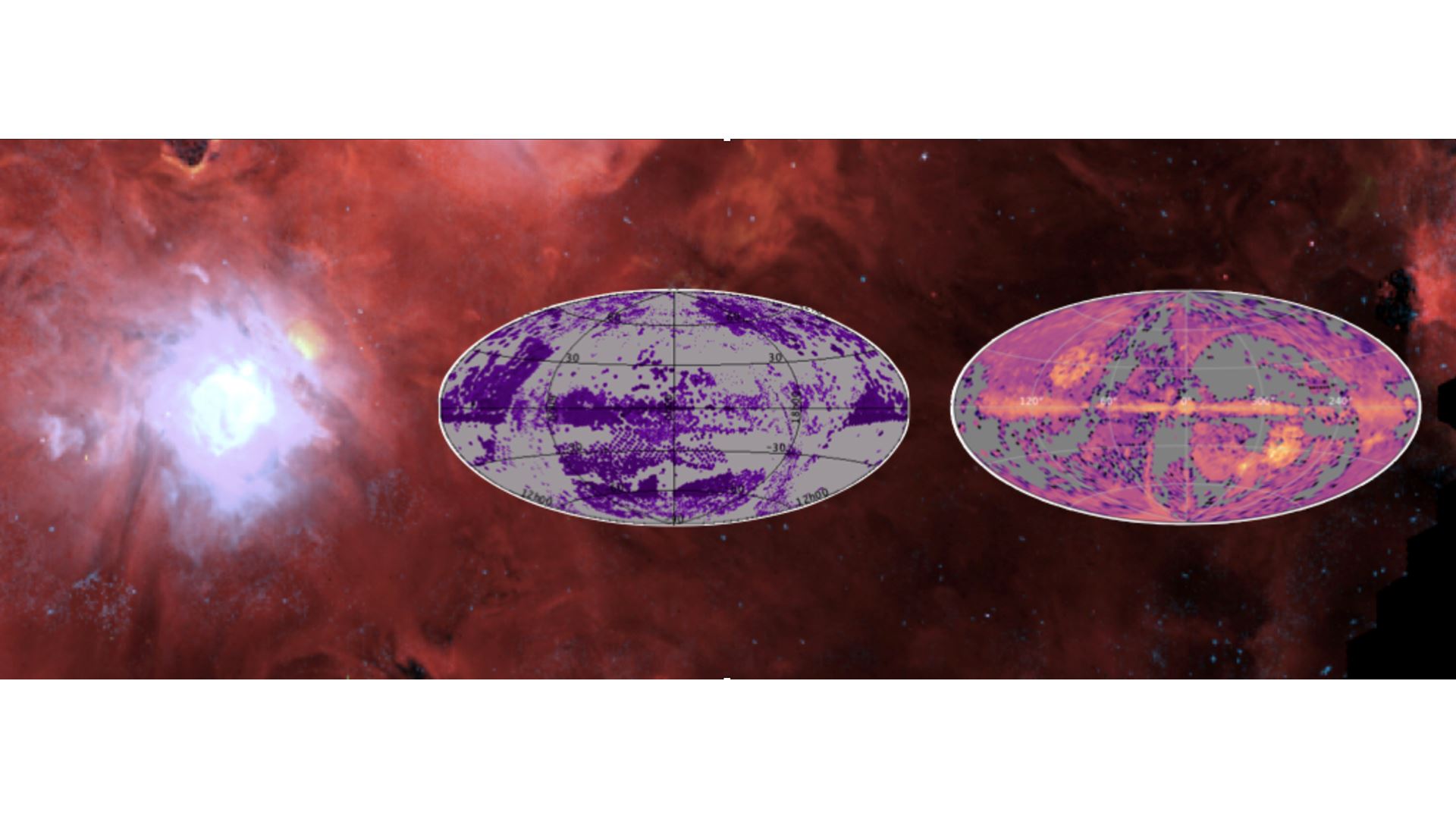
The Sloan Digital Sky Survey’s recent 20th data release for the first time provides a time-lapse, detailed map of the universe from both hemispheres on Earth. It integrates full all-sky panoptic spectroscopy across both hemispheres, providing an unprecedented look at the stars, interstellar gas and distant galaxies of the cosmos.
New Mexico State University has played a critical role as one of the founding institutions and operates the SDSS telescope in southern New Mexico. For more than 26 years, SDSS has been providing a kind of free library of data about the universe for scientists and amateurs alike around the world. SDSS consortium collaborators are incredibly enthusiastic about the recent data release.
“DR20 represents an enormous leap in the scale of SDSS data products – today we release over three million spectra of stars and galaxies along with 18 value added catalogs,” said Emily Griffith of University of Colorado Boulder, spokesperson for the SDSS-V collaboration. “It’s the product of years of work by a dedicated, international team of astronomers. We’re excited to share DR20 with the world and see what the community discovers with it.”
DR20 incorporates findings not only from the custom 2.5-meter telescope managed by NMSU at Apache Point Observatory in Sunspot, New Mexico, but also a second major telescope in the Southern Hemisphere. With the added data from the Irénée du Pont Telescope in the Atacama Desert in northern Chile, SDSS data can finally map the entire sky.
“We've entered a whole new dimension, literally, with these data, in that we're taking multiple spectra,” said Joe Burchett, NMSU assistant professor in the Department of Astronomy and commissioning scientist for SDSS-V. "This sets a standard for the surveys to come, as has been the case for every generation of the Sloan Digital Sky Survey. Each one sets a new benchmark."
SDSS represents a completely different style of science. SDSS acts like a 500-tentacled octopus, with each tentacle collecting a spectrum of a star or galaxy and collectively mapping massive chunks of the sky all at once. By creating enormous, organized catalogs of data and giving them away for free, SDSS practically invented "big data astronomy." Its papers have an exceptionally high citation-per-paper ratio, meaning when SDSS releases data, the entire scientific community relies on it to back up their work.
The recent data release includes spectra of more than 3.3 million space objects, including 1.5 million stars and 500,000 galaxies. Spectra break down the light into its precise colors (or wavelengths) and act like a chemical fingerprint, telling scientists exactly what these objects are made of, how fast they are moving and how old they are.
“SDSS has been historic in terms of the innovations that it’s made overthe years. First in how we can take a lot of data efficiently and how to store that data, and second how to make it freely and easily available to the world," said Burchett. “SDSS has been on the cutting edge of bringing science to the entire world from our humble southern New Mexico mountaintop."
Since the consortium began taking observations, nearly 10,000 papers have been published using data from the Sloan Digital Sky Survey. NMSU faculty, students, and staff have been involved in well over 100 refereed scientific papers using SDSS data.
-30-