

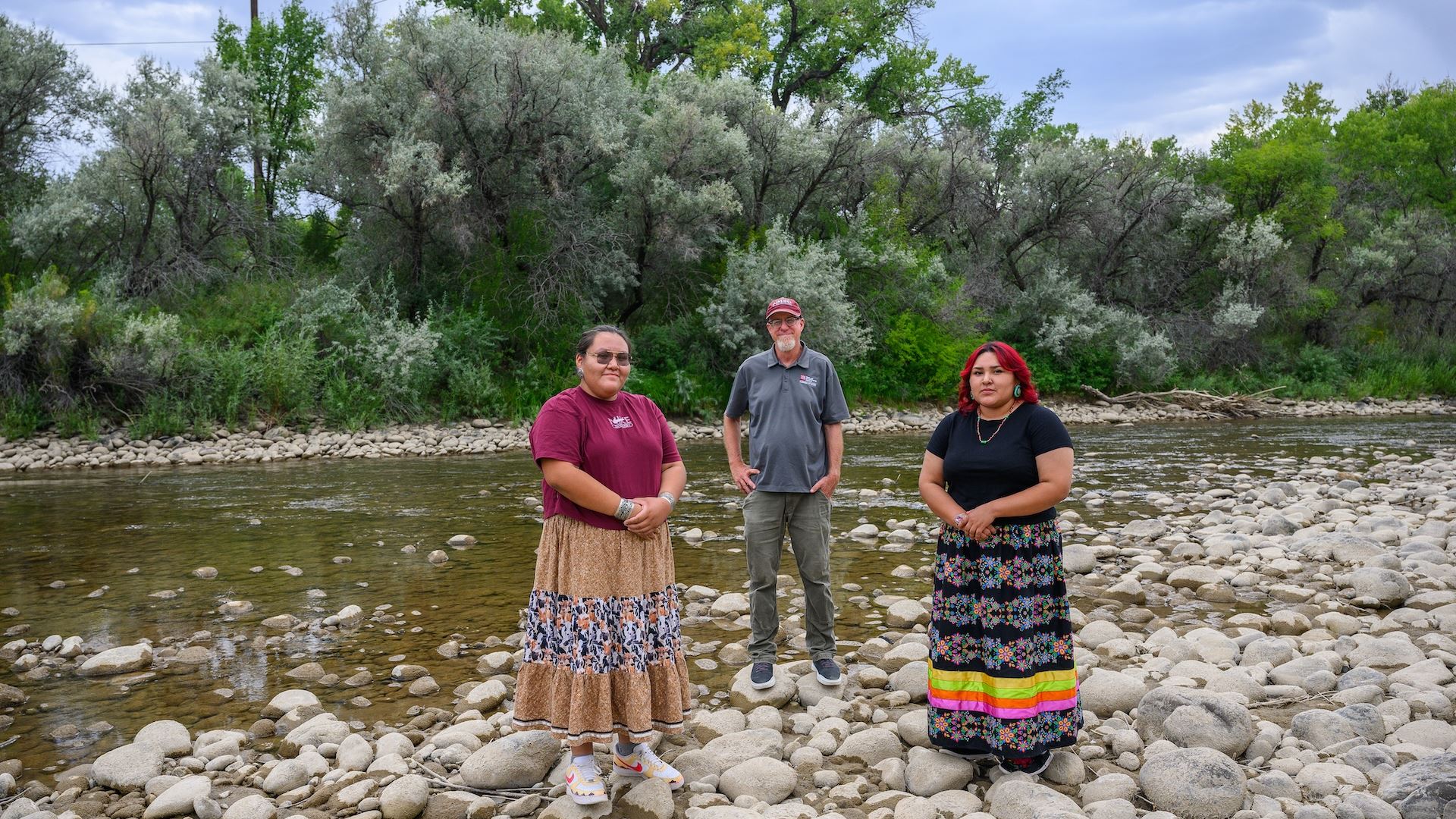
On Aug. 5, 2015, the Gold King Mine Spill devastated communities along the Animas and San Juan rivers in the Four Corners region. The spill consisted of the unplanned, accidental release of 3 million gallons of mining sludge from the Gold King Mine in Colorado into the headwaters of the Animas River, which flows into the San Juan River.
Today, New Mexico State University and other regional researchers continue to address concerns related to the spill through the Northwest New Mexico Agricultural Restoration Project, with funding from the New Mexico Attorney General’s Office. The project, co-led by Kevin Lombard of NMSU’s Agricultural Science Center at Farmington and Bonnie Hopkins Byers of the San Juan County Extension Office, aims to build capacity for soil health measures, establish pilot demonstrations for hoop houses and agricultural photovoltaics, and create digital storytelling efforts to raise awareness of farming along the San Juan River.
Lombard has assisted film students Daveishena Redhouse and Cayden Manuelito in the production of their documentary on Navajo farmer stories. Redhouse is pursuing a master’s degree in animation at the Savannah College of Art and Design, while Manuelito is working on an associate degree in applied science, digital media arts and design at San Juan Community College.
Their documentary, “Story Through Lenses: Resilience in Farming along the San Juan River,” features one-on-one interviews with farmers and community members, who discussed the spill and its aftereffects, as well as animation to help tell their stories.
“We have found it particularly interesting that many young adult residents of northwest New Mexico, who were kids at the time of the spill, have very limited recollection or knowledge of what took place 10 years ago,” Lombard said.
“When I ask high school students to raise their hands if they remember the Gold King Mine Spill,” he continued, “only one or two students respond, which is why it is important to have some 10th-year remembrance of the event to maintain awareness for the next generation so that nothing like the spill ever happens again, while also highlighting the resilience and importance of northwest New Mexico and Navajo Nation farming and the multiple uses of the Animas and San Juan river waters in relation to regional cultural values.”
Redhouse said she was surprised to receive such largely positive reactions to the documentary, especially among her interview subjects.
“From the stories and personal accounts shared during our interviews, it was clear that what impacted people the most during the spill was not only water contaminations, but also the loss of their crops,” Redhouse said. “For the elderly, crops are like our relatives, so losing them was like losing a family member. From the youth, the hurt that came from the water being contaminated. It was an unfair act that should have involved more caution.”
The documentary also sheds light on the farmers who struggled to sell produce after the spill.
“Many people had a stigma against all crops from the Shiprock farmers, believing them to be contaminated and not buying from them. But in reality, the water they were using was immediately shut off along the irrigation ditch, so none of their produce was contaminated with the Gold King Mine water,” Redhouse said. “However, from the media and social media coverage, people were already fearful of buying their crops. Not only did many lose financial value, but much of their produce was also wasted.”
Immediately following the spill, NMSU researchers worked with the New Mexico Department of Agriculture, the New Mexico Environment Department and the Office of the State Engineer, among other agencies, to address the short- and long-term impacts of the contamination. For example, Lombard said, a soil chemistry team led by April Ulery, a professor in the Department of Plant and Environmental Sciences at NMSU, analyzed soil and plant samples from farmland and irrigation ditches for about five years after the spill.
Today, NMSU and others continue to address concerns among impacted communities through continued education and training, but much more work must be done.
“While assurances may have been received from federal, state and tribal agencies regarding the recovery of the rivers and surrounding landscapes, assurances alone are often insufficient to overcome deeply ingrained worries and public perceptions,” Lombard said. “Some negative perceptions still exist today.”
A version of this story appears in the fall 2025 issue of ACES Magazine. For more stories, visit https://nmsu.news/aces-magazine-2025.
-30-
Cutline: From left, Daveishena Redhouse, Kevin Lombard of New Mexico State University’s Agricultural Science Center at Farmington and Cayden Manuelito are producing a documentary about farming along the San Juan River in the aftermath of Gold King Mine Spill. (Photo by Sam Wasson)
Cutline: Manuelito edits the documentary at New Mexico State University’s Agricultural Science Center at Farmington. (Photo by Sam Wasson)
Cutline: New Mexico State University’s Agricultural Science Center at Farmington continues to play a vital role in helping San Juan County communities recover from the spill. (Photo by Sam Wasson)